

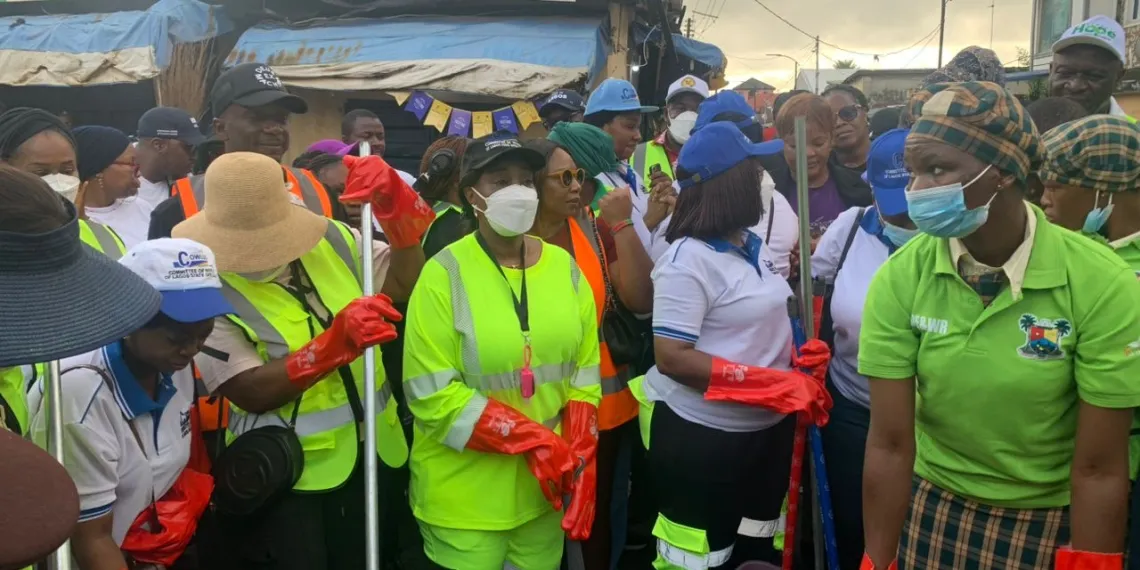
Movement and commercial activities were temporarily halted across parts of Lagos on Saturday as residents observed the state’s revived monthly environmental sanitation exercise, led by First Lady, Ibijoke Sanwo-Olu.
The exercise, held between 6:30 a.m. and 8:30 a.m., recorded widespread compliance, with shops closed and residents either remaining indoors or participating in the cleanup in line with government directives.
The coordinated sanitation drive spanned key areas from Ojo Street junction by Obalende Road through Ajeniya, Odo, Eleshi and Moshalashi streets, extending to the Holy Child School gate, with Blaude Close marking the final stretch.
Addressing participants, the First Lady expressed satisfaction with the turnout and level of adherence, describing the exercise as a positive step towards restoring environmental responsibility among residents.
“The investment for this morning is good. It was flagged off last month and we’re having the first incident today. We have seen the residents come out. We have seen them participate. It’s like a gradual process,” she said.
She noted that since the programme’s reintroduction, public engagement had improved, with traders complying by suspending business activities during the sanitation window.
Sanwo-Olu stressed that environmental cleanliness should extend beyond the monthly exercise, urging residents to embrace daily sanitation habits as a civic responsibility.
She also called for greater involvement of students, noting that early exposure is key to building a sustainable culture of cleanliness.
Also speaking, the Commissioner for Environment and Water Resources, Tokunbo Wahab, described the initiative as part of efforts to instil environmental discipline across the state.
He said dedicating 120 minutes on the last Saturday of each month was a minimal sacrifice compared to the long-term benefits of a cleaner and healthier Lagos.
Wahab added that the government would review performance across local councils following the maiden exercise, with plans to recognise and reward the cleanest areas as a way of promoting accountability and healthy competition.
On concerns surrounding movement restrictions during sanitation hours, the commissioner referenced legal challenges previously filed, noting that a Court of Appeal ruling in Lagos had affirmed the state’s authority to impose such measures when necessary.
Despite this, he said the government was prioritising a community-driven approach over strict enforcement, aimed at encouraging voluntary compliance and lasting behavioural change among residents.
He maintained that no existing law prohibits the state from enforcing movement restrictions during sanitation hours, adding that the focus remains on building public ownership of the programme.