

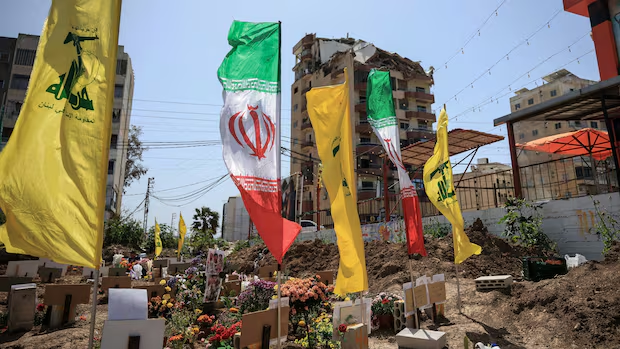
Donald Trump is in a hurry to pivot away from Iran, but the messy side conflict in Lebanon was threatening to stall his momentum.
On Thursday, in characteristic fashion, the U.S. president attempted to solve the problem with a social media post.
“It has been my honor to solve 9 Wars across the World, and this will be my 10th,” he wrote of the Israel-Hezbollah conflict, leaving aside the fact that his tally of purported successes is widely disputed.
The war in Lebanon would be paused for 10 days, he announced.
U.S. President Donald Trump posted on TruthSocial that Israel and Lebanon had agreed to a 10-day ceasefire beginning at 5 p.m. ET on Thursday. At the same time, White House officials say they’re prepared to resume war with Iran if it doesn’t agree to the U.S.’s terms
Israeli media suggest Prime Minister Benjamin Netanyahu didn’t even have time to tell his cabinet about the ceasefire deal before Trump was announcing it publicly.
Yet, given Trump’s well-documented history of claiming victory before the underlying conflict has been resolved, the prospect of his latest truce holding may be equally tenuous.
“You cannot flick [the war] on and off with the push of a button,” said Kamal Shehadi, a cabinet minister in Lebanese President Joseph Aoun’s government.
“This is something that will take time.”
In an interview in Beirut with CBC News a few hours before Trump’s ceasefire announcement, Shehadi was clear-eyed about the challenges ahead in reigning in Hezbollah, a Lebanon-based militia armed and controlled by Iran.
It’s a task at which Lebanon’s national government has repeatedly failed, but Shehadi said a ceasefire is an imperative first step.

“The strategy now is to give an opportunity for Hezbollah to deliver its weapons to the government and to recognize that it is not only unable to protect the community it claims to protect, but that, in fact, it’s doing quite the opposite,” he said.
Lebanon’s Ministry of Public Health reports that more than 2,100 people have been killed since Hezbollah launched its rockets at northern Israel and joined in the war against Iran started by Israel and the United States on March 2.
The conflict has triggered an immense humanitarian and economic disaster with more than 1.2 million people — or a quarter of Lebanon’s population — forced from their homes.
Israel’s military now controls vast areas of southern Lebanon and has demolished countless buildings — even entire villages, critics contend — to ensure Hezbollah is unable to launch attacks into northern Israel.
Resistance movement
The militant group has its origins as a movement of resistance to Israel’s 18-year-long occupation of southern Lebanon that ended in 2000.
While it is a homegrown Lebanese organization, Iran has always been the puppet master, using Hezbollah to advance its own interests, particularly with regards to confronting Israel.
For decades, Lebanon’s national government has been too weak militarily and plagued with political dysfunction to confront Hezbollah directly, despite repeatedly signing international agreements where it promised to do so.
But under Aoun’s presidency, there’s been reason for some calibrated optimism.
Lebanon recently banned Hezbollah’s military activity and it has targeted Iranians that supplied the group with weapons and intelligence.
And by going over the head of Hezbollah and engaging directly with Israel for the first time in decades, such as during the Washington ambassadorial discussions last week, Lebanon’s government appears determined to assert its national sovereignty and cut out the middlemen.
“Reasserting state control is something that will take time,” said Shehadi.
“What you want to see is 100 per cent effort from the Republic of Lebanon. And so if you have 100 per cent efforts within a few weeks, within a few months, you will have 100 per cent results. No one can expect miracles overnight.”
Assuming the ceasefire holds, Hezbollah will emerge from this war not just as a weakened militant force, but with its political clout diminished as well.
Existential crisis
“They [Hezbollah] feel it’s an existential crisis for them,” said Maha Yahya, director of the Malcolm H. Kerr Carnegie Middle East Center in Beirut.
Yahya says the group has lost political allies in parliament, and that Lebanese people who previously approved of the group’s confrontation with Israel are now weary from war.

“We are already starting to see criticisms from within the broader Shia community, but also those within the sphere of influence of Hezbollah,” she said.
Still, Yahya says Israel’s brutal tactics in southern Lebanon — including repeatedly targeting paramedics, and the mass killing of civilians in the so-called “Black Wednesday” attacks last week that killed more than 350 people — mean there’s little appetite for engagement with Israel, much less normalizing relations.
Precisely how this ceasefire in Lebanon could affect the broader negotiations between the United States and Iran is uncertain.
Iran insisted Lebanon be included in the initial truce, but continued discussions with the United States nonetheless — and talks continued even after last Wednesday’s horrific attacks on Beirut and the country’s south.
Yahya says Iran is evidently keeping its own interests paramount — and yet, if it senses an opening, it’s still prepared to throw a lifeline to Hezbollah.
“It’s one more card that they can use, but I think their priorities are Iran. If they can manage to keep this card, then good.”