

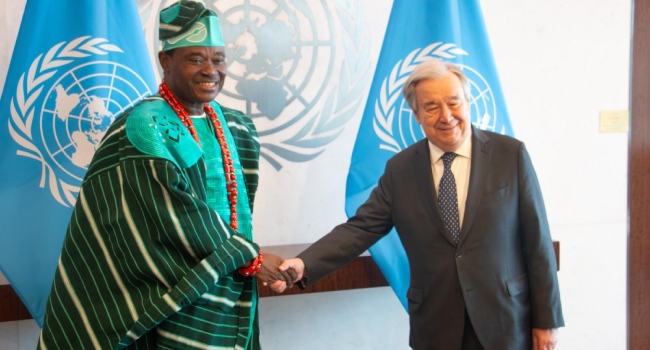
Nigeria’s ambassador and permanent representative to the United Nations, Jimoh Ibrahim, has said President Bola Tinubu remains committed to resolving long-standing grievances driving insecurity across the country.
Speaking in New York while presenting his letter of credence to the UN Secretary-General, António Guterres, Ibrahim conveyed Tinubu’s message, underscoring Nigeria’s resolve to confront both domestic and global security challenges.
Ibrahim noted that Nigeria would continue to mobilise support to tackle insecurity in the Sahel and West African sub-region.
He added that the country remains committed to advancing peace-building efforts across the continent.
READ ALSO: Tinubu Will Use AI To Tackle Insecurity In 2025, Says Senator

On the economy, Ibrahim highlighted key reforms by the Tinubu administration, including fuel subsidy removal and exchange rate unification.
The ambassador said tighter monetary policies are also being implemented to curb inflation.
According to him, early indicators show progress, with improvements in debt sustainability and easing inflationary pressures.
NIGERIA FILLS UN SEAT!
Senator Jimoh Ibrahim, PhD (Cantab) CFR, on Monday April 20, 2026 formally presented his Letter of Credence to United Nations.
UN Secretary General António Guterres, officially received and accredited him as the Permanent Representative Extraordinary and… pic.twitter.com/FdZ5zNe9YI
— Temitope Ajayi (@TheTope_Ajayi) April 21, 2026
He said investments in infrastructure and the power sector are also being sustained.
Ibrahim reaffirmed Nigeria’s commitment to multilateral cooperation, particularly in promoting peace in sensitive regions such as the Strait of Hormuz.
He assured the UN of Nigeria’s readiness to support global peace initiatives and diplomatic engagements.
Speaking after receiving the letter of credence, Guterres welcomed Ibrahim’s appointment. He said the United Nations is excited to work with him in advancing shared global goals.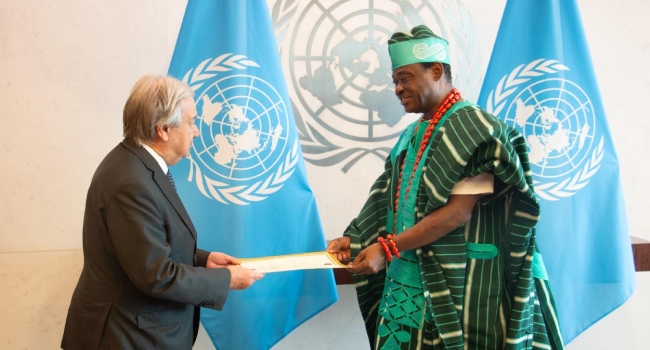
The UN chief described Ibrahim’s diplomatic role as timely and important. He expressed confidence in strengthening cooperation between Nigeria and the United Nations.
Ibrahim got his letter of credence from the Nigerian foreign ministry on April 1, following his clearance to assume office.
He, alongside others, was nominated in November 2025.
“In two separate letters to the Senate President, Godswill Akpabio, President Tinubu asked the Senate to consider and confirm expeditiously 15 nominees as career ambassadors and 17 nominees as non-career ambassadors,” presidential spokesman Bayo Onanuga said then.
They were subsequently cleared by the lawmakers despite criticisms over some names in the list of ambassadorial nominees.