

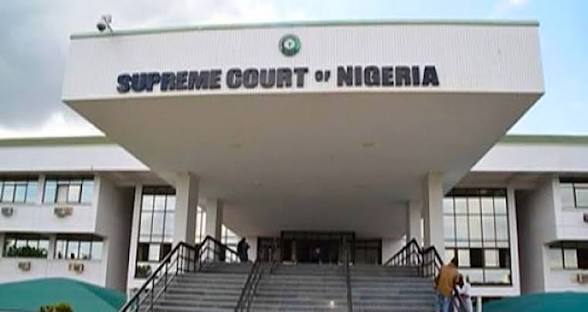
The Supreme Court on Wednesday reserved judgment in the leadership tussles within the Peoples Democratic Party and the African Democratic Congress, heightening uncertainty over the internal stability of both parties ahead of the 2027 general elections.
A five-member panel of the apex court, led by Justice Mohammed Garba, fixed no date for judgment after hearing arguments from parties in separate appeals challenging the decisions of the lower courts on the disputes.
The Independent National Electoral Commission has announced May 10 as the deadline for political parties to submit their membership registers. It also fixed the presidential and national assembly elections for Saturday, January 16, 2027, while the governorship and state houses of assembly elections are scheduled for Saturday, February 6, 2027.
The Commission further stated that party primaries, including the resolution of disputes arising from them, will be conducted between April 23, 2026, and May 30, 2026.
According to INEC, campaigns for the presidential and National Assembly elections will begin on August 19, 2026, while campaigns for the governorship and state houses of assembly elections will commence on September 9, 2026.
With both major opposition political parties now entangled in multiple litigations, coupled with the looming INEC deadline, their ability to stabilize and organize a clear schedule of activities has been significantly disrupted. This has set the stage for further complications in party management and election preparations.
This development has also left aspirants seeking elective positions on the PDP and ADC platforms in a state of uncertainty and despair, as the unfolding situation makes it increasingly difficult for them to determine their next line of action.
While the party leadership remains uncertain about its ability to produce candidates, members are also left in limbo.
Ultimately, the political future of many politicians within these parties now hangs in the balance, pending the Supreme Court’s final determination.
Against this backdrop of instability, the PDP has remained embroiled in a prolonged internal crisis, resulting in a split into two factions—one led by Tanimu Turaki (SAN) and supported by Oyo State Governor Seyi Makinde and his Bauchi counterpart, Bala Mohammed, and the other headed by Abdulrahman Mohammed with the backing of the Minister of the Federal Capital Territory, Nyesom Wike.
In the PDP matter, the court reserved judgment in two appeals filed by the factional leadership led by former Minister of Special Duties, Turaki, seeking to validate the party’s national convention held in Ibadan, Oyo State, on November 15 and 16, 2025.
The appellants are asking the court to set aside concurrent judgments of the Federal High Court and the Court of Appeal, which nullified the convention on the grounds of procedural breaches and internal party violations.
One of the appeals was against the decision of Justice Peter Lifu, who restrained the PDP from conducting the convention after finding that a former Jigawa State Governor, Sule Lamido, was unjustly denied the opportunity to contest for the position of national chairman.
Another appeal arose from the judgment of Justice James Omotosho, which barred the party from proceeding with the exercise on the basis that it failed to conduct valid state congresses as required by law and party guidelines.
Sponsored
At the hearing, counsel to the appellants, Paul Erokoro (SAN), urged the court to allow the appeals and dismiss preliminary objections filed by Lamido’s counsel, J.C. Njikonye (SAN), and the faction aligned with the FCT minister, represented by Joseph Daudu (SAN).
In a related development, the apex court also reserved judgment in an appeal filed by a former Senate president, David Mark, over the leadership tussle within the ADC.
On April 1, the Independent National Electoral Commission announced the removal of key figures of the ADC, including National Chairman, Mark and National Secretary Rauf Aregbesola, from its official register, stating that the action complied with a court order directing the commission to maintain the status quo pending the final judgment of the trial court.
The party has continued to grapple with a leadership crisis following the inauguration of a new National Working Committee under Mark’s leadership in July.
The dispute stemmed from disagreements over the tenure of former chairman Ralph Nwosu, who handed over the party leadership to the coalition group led by Mark, while sidelining his deputy, Nafiu Gombe, who insisted on assuming the role of acting chairman after Nwosu’s exit.
The disagreement later escalated into factional struggles for the control of the party, resulting in multiple legal battles at both the Court of Appeal and the Supreme Court, and raising concerns about the party’s readiness for the 2027 elections. In response, Mark, on April 2, called for calm and maintained that the party would continue with its scheduled activities.
In a related development, a faction backed by the party’s 2023 presidential candidate, Dumebi Kachikwu, announced a caretaker committee on April 7 in Abuja during a National Executive Committee meeting convened by some state chairmen.
The situation has since split the party into three factions: one led by Mark, representing the coalition bloc; another led by Gombe; and an NEC-backed group aligned with Kachikwu and headed by Kingsley Ogga, the Kogi State ADC chairman.
Consequently, like the PDP, the various factions have also instituted several cases in court.
Mark, through his counsel, Jubril Okutepa (SAN), challenged a March 12 judgment of the Court of Appeal, arguing that the dispute bordered on the internal affairs of a political party and was therefore not justiciable.
He urged the court to restrain the electoral commission from recognizing any leadership outside his faction and to set aside the appellate court’s order maintaining the status quo.
However, respondents in the suit, including a faction led by Gombe and others, urged the court to dismiss the appeal, insisting that the lower court acted within its jurisdiction.
Following the conclusion of arguments in all the matters, the apex court reserved judgment, with a date to be communicated to the parties.
Reacting in a statement on Wednesday, the Turaki-led NWC National Publicity Secretary, Ini Ememobong, expressed hope that the apex court will deliver judgments that would preserve multiparty democracy and prevent the imminent emergence of a one-party state.
.....