

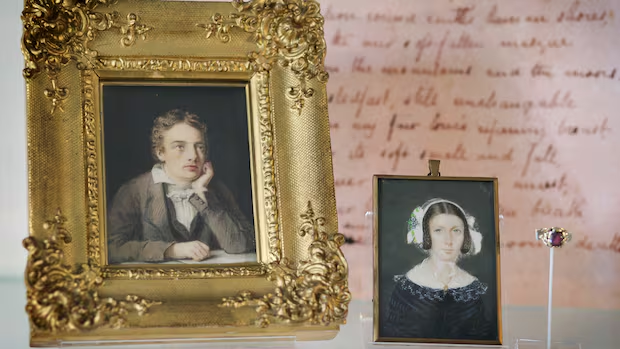
The owners of B&B Rare Books in New York City say they knew something was amiss when a young man showed up last year with an incredible bounty of antique literature for sale.
Among his offerings was a bound volume of 37 love letters, some handwritten, composed by English poet John Keats for his fiancée, Fanny Brawne.
The store’s co-owner, Joshua Mann, says the seller claimed they’d been in his family for generations and belonged to his grandfather but wouldn’t provide evidence to back up his story.
“Everything just felt fishy about it,” Mann told As It Happens guest host Nora Young.
Mann’s instincts proved correct. The books — valued at roughly $3 million US ($4.1 million Cdn) — turned out to have been stolen from a private collection in the 1980s. They have now been returned to their rightful owner.
“We will not allow our borough to be a centre for trafficked art and antiquities,” Manhattan District Attorney Alvin Bragg said in a statement this week.
A tragic love story
Keats, a poet from the Romantic era, considered Brawne the love of his life and his muse.
They had planned to marry. But in September 1820, Keats left for Rome, hoping a warmer climate would cure him of the illness that had long plagued him.
He died there five months later from tuberculosis at the age of 25.
In his final letter to Brawne, he wrote: “I wish you could invent some means to make me at all happy without you. Every hour I am more and more concentrated in you; every thing else tastes like chaff in my Mouth.”
When Brawne died in 1865, she left the letters to her children, who sold them at auction in 1885.
At the time, Irish poet and playwright Oscar Wilde wrote a scathing poem about the auction, writing of the bidders: “I think they love not art.”
Eventually, the book ended up in the private collection of John Hay Whitney, former publisher of the New York Herald Tribune and U.S. ambassador to the United Kingdom.
According to the New York District Attorney’s Office, Whitney was an avid collector of rare art and books, at least 28 of which were stolen from his estate on Long Island between 1982 and 1989.
They wouldn’t show up on the public radar again until 2025, when an individual tried to sell 17 of them to B&B Rare Books and Adam Weinberger Rare Books in Manhattan.
‘Incredibly meaningful for the family’
Mann says he and his business partner at the bookstore had to “devise a plan” on the spot to buy themselves enough time to investigate the books’ origins — or risk having the seller walk out with them forever.
They told the man they were considering buying the books and asked him to leave them to be appraised.
After several dead ends, they reached out to the Art Loss Register, a U.K. company that maintains a database of stolen art, and found a 1989 police report describing the theft.
“We forwarded that on to our lawyers,” Mann said. “We got a call from the district attorney’s office within, like, 24 hours saying, ‘You guys did the right thing.’”

On Monday, at a press conference, authorities returned the 17 stolen items to Peter di Bonaventura, Whitney’s grandson.
“It’s incredibly meaningful for the family,” di Bonaventura said, according to Gothamist .
The other stolen books are still missing, and an investigation into the theft remains open. The person who tried to sell them has not been charged, as authorities say he wasn’t yet born when the books were pilfered.
The family said it would sell the collection — which includes works by Wilde, James Joyce and the Brothers Grimm — at auction and donate the proceeds to charity.
The Keats letters alone are valued at $2 million US ($2.7 million Cdn).
Mann says he and his partner have “mixed feelings” about the letters going back on the auction block. A lot of public institutions and special collection libraries were interested in acquiring them, he said.
“We would have loved to choose who would be able to buy it, not necessarily send it off to the highest bidder,” he said.
John Savarese, a scholar of Romantic literature at Ontario’s University of Waterloo, says the letters, especially the handwritten ones, have tremendous value beyond their price tag.
Fans of Keats, he says, have felt “a kind of vicarious intimacy” with the poet since his untimely death and treat the objects he left behind as “relics.”
“This is a massively important rediscovery of letters that have been long lost,” Savarese said in an email.