

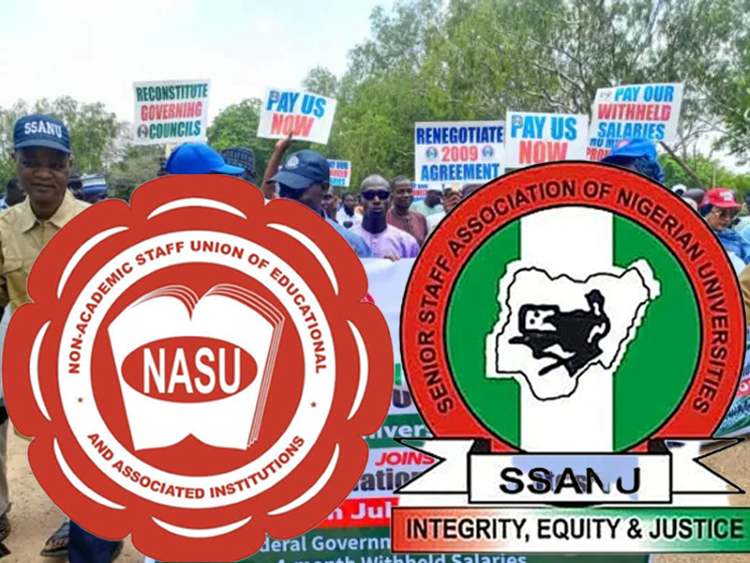
The Senior Staff Association of Nigerian Universities (SSANU) has rejected the federal government’s proposed 30 per cent salary increase for non-academic workers in tertiary institutions.
The group warned that a nationwide strike may begin if negotiations are not concluded before the end of April.
The approval comes after years of agitation by non-academic staff unions, particularly the Senior Staff Association of Nigerian Universities and the Non-Academic Staff Union, over salary disparities and unpaid allowances.
It also followed approval of a 40 per cent pay rise granted to the Academic Staff Union of Universities by the Federal Government.
But the National Executive Council of the SSANU has insisted that no final agreement has been reached.
SSANU has threatened industrial action if talks were not concluded by the end of April.
FG, in a letter dated March 30, 2026, and signed by Tunji Alausa, the minister of education said the increment would be implemented as a consolidated non-teaching tools allowance.
“I write to convey the approval of His Excellency… for a thirty per cent (30%) increase in the consolidated salary structures of non-academic staff of federal universities, polytechnics and colleges of education,” the minister stated.
The directive, addressed to the executive secretary of the national commission for colleges of education, national universities commission and the national board for technical education, indicated that details of the implementation are contained in an attached memorandum.
The Minister said the decision reflected the government’s commitment to improving the welfare and productivity of non-academic staff, who play critical administrative and technical roles in higher institutions.
“This approval underscores the Federal Government’s commitment to enhancing the welfare, motivation, and productivity of non-academic staff,” he said, adding that it would also strengthen “the quality, stability and global competitiveness of Nigeria’s tertiary education system.”
Alausa further urged relevant agencies to ensure the smooth execution of the policy.
“We look forward to your usual cooperation and support for the seamless and timely implementation of this approval,” the minister added.
SSANU’s position rejecting the agreement was contained in a communiqué issued at the end of a special NEC meeting held on Saturday at the union’s National Secretariat in Abuja, where leaders reviewed developments in the negotiation process.
According to the communiqué signed by Muhammad Ibrahim, the National President of SSANU and forwarded to the press on Sunday, the NEC reaffirmed that “the renegotiation process with the Federal Government is still ongoing and has not been concluded.”
The council also expressed concern over what it described as misleading reports in the public space, suggesting that the process had been concluded.
It specifically pointed to the circulation of a letter allegedly indicating approval of a 30 per cent increase in allowances, insisting that discussions were still ongoing and no binding agreement had been signed.
NEC stated that “SSANU will not accept any outcome that falls below the negotiated understanding reached in the course of the renegotiation process, and insists that fairness, due process, and collective bargaining principles must be respected.”
Reiterating its earlier stance under the Joint Action Committee of NASU and SSANU, the council maintained the ultimatum given to the Federal Government from April 1 to April 30, 2026, to conclude negotiations and sign agreements.
It warned that failure to meet the deadline would leave the unions with no choice but to embark on industrial action.
The communiqué stated that SSANU “will have no alternative but to, along with NASU, commence an indefinite, comprehensive, and total industrial action.”
The council urged members across all branches to remain calm but vigilant, and to stay united in readiness to comply with any directives issued by the union leadership.
“NEC called on all members of the union across the branches to remain calm, vigilant, united, and prepared to fully comply with the decisions of the Union in defence of their welfare, dignity, and collective interest,” the communiqué read.
It further reiterated SSANU’s commitment to defending members’ rights and welfare, stating that the union “will continue to pursue justice with firmness, unity, and resolve.”
The latest warning follows an earlier communiqué issued after SSANU’s 54th National Executive Council meeting held at Ekiti state university, where the union expressed dissatisfaction with the slow pace of renegotiations and issued a final ultimatum to the Federal Government.
At the time, SSANU also raised concerns over salary delays, poor funding of universities, and deteriorating working conditions across the system.
Meanwhile, the National Commission for Colleges of Education has directed provosts of federal colleges of education to commence necessary processes for the implementation of the new payment plan.
The memo, issued on behalf of Angela Ajala, the executive secretary instructed bursars and institutional heads to take note of the development and align with the new salary structure.
“On behalf of the Executive Secretary… I write to respectfully bring to your attention the recent approval by the Federal Government… the thirty per cent (30%) increase in the consolidated salary structure of non-teaching staff,” the commission stated.
It added that the minister’s approval had been attached to guide execution, signalling the start of formal rollout across federal colleges of education.
Both unions have repeatedly embarked on industrial actions in recent years, protesting what they described as inequitable treatment compared to academic staff under the Academic Staff Union of Universities.
Strikes by SSANU and NASU have disrupted administrative operations across campuses, affecting student services, examination processing, and institutional governance.
Their demands have typically included improved remuneration, payment of earned allowances, and inclusion in government intervention funds.