

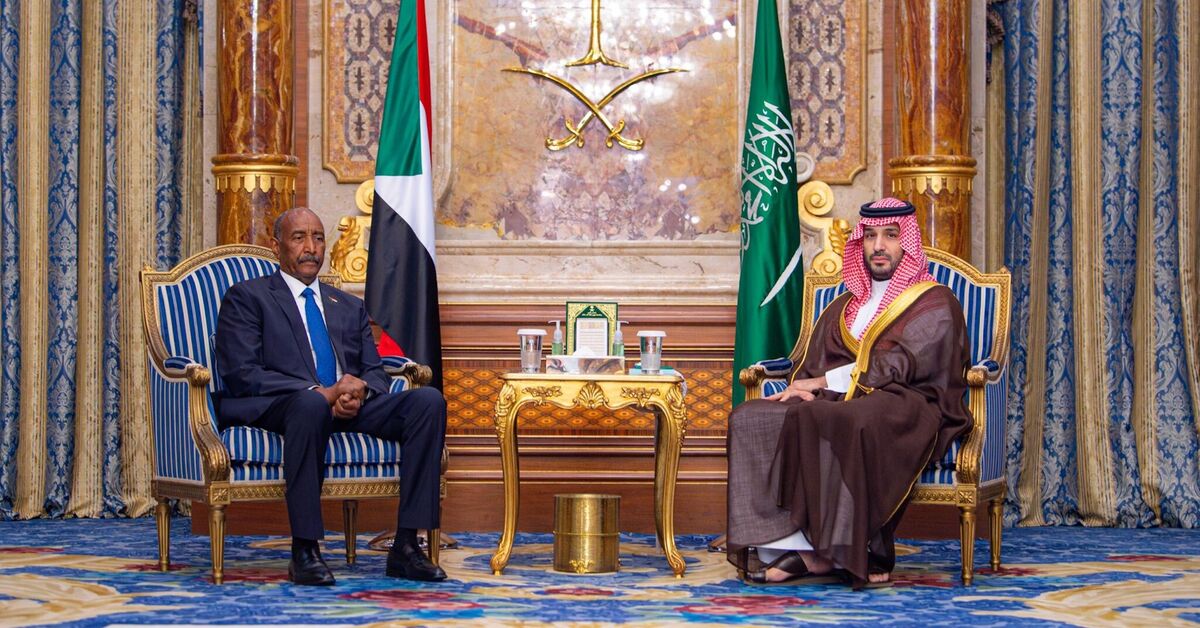
Sudan’s army chief, Abdel Fattah al-Burhan, met Saudi Crown Prince Mohammed bin Salman in Jeddah Monday amid a report that Saudi Arabia has stepped in to halt a $1.5 billion weapons deal between Pakistan and Sudan.
During their meeting, the two leaders “emphasized the importance of ensuring Sudan’s security and stability” as well as “preserving its sovereignty, unity and territorial integrity,” a readout from the official Saudi Press Agency said. The two also discussed the latest developments in Sudan.
Sudan’s state news agency, SUNA, said that Burhan and Prince Mohammed also discussed strengthening bilateral relations and “advancing areas of joint cooperation.”
What we know: The meeting comes as Saudi Arabia prepares to host a Sudanese-Saudi investment forum in June, according to the Sudan Tribune, and less than a week after Berlin hosted a conference that drew more than $1 billion in pledges for humanitarian aid for Sudan.
The June forum is expected to convene senior political and economic leaders from both Saudi Arabia and Sudan, according to the Tribune. The gathering aims to identify and address key barriers to investment, with a particular focus on challenges in the banking sector, including restrictions and inefficiencies in financial transfers that have hindered cross-border economic activity.
The Berlin conference, meanwhile, excluded both the Sudanese Armed Forces and the paramilitary Rapid Support Forces, drawing pushback from Sudan’s government.
The SAF and the RSF have been locked in a brutal conflict since April 2023, when a power struggle between army chief Abdel Fattah al-Burhan and RSF commander Mohamed Hamdan Daglo, known as Hemedti, over the integration of their forces during a planned transition to civilian rule erupted into open war. The conflict has now entered its fourth year, after marking its third anniversary last Wednesday.
The kingdom has backed the SAF with financial assistance and political and diplomatic support against the RSF — which the Sudanese government accuses of receiving support in the form of weapons and funding from the United Arab Emirates. The UAE denies this.
Why it matters: Saudi Arabia’s approach to Sudan has been shaped by its own rivalry with the UAE. That split reflects a broader breakdown in cooperation between Riyadh and Abu Dhabi across the Red Sea region and particularly in the Horn of Africa, where both Gulf states seek access over ports, trade routes and political actors.
A February Reuters report alleged that the UAE helped finance an RSF training camp in Ethiopia.
Additionally, the meeting comes amid a Monday Reuters report that Pakistan suspended a $1.5 billion agreement to provide Sudan with jets and weapons after Saudi Arabia requested a cancellation of the deal and refused to provide the Sudanese government with funding for the deal.
Saudi Arabia maintains close ties with Pakistan, which recently sent military personnel and military equipment to Saudi Arabia under the Strategic Mutual Defense Agreement signed in 2025. The pact declared that “any aggression against either country shall be considered an aggression against both.”
Riyadh has served as a primary mediator in the Sudanese conflict since it began. In May 2023, Saudi Arabia facilitated the Jeddah Declaration, an agreement requiring both sides to safeguard noncombatants, permit the delivery of humanitarian aid and comply with international law. The deal eventually collapsed as the warring parties failed to uphold its terms.
Since the Jeddah Declaration, Saudi Arabia has participated in a diplomatic grouping known as the Quad, which also includes the United States, the UAE and Egypt. In early 2026, the Quad continues to push for a humanitarian truce aimed at laying the groundwork for a permanent ceasefire, but the effort has stalled amid ongoing fighting and entrenched divisions between the SAF and the RSF.
Know more: The divergence between Saudi Arabia and the UAE became clear in Yemen in late 2025, after Saudi fighter jets struck the Red Sea port city of Mukalla in December following accusations that Abu Dhabi had supplied weapons to the UAE-backed separatist group the Southern Transitional Council. Following the escalation, Abu Dhabi said it would comply with an ultimatum issued by Yemen’s internationally recognized government calling for the withdrawal of its forces from the country.