

•Over 100 recovered bodies already buried
•Those killed not innocent civilians —Minister of Defence
•Why market still operates in spite govt closure
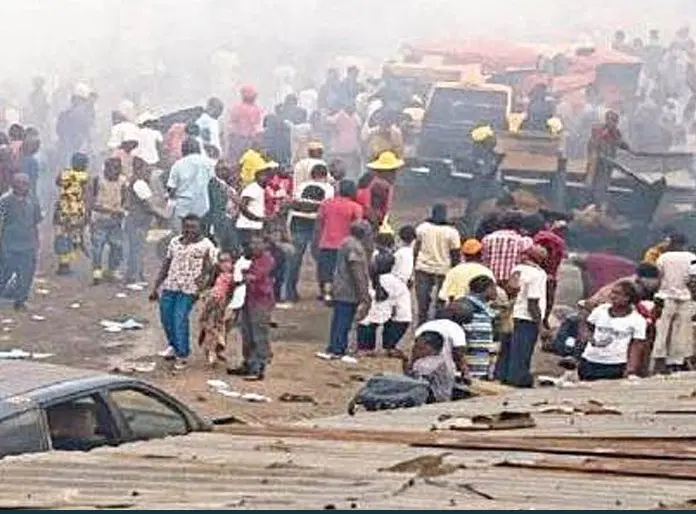
Mallam Abatcha Gubio, a resident of the Jilli community in Borno-Yobe border, has claimed that he lost six brothers at last Saturday’s airstrikes targeted at terrorists, disclosing that over 100 bodies that were recovered after the airstrike had been buried.
Mallam Gubio also explained why the market usually attracted traders and buyers from surrounding communities, despite the fact that the Borno State government had shut it down five years ago.
The Jilli axis, known locally as “Kasu Daulaye in Kanuri” or “terrorists’ market”, was said to be a high-risk zone which had long been under the control of insurgents. The Market Day was held every Saturday. Intelligence had established that the location served as a hub for collection of levies by the terrorists, logistics coordination, and planning of attacks.
The Bindul–Jilli corridor had also remained a hot spot for terrorist operations as an IED attack on troops was witnessed there in January and coordinated assaults in Ngamdu and Benisheikh earlier in April.
The Borno State Government, in a statement by the spokesperson to Governor Babagana Zulum, Dauda Iliya, insisted that the Jilli Market was closed down five years ago, and that anyone patronizing the market was automatically a Boko Haram sponsor or collaborator.
Likewise, the Minister of Defence, General Christopher Musa, defended the airstrike on Jilli insisting that those who were killed in the operation were not innocent civilians but individuals actively supporting insurgents.
Speaking during an interview on Arise TV, Musa maintained that the strike was based on credible intelligence and targeted a hub known for terrorist logistics and supplies. He said, “There was no innocent person there. Anybody in that location knew what they were doing. They were there for business with terrorists.”
But in an exclusive interview with Saturday Vanguard, Mallam Abatcha Gubio said that innocent persons were killed during the operation, which included six of his brothers.
His words: “The Jilli Market has been in existence since the days of our forefathers. We grew up knowing the market and it operates legally. 80% of the Jilli community or landmarks are located in the Gubio Local Government Area of Borno state, while 15 or 20% of its landmarks are located in Geidam Local Government Area of Yobe State. It is about 30kms drive from Gubio Local Government Headquarters, and it is also not far from Geidam town.
“Many people from Benesheikh in Kaga Local Government Area, Damasak, Geidam, Magumeri, Maiduguri and foreigners from the Niger Republic patronize the market. At Jilli Market, domestic animals such as goats, sheep, cows and camels are very cheap compared to other markets. You can get almost anything in the market.
Sponsored
“My brothers who died after the airstrike on the market were, Abatcha Ali, Modu Moruma, Mohammed Moruma, Shehuri Modu, Bukar Sugum and Ali Chellu. We have succeeded in burying over 100 dead bodies so far recovered in the market.”
Explaining why his brothers were patronizing the market after its closure for the past five years, Gubio said, “Yes it was in 2022, after a security meeting, that the market was partially closed down. But people from Benesheikh, Geidam, Gubio, and other surrounding settlements and communities kept on patronizing the Jilli Market because of its strategic importance, as there were no markets around. Jilli is a legally established settlement with civic authority as the community has a village head, Islamic scholars, and traditional rulers.
He also revealed that members of the terrorist groups were always coming to the market to do business, as they came from Bulabulin enclaves near Damasak, the headquarters of Mobbar Local Government area of Borno state.
Sources said the fighter jet that carried out the operation was tracking a group of suspected insurgents believed to have visited the market to collect levies from traders and obtain supplies.
Meanwhile, a former Chief of Army Staff, retired Lt.-Gen. Tukur Buratai described the airstrike on Jilli Market as a necessary military action against a terrorist stronghold.
Buratai, in a statement on Sunday, said the strike was based on credible intelligence indicating that Boko Haram and ISWAP fighters were using the market for logistics and operations.
He acknowledged reports of civilian casualties, noting that the loss of the innocent lives was painful and deeply regrettable.
According to him, “Jilli market has a long history as a terrorist logistics hub in spite of repeated military raids and closures over the years”.
He recalled that troops had occupied the area during Operation LAST HOLD in 2018, engaging insurgents in several encounters. Buratai noted that terrorists continued to exploit the market with the cooperation of some individuals who patronised and supplied them.
He stressed that insurgents often embed within civilian populations, using them as shields, thereby complicating military operations.
“No military wishes to harm civilians, but when such locations are persistently used by terrorists, action becomes necessary,” he said.
He urged residents of Geidam, Gubio, Damasak and Ngamdu to desist from trading in markets linked to insurgent activities. According to him, communities that continue such interactions risk exposure to military operations targeting terrorists.