

Listen to this article
Estimated 5 minutes
The audio version of this article is generated by AI-based technology. Mispronunciations can occur. We are working with our partners to continually review and improve the results.
WARNING: This article may affect those who have experienced sexual violence or know someone affected by it.
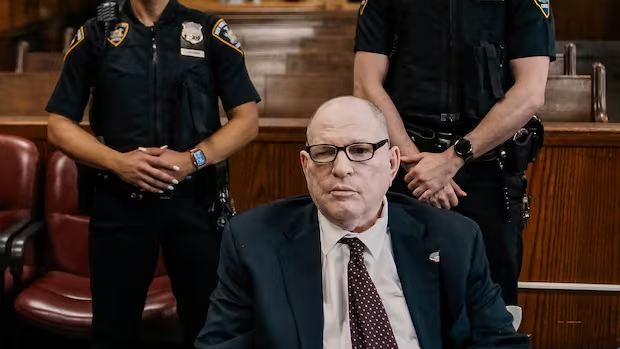
Prosecutors once again portrayed Harvey Weinstein as a onetime Hollywood power player who used his sway as a tool of sexual assault, repainting a familiar but fraught picture Tuesday at a rape retrial, nearly eight years after the former movie tycoon’s arrest.
“This case will come down to power, to control and to manipulation,” Manhattan Assistant District Attorney Candace White told jurors as opening statements began in the bellwether #MeToo case, with District Attorney Alvin Bragg watching from the audience.
Weinstein lawyer Jacob Kaplan countered that the case actually “is about consent, about choice and about regret,” echoing Weinstein’s longtime defence that his accuser has recast a willing encounter as a crime.
Since Weinstein became a major target of the #MeToo movement against sexual misconduct nearly a decade ago, he has been convicted of some sexual assault charges and acquitted of others in trials on two U.S. coasts. A couple of charges ultimately were dismissed. But the rape charge involving a 2013 encounter in a Manhattan hotel has lingered, due to an overturned conviction followed by a jury deadlock.
The allegation is, by now, well known. But the contours of the case have changed.
The prior trials included other accusers and charges. This trial is pared down to the single question of what happened in a hotel room one morning between Weinstein and hairstylist and actor Jessica Mann, though jurors will again also hear a lot about their relationship before and after.
Change in trial
Weinstein also switched his legal team, and with it the rhetorical style and perhaps some strategic choices in his defence. His new attorneys have made clear that they intend to be more circumspect about broaching, for example, Mann’s compensation from a claims fund for women who said Weinstein sexually mistreated them.
Weinstein has pleaded not guilty and denies ever having nonconsensual sex. He said in court in January that he had been unfaithful to his then-wife and “acted wrongly, but I never assaulted anyone.”

Harvey Weinstein was convicted Wednesday on one of the charges in his sex crimes retrial but acquitted of another. A verdict is still yet to be reached on a third charge of third-degree rape.
The jury — seven men and five women — was selected last week. Weinstein’s last New York jury was majority female, but his first was mostly male.
Now a 73-year-old prison inmate, Weinstein was once one of the most influential people in Hollywood. An Academy Award-winning producer and a studio boss, he helped bring such acclaimed films as Pulp Fiction, Shakespeare in Love and Gangs of New York to movie houses and the popular reality series Project Runway to TV. He also was a prominent Democratic donor.
His career collapsed in 2017, when years of Hollywood whispers about his behaviour toward women became public accusations in news and social media. Criminal charges followed in New York and Los Angeles.
Weinstein and Mann’s history
Jessica Mann was a 27-year-old hairstylist hoping to break into big-time acting when she met Weinstein at a Los Angeles-area party in early 2013.
She has testified that she was looking for a professional connection but ended up, ambivalently, in a consensual relationship with the then-married Weinstein.
During a New York trip with a friend in March 2013, she arranged a breakfast for pals and Weinstein, she said at previous trials. According to Mann’s prior testimony, Weinstein ultimately trapped her in a hotel room, ignored her protestation that “I don’t want to do this,” demanded she undress and grabbed her arms. She said she succumbed because she “just wanted to get out.”

New York’s highest court has overturned Harvey Weinstein’s 2020 conviction for sexual assault and rape, a landmark ruling of the #MeToo movement. Andrew Chang explains how the prosecution knew it was taking a gamble, and where that gamble went wrong.
White told jurors Tuesday that Weinstein “was used to getting his way. He did what he wanted, when he wanted and with whom he wanted.”
“Behind closed doors, power meant him taking what he wanted from the victim in this case.”
Weinstein shook his head slightly at one point as White claimed that he had “silenced” Mann by letting her know that crossing him could be professional quicksand.
Weinstein’s defence emphasized that after the alleged rape, Mann kept seeing Weinstein, accepting invitations, asking him for career help and sending warm messages to him.
She has said she was trying to avoid angering a volatile and well-connected man. But his lawyer said the case “isn’t a ‘he-said, she-said’ — it will be her word against her own word.”
“Ask yourself: What is Jessica Mann getting from Harvey Weinstein?” Kaplan told jurors. He contended that she re-evaluated the relationship and came to regret it years later, but that “does not remove consent.”
The Associated Press does not identify people who say they have been sexually assaulted, unless they agree to be named, as Mann has done.
The trial is expected to take up to four weeks.