

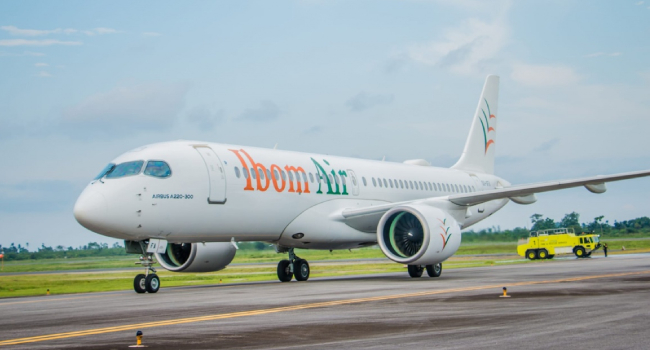
The Nigerian Midstream and Downstream Petroleum Regulatory Authority (NMDPRA) has capped prices of Aviation Turbine Kerosene (ATK) in Nigeria to between ₦1,960 and ₦2,800 per litre.
The move followed skyrocketing fuel prices, which have resulted in an equal rise in airlines’ operating costs.
Airline Operators of Nigeria (AON) have since cut down on flight operations and are threatening to down tools if nothing is done to stem the tide.
However, a statement by the Director, Public Affairs Department, NMDPRA, George Ene-Ita, noted that “The nationwide retail prices surveyed as of 17th April 2026 range between N1,960 per litre to N2,800 per litre”, adding that the speculated N3,300 per litre price being peddled in the media does not reflect current market reality.

Minister of Aviation and Airspace Management, Festus Keyamo, had earlier waded into the crisis.
Despite the intervention, however, airline operators have maintained their position, warning that operations could be disrupted if urgent measures are not implemented. The carriers had earlier issued a seven-day ultimatum, threatening to halt flights.
Industry data shows that the cost of fuelling aircraft has risen sharply in recent months. For instance, fuelling a Bombardier CRJ 900 or Airbus A220, which cost about N2.1 million per flight in January, has surged to approximately N7.6 million as of April 26, a 350 per cent increase.

The vice president of AON, Allen Onyema, attributed the spike partly to global tensions, including the US-Iran crisis, but argued that local price increases are disproportionate to international trends.
“Since the advent of the US-Iran war, there has been a spike in aviation fuel price in Nigeria, which we feel is not proportionate to the hike internationally,” Onyema said.
“We expect that in the next 48 hours something drastic should be done because no airline will fly in this country in the next seven days if nothing is done—not because they don’t want to fly, but because fuel may not be available to us at sustainable pricing.”
In response, the NMDPRA said it has introduced a series of measures aimed at easing supply constraints and reducing costs. These include directing marketers to sell aviation fuel directly to airlines to eliminate middlemen and improve transparency within the supply chain.
Further reacting to the crisis, the NMDPRA, in line with its mandate, said it will continue to closely monitor the supply situation and take appropriate regulatory measures to prevent disruption of supply of petroleum products and profiteering across the country.
While appreciating the continued efforts of all stakeholders in the aviation fuel supply chain in ensuring adequate supply and distribution of the product, the Authority assured the public of its continued commitment to guarantee energy security in the country.

READ ALSO: AfCFTA: FG Launches Multi-Lingual Toolkits To Boost Nigeria’s Participation
On Monday, the group manager, Marketing and Communication, Ibom Air, Aniekan Essienette, disclosed that the carrier could begin reducing flight frequencies in the coming days as fuel costs reach unsustainable levels.
According to the airline, operators can no longer continue flying merely to cover fuel costs.
Essienette described the current pricing regime as an “unprecedented crisis,” stressing that it had become financially unsustainable for domestic carriers.
She revealed that the cost of fuelling a single flight had more than tripled within a short period.
According to her, while Ibom Air spent an average of N2.1 million per flight in January, that figure had risen to about N7.6 million as of April 26, representing a 350 per cent increase.
Despite the emergence of the Dangote Refinery, which reportedly supplies over 95 per cent of Nigeria’s Jet A1 fuel, the airline expressed concern that domestic prices remain significantly higher than global benchmarks.
“Domestic airlines are baffled at why the price of aviation fuel in Nigeria has ballooned to this level, far above what obtains in other parts of the world,” the airline said.
It added that while international carriers typically cut capacity in response to even modest fuel increases, Nigerian airlines have continued to absorb steep cost pressures in a bid to keep fares affordable.
Ibom Air, which operates a fleet of Bombardier CRJ 900 and Airbus A220 aircraft, said it can no longer sustain normal operations under current conditions.
“It is clear to us that the current conditions are unsustainable,” Essienette said. “We will have to take whatever ameliorating actions we can in the days ahead, including reducing our capacity if necessary.”