


One thing is becoming a disturbing pattern in Nigeria’s politics: once a southern president is in power, a section of northern elites quickly weaponises every regional challenge and lays it at his doorstep. I am a Nigerian and northerner, and a strong proponent of leadership rooted in inclusivity where religion, tribe, and regional identity are not the determining factors. Yet, history keeps repeating itself.
During the 2014 APC presidential primaries in Lagos that produced President Muhammadu Buhari of blessed memory, the North was already heated with political narratives. Former President Goodluck Jonathan was painted in black across the North as the “enemy of the region,” accused of marginalisation and neglect. Ironically, time would reveal that GEJ, in many respects, turned out to be one of the North’s best friends through policies like the almajiri schools, new federal universities, and key appointments.
When Buhari took over in 2015, Boko Haram was significantly degraded — kudos to him and the Armed Forces. But almost immediately, the North-west became an enclave of banditry. From mass kidnapping for ransom to entire communities being levied illegal “taxes” before they could farm, the region bled. Yet, the North remained calm, steadfast, and prayerful, with a strong belief that “it is Almighty Allah’s doing.” There were no national summits to unseat Buhari. In 2019, he was re-elected for a second term with overwhelming northern support despite the deteriorating security. That same tolerance and patience is now missing.
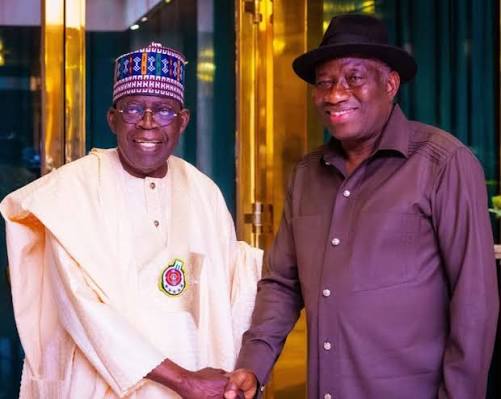
The events seem to be turning again, and the GEJ-style playbook is gradually being adopted. Everything that happens in the North from insecurity to economic hardship is now blamed on President Bola Ahmed Tinubu, who has barely spent two years in office. Why always the North? It is a question that ought to be answered honestly by some northern elites who routinely gang up once a southern president is in power.
What recently caught my attention was the Ibadan opposition summit featuring prominent political figures, mostly from the North, where the central discussion was how to unseat President Tinubu ahead of his anticipated second-term bid in 2027. Many public office holders, including members of the National Assembly from the North, now attribute their own failures to the president, seemingly more focused on conserving votes for themselves than on delivering for the people or supporting the administration they are part of.
This blame game persists even though the North has led Nigeria for most of its post-independence history, yet the region still records the highest indices of poverty, out-of-school children, and insecurity. From 1960 to date, leaders like the late Abubakar Tafawa Balewa, General Yakubu Gowon, General Murtala Ramat Mohammed,
Alhaji Shehu Shagari, General Ibrahim Babangida, General Sani Abacha, General Abdulsalami Abubakar, Alhaji Umaru Musa Yar’Adua, and Buhari all hailed from the North.
While some recorded modest gains, the structural underdevelopment of the region was not fundamentally reversed in decades of northern leadership. Billions were voted for the North through successive budgets, yet critical human development indicators remain poor. The question is: if northern leaders could not fix the North in over 40 years of power, why is a southern president expected to do it in 36 months?
The truth is, the North’s woes are largely self-inflicted by decades of elite neglect, misplaced priorities, and the politicisation of poverty. Rather than hold their governors, legislators, and ministers accountable, some elites find it convenient to externalise blame once a southerner occupies Aso Rock. This strategy has led the region down for decades, because it replaces responsibility with conspiracy. It is easier to organise summits in Ibadan than to convene a Northern Security and Education Emergency Summit in Kaduna or Maiduguri. The North’s biggest enemy has never been the South nor President Tinubu; it has been the failure of its own leadership to convert political dominance into development.
But the northern electorate of 2027 are not the electorate of 2011 or 2015. They are well-informed, politically conscious, and cannot be cowed into believing any coalition game built on ethnic blackmail. They saw how Buhari was given eight years support to fix Nigeria despite challenges, and they now ask why Tinubu should not get the same grace. They can differentiate between global economic headwinds and local sabotage. They know propaganda when they see it. No amount of Ibadan meetings or recycled slogans will convince a farmer in Katsina or a student in Borno to abandon a government that is finally confronting hard decisions, if they see tangible results.
And the results are coming. President Tinubu has approved and is executing critical projects across the North that no sincere observer can ignore. These include: the Sokoto-Badagry Superhighway, which unlocks the Northwest corridor; the Kano-Maradi Railway to boost trans-Saharan trade; the AKK Gas Pipeline from Ajaokuta-Kaduna-Kano to power industries; reconstruction of the Abuja-Kaduna-Zaria-Kano Expressway; renewed commitment to the Mambilla Hydro Power Project in Taraba; dry season farming support and agro-mechanisation across 12 northern states under the National Agricultural Growth Scheme; revitalisation of the River Basin Development Authorities; new Forward Operating Bases in Sokoto, Katsina, Niger, and Zamfara to fight banditry; and the creation of the Northwest and Northcentral Development Commissions to accelerate regional development.
So, why always the North blaming southern leaders? Because blame is a political strategy, not a development plan. But strategy without substance expires. The North does not need more summits to fight Tinubu; it needs summits to fight illiteracy, insecurity, and poverty. 2027 will not be won by coalitions of grievance, but by records of performance. And on that score, President Tinubu is laying foundations that even his critics from the North will eventually admit are transforming the region, if only they are patient and honest enough to see.
One of the deepest wounds in northern politics is the death of mentorship, a stark contrast to the South where political godfathers and leaders deliberately groom successors. The Sardauna of Sokoto, Sir Ahmadu Bello, and Prime Minister Tafawa Balewa understood that power without succession planning is empty. The Sardauna built a second generation of leaders civil servants, technocrats, and politicians who ran the North with vision and discipline. He established institutions like ABU Zaria, the Northern Nigeria Development Company, and a formidable civil service that produced competent hands. But that wisdom was not maintained.
The same generation that inherited Sardauna’s North failed to replicate his model. Instead of building new leaders, they built personal estates. Instead of transferring values, they transferred entitlement. Today, the North parades the highest number of ex-governors, ex-ministers, and political elders, yet there is a shocking scarcity of pan-Northern statesmen with ideological depth. The region is rich in offices but poor in mentorship, and that leadership vacuum is why every electoral cycle descends into a blame game rather than a contest of ideas.
Contrast this with the South-west’s political discipline. In 2019, when Buhari sought re-election, it was Tinubu who wholeheartedly mobilised the South-west to back him. Despite having the structure, resources, and political capital to sponsor a strong southern challenger, Tinubu ensured the South did not fracture the APC ticket. He subordinated personal ambition to party stability and regional honour, arguing that Buhari deserved to complete eight years.
The South-west voted massively, and no Ibadan summit was convened to stop a northern president. The question is: why can’t the North replicate that same political maturity now that a southerner is in power? Why is loyalty conditional when it flows South? Tinubu kept his word in 2015 and 2019. He waited, built bridges, and took his turn in 2023. If the North truly believes in equity and national cohesion, it should mirror that patience. But what we see instead are hurried coalitions and midnight meetings, not to build the North, but to stop Tinubu by 2027; the same Tinubu who stood by Buhari when it mattered most.
Surprisingly, the architects of this new “Northern coalition” are not fresh voices or reformers. They are the same men who served prominently in the previous APC regime under Buhari for eight years as ministers, governors, advisers, and party chiefs. For eight years they had the federal might, budgetary allocations, and security control to transform the North. Yet banditry festered, schools closed, and poverty deepened on their watch. Now, less than fours years after leaving office, they have rebranded as opposition champions, blaming Tinubu for problems they could not solve with eight years of power.
This is not a coalition of ideas; it is a coalition of vested interests determined to capture power with no blueprint. There is no Sardauna-style development agenda, no Balewa-type national vision just a desperate scramble to regain relevance. The North deserves better than recycled anger. It deserves leaders who will do what Tinubu did for Buhari: stand down, build, support, and wait for their turn with a plan. Until the North revives mentorship and rewards loyalty with loyalty, the “blame game” will remain its most durable political industry, and the region will keep exporting bitterness instead of leadership.
The importance of unity among political actors cannot be overstated, especially in a fragile democracy like Nigeria’s. Disagreement is natural in politics, but when it mutates into a permanent campaign to delegitimise whoever occupies Aso Rock, the entire country pays the price. Nigeria must come first above party, above region, and above personal ambition. The dangerous trend of weaponising regional grievances to unseat sitting presidents creates a cycle where no leader, North or South, is allowed to govern in peace.
If every election loss or policy dispute becomes an excuse to convene coalitions of outrage, then we are teaching a younger generation that power is only respected when it is in our hands. That path erodes nationhood. Political actors must learn to compete without combusting the system, to oppose without plotting to collapse it. The North and South have both ruled, both failed, and both achieved. Maturity demands we admit this truth and unite around a common minimum: Nigeria’s survival and progress.
Let it be said clearly: it is the constitutional right of every Nigerian, North or South, to aspire, to contest, and to form coalitions. No one can take that away. But with rights come responsibilities and with power comes the duty to protect, not poison, the nation. To the elites of the North and South, I say this with pain: your children are watching. The farmer in Daura and the trader in Aba are watching. The widow in Zamfara and the student in Ekiti are watching. They see how we treat power as a ladder to lift others, or as a sword to cut down anyone who is not “our own.” They see how we run to London or Dubai when the fire starts, while the poor are left to roast in the ashes of our ambition.
History will not remember how many summits we held to unseat a president. It will remember how many schools we built while in office, how many hungry children we fed, how many widows we comforted, and how many young men we pulled back from the grip of banditry. The Sardauna did not become immortal because he fought to keep power in the North; he became immortal because he used power to build the North. Tafawa Balewa is not revered because he played the blame game; he is revered because he carried Nigeria on his back with humility.
Exercise your rights. But ask yourselves: when the music stops and the crowds disperse, will your legacy be one of healing or one of hurt? Will your name be whispered in prayers or cursed in pain? Nigeria is bleeding, and she does not need more politicians who see her as a carcass to be shared. She needs statesmen who see her as a mother to be healed. The North is not the enemy of the South, and the South is not the master of the North. We are brothers, bound by blood, by tears, and by a destiny we can no longer afford to betray. For once, let Nigeria come first not in speeches, but in sacrifice. Because if we burn this house down in the name of politics, there will be no North or South left to rule. Only ruins. And the children we failed will ask us, “Where were you when Nigeria died?”
Let the truth echo from Sokoto to Maiduguri: Tinubu is not our problem, and he is not the reason the North lies broken after decades of power. We are. We held the reins for 40 years and watched our schools rot, our children beg, and our farms bleed while we blamed everyone but ourselves. How long shall we deceive our own people? A man who has barely spent two years cannot be guilty of the sins of generations. The mirror does not lie. The North must rise, not with tears of blame, but with the courage to own its failures. Until we stop shouting “Tinubu” and start whispering “it is us,” our children will inherit nothing but ruins, and history will write our name in shame.