

Follow our live coverage here.
WASHINGTON/TEHRAN – Just days before a ceasefire between the United States and Iran was set to expire, US President Donald Trump and Iranian officials were publicly at odds on April 19 over whether top officials would meet this week in Pakistan for a second round of negotiations to end the war – and Mr Trump said in a social media post that a US Navy destroyer attacked an Iranian cargo ship that he contended had violated the blockade in the Strait of Hormuz, a strike that could imperil the fragile ceasefire.
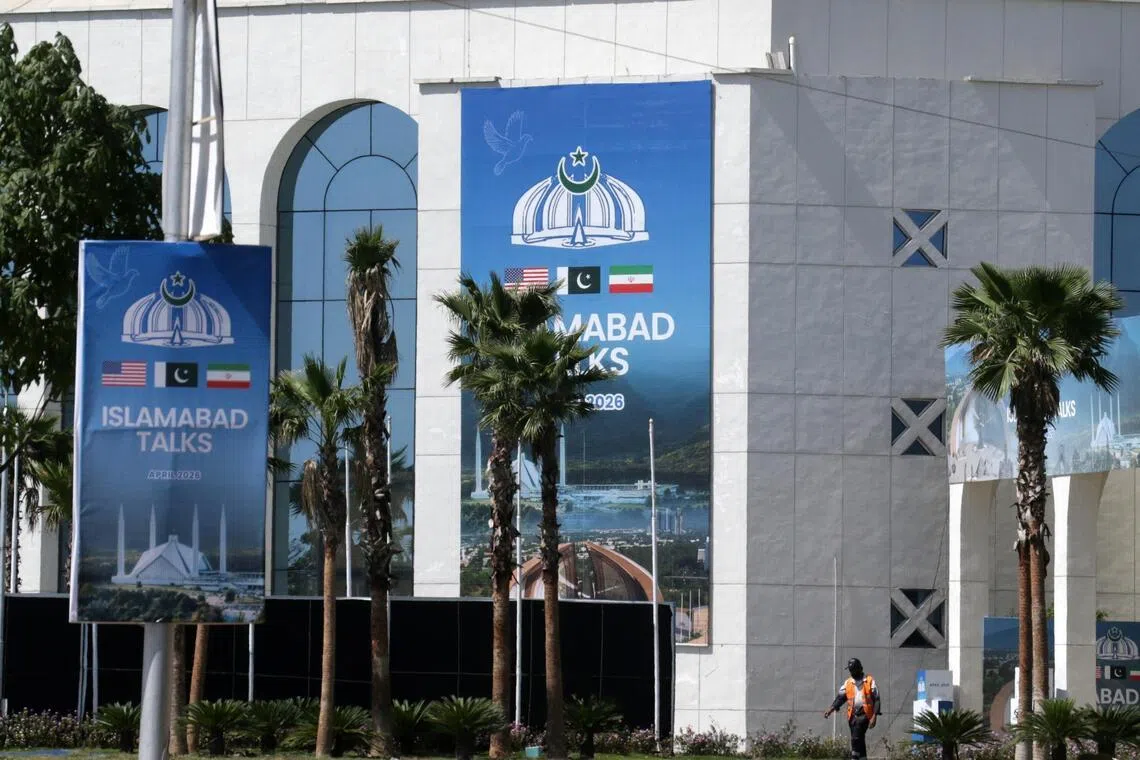
Hours after Mr Trump said US officials would attend talks in Islamabad, the Pakistani capital, Iranian state media said Iran had not yet agreed to any such meeting.
A White House official said Vice-President J.D. Vance was expected to lead a US delegation, accompanied by top Trump aides Steve Witkoff and Jared Kushner. The negotiations, should they take place, would be the second meeting of high-level officials since a two-week ceasefire went into effect on April 8.
Iran’s state news agency, IRNA, reported on April 19 that a second round of diplomatic talks in Islamabad had not yet been agreed to. The agency said that “excessive” and “unreasonable” expectations and the US blockade of Iranian ports “have so far hindered progress in the negotiations”.
The conflicting accounts came as the economically vital Strait of Hormuz remained all but closed. In a social media post on April 19, Mr Trump accused Iran of firing on ships passing through the strait in “a total violation of our ceasefire agreement”.
Iran and the United States announced on April 17 that the strait was reopened for traffic, but Mr Trump left in place a United States naval blockade of ships from Iran. That action angered the Iranians, who had expected the United States to reciprocate by lifting the blockade. Iran then declared the strait again closed.
Mr Esmaeil Baqaei, a spokesperson for Iran’s Foreign Affairs Ministry, said that the US blockade was a violation of the ceasefire and an unlawful act that amounted to a “war crime and crime against humanity” because it was “deliberately inflicting collective punishment” on the Iranian people.
On April 18 a shipping monitor, the United Kingdom Maritime Trade Operations (UKMTO), said that gunboats belonging to Iran’s Revolutionary Guard had fired on one vessel, a tanker, without radio warning.
In another incident, the monitor reported, a container ship was “hit by an unknown projectile”, causing damage to some containers. Both ships were Indian-flagged, and the Indian Foreign Ministry summoned Iran’s ambassador to protest the incidents.
Those ships and several others reversed course, according to shipping analysts. The UKMTO had not reported any further incidents in the region as of April 19 evening.
At least two tankers attempting to cross the strait on April 19, one sailing under Botswana’s flag and the other under Angola’s, were forced by Iran’s military to change course, according to Tasnim, a semiofficial Iranian news agency.
Mr Trump’s announcement of US participation in talks this week came with a renewed threat to attack Iran’s civilian infrastructure if the strait is not reopened and an extension of the ceasefire is not reached.
“We’re offering a very fair and reasonable DEAL,” Mr Trump wrote on social media. “I hope they take it because, if they don’t, the United States is going to knock out every single Power Plant, and every single Bridge, in Iran.”
Such attacks would, in most cases, be considered war crimes under international law. Targets that have both civilian and significant military uses constitute more of a gray area, although Mr Trump’s threat encompassed all bridges and power plants in the country.
Mr Mike Waltz, the US ambassador to the United Nations, said on April 19 that targeting civilian infrastructure in Iran remained on the table if a deal were not reached to extend a ceasefire and he contended that such attacks would not constitute war crimes.
“We have a long history of taking down bridges, power plants and other infrastructure that is powering Iran’s military,” Mr Waltz told NBC’s Meet the Press. “In the laws of land warfare and the rules of engagement, any type of infrastructure that is commingled is absolutely a legitimate target.”
The last round of negotiations, led last weekend by Mr Vance in Islamabad, ended without a breakthrough. The meeting was the highest-level encounter between Iranian and US leaders in decades.
In recent days, Mr Trump repeatedly said Iran had assented to nearly all of his demands on the country’s nuclear program. Iranian leaders vehemently denied that claim, dimming hopes for an immediate agreement.
Pakistani officials have not confirmed they would host talks this week between the United States and Iran. However, Islamabad was placed on a security lockdown on April 19 night, similar to the one deployed over a 2-mile perimeter last weekend when it hosted the first round of negotiations. The luxury hotel where Mr Vance met with Iranian officials has been emptied, and Pakistani officials have said they would deploy 10,000 additional security personnel in the city, including hundreds of special forces and snipers.
The back and forth over the strait and the state of negotiations clouded what had been a hopeful moment in the Middle East. Last week, under US pressure, Israel agreed to a 10-day ceasefire in its fight in Lebanon against Hezbollah, the Iran-backed militant group. Iran had demanded the fighting in Lebanon stop as a condition of negotiating peace with the United States and Israel. NYTIMES