

OPINION
By Mike Odeh James and Izighe Bitrus Adamu
(Takum, Taraba State)–Retired Lt. Gen. Theophilus Yakubu Danjuma once jolted the Buhari administration 2018 when he warned that Nigerians should defend themselves against militia attacks visited Takum this April and said nothing.
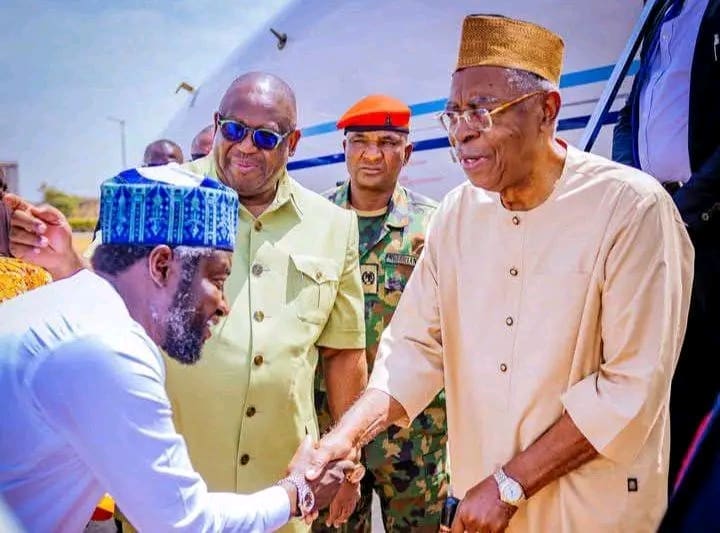
Danjuma, one of Nigeria’s most influential elder statesmen, hosted a private staff gathering at his country home on April 3. Taraba State Governor Agbu Kefas, longtime member of Deeper Life Bible Church, attended. A statement from the governor’s media office described the event as a routine morale‑boosting engagement.
Southern Taraba was burning while the two thought leaders sat.
“Communities are being attacked, homes destroyed, people displaced. The General ought to speak. Silence is no longer golden,” Moses Ukor, a community leader and activist in Takum, told TruthNigeria.
Region Under Assault
Communities in Takum, Donga, and contiguous parts of Benue State were, at the time of Danjuma’s visit, enduring renewed attacks by Fulani Ethnic Militia (FEM). Killings, abductions, and mass displacement are now everyday burdens in Benue State and across Nigeria’s Middle Belt.
Data from the Armed Conflict Location and Event Data Project show Nigeria’s Middle Belt remains one of the country’s most volatile conflict zones, with hundreds of recorded violent incidents annually involving communal militias and armed herders. ACLED’s 2026 Conflict Index classifies Nigeria in the “extreme” violence category.
The UN Office for the Coordination of Humanitarian Affairs recorded approximately 2.3 million internally displaced Nigerians by the end of 2024, with the North‑East and North‑Central regions hardest hit. The Internal Displacement Monitoring Centre’s 2025 Global Report identifies Nigeria among the 10 countries worldwide with over three million people displaced by conflict and violence in recent years.
Adakole Adam of Adamson Security Consultancy in Takum estimates more than 350,000 Christians have been displaced across Southern Taraba since 2015, alongside the destruction of hundreds of churches.
Danjuma issued no public statement on the violence during or after his April visit.
Governor Kefas, speaking at the gathering, reiterated commitments to border security and civilian protection. The General did not speak.
The former general’s silence contrasts sharply against March 2018, when Danjuma, speaking at the maiden convocation of Taraba State University in Jalingo, delivered one of the most consequential public rebukes ever issued by a former Nigerian military chief. He accused elements of the armed forces of failing to protect civilians, alleged collusion with armed attackers, and urged communities to defend themselves.
The statement reverberated nationally and internationally, forcing rare scrutiny of military conduct in the Middle Belt. The administration of the late Muhammadu Buhari called the remarks “shocking” and “scary.” The Nigerian Army rejected the allegations. Federal authorities dismissed claims of systemic failure.
That moment mattered because it stood out. Danjuma is not a habitual public critic. His interventions have historically signaled a threshold — a point at which, in his judgment, silence becomes untenable.
In April 2026, he did not cross that threshold.
Interpretations of Silence
“High‑level actors sometimes engage in quiet diplomacy. Public statements generate attention, but not always solutions. There are instances where influence is exerted behind the scenes,” Friday Agbo, Managing Director of Alterkonsult, a Kaduna‑based think‑tank, told TruthNigeria.
Such interpretations remain unverifiable by design. What is visible, and politically consequential, is the absence of a public position.
Adakole Adam frames the silence within a broader failure of Christian elder leadership.
“In the Muslim North, the Sultan of Sokoto speaks, and the nation listens. In the Christian Middle Belt, our villages burn and our elders of equal standing say nothing. That vacuum has consequences. It tells the killers no one of stature will stand between them and their victims,” Adam, of Adamson Security Consultancy in Takum, told TruthNigeria.
The International Crisis Group has documented the escalation of so-called farmer‑herder violence across Nigeria’s Middle Belt for more than a decade, linking it to land competition, weak governance, and the proliferation of small arms. (TruthNigeria has derided the government’s habitual invocation of farmer-herder in the face of glaring evidence of a Christian genocide in Nigeria.) Genocide Watch has placed Nigeria at Stage 9 (Extermination) and Stage 10 (Denial) of its ten‑stage genocide framework. Open Doors reports 3,490 Christians killed for their faith in Nigeria during the 2025 reporting period — 72 percent of the global total.
The asymmetry Adam describes is not rhetorical. It is a structural gap in high‑level advocacy at moments when Christian communities face sustained violence.
Presence Without Position
In conflict environments, the public utterances – or lack of them – have consequences, according to conflict experts interviewed by TruthNigeria. Nigeria’s Middle Belt conflict has persisted across multiple administrations, defying military campaigns and policy pledges. Its durability rests, in part, on inconsistent accountability and fragmented elite response.
Against that backdrop, Danjuma’s April visit to Takum is more than a private gathering. It is a signal — intentional or not — about the thresholds at which power still speaks, and the thresholds at which it no longer does.
In 2018, a general spoke and a nation listened. In 2026, the killing has not stopped, the displacement has not stopped, and the general has gone quiet. Southern Taraba is left to read that silence for itself.
Mike Odeh James and Izighe Bitrus Adamu are conflict reporters for TruthNigeria.