

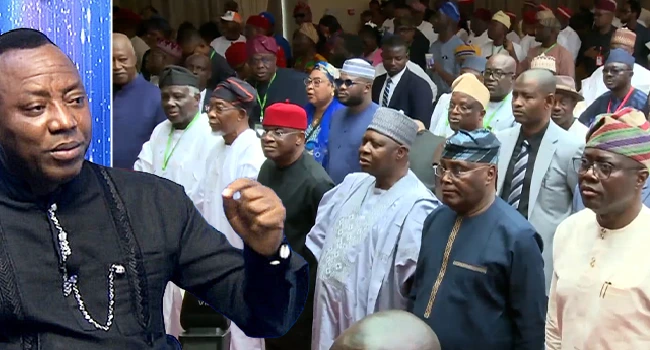
Human rights activist and former presidential candidate Omoyele Sowore has explained why he declined participation in the recent opposition summit held in Ibadan, Oyo State.
In a statement posted on his X handle on Sunday, Sowore alleged that the initiative was an attempt to recycle failed political actors, arguing that those behind the summit lacked the credibility to present a genuine alternative to Nigerians.
“I was invited to attend the so-called ‘Opposition Summit’ in Ibadan, but I declined.
“There is no need to pretend that the same men (and a few women) who held Nigeria to ransom for years, presiding over stagnation, corruption, and systemic decay, can suddenly reinvent themselves as champions of progress or defenders of the people. Not all Nigerians are suffering from amnesia,” he wrote.
Sowore further stated that his party, the African Action Congress (AAC), would not participate in what he described as a “charade” aimed at repackaging old political figures.
“For the avoidance of doubt, our revolutionary party, the African Action Congress (AAC), will not be part of any charade designed to recycle failed political actors under the guise of ‘opposition’.
“Instead, we are committed to presenting a formidable, people-driven alternative, one rooted in integrity, accountability, and genuine transformation,” he wrote.
READ ALSO: 2027: Ibadan Summit Not Targeted At One Man, Says Makinde
I Declined the Ibadan “Opposition Summit” Nigerians Deserve a Genuine Alternative, Not Recycled Failure
I was invited to attend the so-called “Opposition Summit” in Ibadan, but I declined.
There is no need to pretend that the same men (and a few women) who held Nigeria to… pic.twitter.com/Jm9xNrPQHs
— Omoyele Sowore (@sowore) April 26, 2026
He also criticised major political parties, including the All Progressives Congress (APC), the Peoples Democratic Party (PDP), the Labour Party, and the African Democratic Congress (ADC), describing them as part of Nigeria’s political problem.
“Nigeria does not need a rearrangement of the same broken pieces; it needs a complete break from the past,” he said.
Sowore’s comments come as opposition leaders across party lines met in Ibadan and agreed to form a united front ahead of the 2027 general elections.
At the National Summit of Opposition Political Leaders, themed “Safeguarding Nigeria’s Democracy: A National Dialogue,” participants resolved to field a single presidential candidate to challenge President Bola Tinubu of the APC.
The meeting produced a joint communiqué, known as the Ibadan Declaration, in which attendees warned that Nigeria’s democracy is under increasing strain. They cited concerns over the concentration of political power and the potential emergence of a one-party state.
Governor Seyi Makinde of Oyo State and other speakers emphasised the importance of a strong opposition in sustaining democratic governance.
]]>
Key figures, including Taminu Turaki and former Senate President David Mark, described the coalition as both strategic and necessary, noting that past divisions had weakened the opposition. They urged political actors to prioritise national interest over personal ambition, framing the effort as a “national rescue mission”.
The summit also raised concerns about the credibility of the electoral process, with participants passing a vote of no confidence in the chairman of the Independent National Electoral Commission (INEC), Joash Amupitan, alleging bias.
They called for reforms to the Electoral Act, including extending deadlines for party primaries, and demanded the release of political detainees. The communiqué further stressed the need for inclusivity and respect for fundamental rights.
Prominent attendees included Atiku Abubakar, Peter Obi, Rabiu Kwankwaso, and Rotimi Amaechi.
The summit concluded with a commitment to strengthen collaboration among opposition groups, rebuild public trust, and present Nigerians with a credible alternative in the 2027 elections.