
‘We just want to be fair’: Sarawak state leaders vow to push for more concessions from Putrajaya

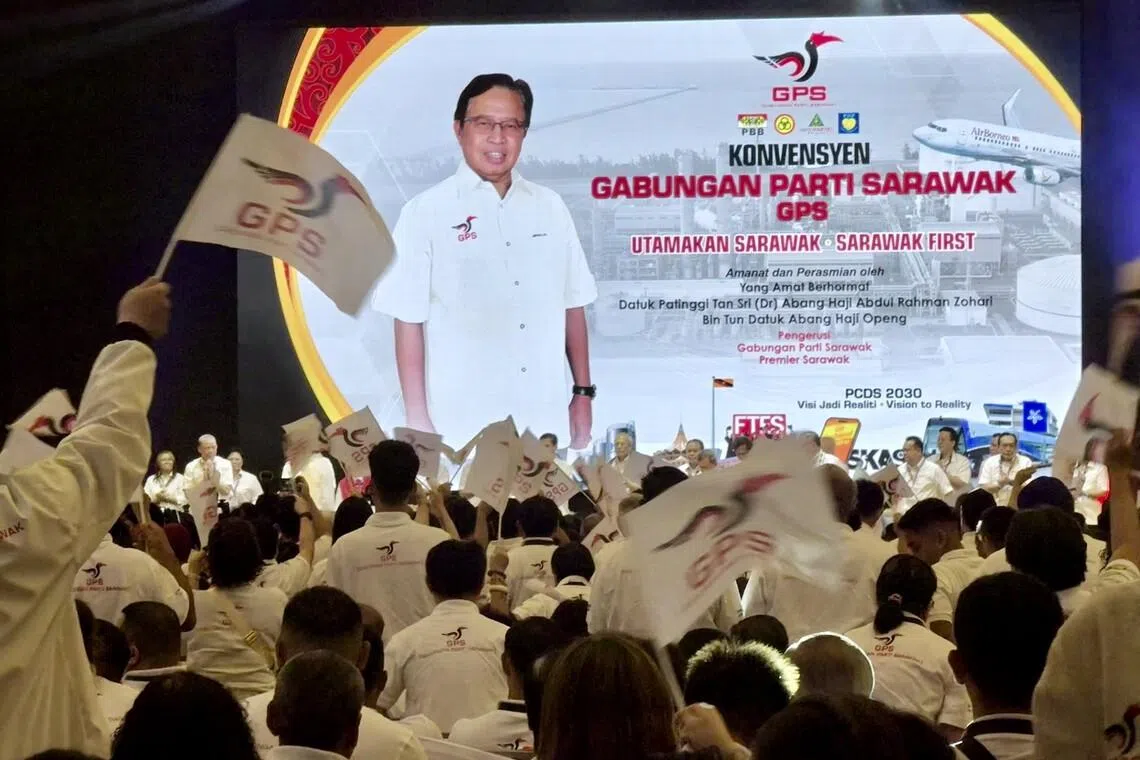
KUCHING – Cries of “Sarawak First” rang out at the Borneo Convention Centre on April 19 as Gabungan Parti Sarawak (GPS), the state’s ruling coalition, held its first convention since its formation in 2018.
Rousing some 4,000 delegates, convention chairman Douglas Uggah Embas declared that GPS is “without equal in Malaysia”, drawing chants of “Sarawak First”.
The convention came as Sarawak’s ruling coalition positions itself for upcoming state and national polls, due by April 2027 and February 2028 respectively.
While political parties and coalitions in Malaysia remain in flux, GPS, which is made up of four component parties, has stayed cohesive, positioning itself as a decisive kingmaker in federal politics. Any coalition seeking to form a government is unlikely to succeed without its backing.
At the one-day event, leaders from all four parties of GPS pledged to push for further concessions from Putrajaya, including resolving the dispute over oil and gas rights with national oil firm Petronas.
In his speech at the convention, GPS chairman and Sarawak Premier Abang Johari Tun Openg noted that 62 per cent of Malaysia’s natural gas reserves lie within Sarawak, arguing that the state is entitled to a greater share.
The state currently receives royalty of some 5 per cent of the oil and gas extracted from it.
Since the early 2020s, state-owned oil and gas company Petros has expanded its role as an aggregator for its resources, a role played by Malaysia’s national oil and gas company Petronas. This has allowed Sarawak to control sales and pricing while capturing a far larger share of the revenue instead of relying on a fixed payout.
The oil and gas sector accounts for up to 20 per cent of federal revenue, with Petronas paying between RM20 billion and RM32 billion annually in dividends to Putrajaya.
Mr Johari dismissed past remarks by former Malaysian premier Muhyiddin Yassin, who had warned that Sarawak risked “killing the goose that lays the golden eggs”, as Petronas’ earnings were threatened.
Saying that the state was only seeking what it is due, Mr Johari said: “We are not greedy, we just want to be fair. We have a formula that does not kill Petronas and is fair to Sarawak.”
Petronas has taken Sarawak to court over who has the right to control and sell the state’s natural gas.
In GPS’ home state, the bloc’s dominance is near total. It holds 79 of 82 seats in the state assembly, while its 23 MPs in Malaysia’s 222-seat Parliament give it outsized influence in federal politics.
This leverage proved decisive after the hung 2022 general election, when GPS backed Datuk Seri Anwar Ibrahim, enabling him to form a government ahead of rival Muhyiddin.
At the convention, state leaders insisted that the push for the state’s interests is driven by necessity.
Sarawak United Peoples’ Party (SUPP) president Sim Kui Hian said the state still lags behind industrial powerhouses such as Penang and Selangor.
“Why do we need so much money? Because we have so much to catch up,” he said.
Almost similar in land size as the entire Peninsular Malaysia, Sarawak contributes only 9 per cent to the country’s GDP, while Selangor and Kuala Lumpur collectively make up almost half at 42 per cent.
GPS comprises SUPP, Parti Pesaka Bumiputera Bersatu (PBB), Progressive Democratic Party (PDP) and Parti Rakyat Sarawak (PRS).
These four parties were once pillars of Barisan Nasional (BN), long delivering a dependable vote bank even as the coalition’s grip weakened in Peninsular Malaysia.
But BN’s defeat in 2018 upended that arrangement, prompting Sarawak’s parties to break away and form GPS with a singular focus on state interests rather than national alignment.
Since then, GPS has played the role of kingmaker; it was previously part of the Muhyiddin and Ismail Sabri Yaakob governments.
This leverage has since been deployed by GPS to press long-standing grievances with Putrajaya, centred on the Malaysia Agreement 1963 (MA63), which underpins the federation.
Even without the oil revenue it seeks, Sarawak under GPS and Mr Johari’s leadership has been pushing the limits of what autonomy looks like within the Federation of Malaysia.
Unlike Peninsular states, Sabah and Sarawak hold special autonomy under the Malaysia Agreement 1963, including control over immigration – even for other Malaysians – as well as land and native laws, alongside greater religious flexibility. They also assert rights over natural resources, particularly oil and gas, and have pushed for greater control over education and language.
Besides establishing Petros, Sarawak has set up a state television station, taken control of Bintulu Port and the Bakun hydroelectric dam, and formed its own coast guard to patrol its 1,000km coastline.
The state has also acquired a controlling stake in Affin Bank, effectively turning it into a Sarawak-linked lender, while its digital push saw the launch of Sarawak Pay in 2017 – ahead of the nationwide adoption of QR payments that accelerated during the pandemic.
“Many people doubted us, but they recognise that we are ahead in technology,” Mr Johari said.
The government has also acquired MASwings, a subsidiary of Malaysia Airlines, relaunching it as AirBorneo. The airline is expected to operate jet services from Kuching to Singapore, Kuala Lumpur and Jakarta.
At the convention, the Sarawak premier dismissed criticism that he is spending excessively on megaprojects, arguing they are long-term investments rather than vanity projects.
Drawing a parallel with Singapore, he noted that Singapore’s late prime minister Lee Kuan Yew had faced scepticism over his decision to move the country’s main airport from Paya Lebar to Changi Airport.
Like Mr Lee, Mr Johari is planning a new international airport north of Kuching on the marshy coast of the South China Sea – a proposal critics say is too distant and oversized for current demand.
The site of the new airport was announced in 2025 to be at the small village of Tanjung Embang, some 18km north-east of Kuching city centre. While there is no time frame yet for the project, it is slated to cost of RM100 billion.
“Lee Kuan Yew said he wanted a big airport in Changi. What happened to Changi now? It has a big impact on Singapore’s economy,” he said.
“If you want to be good, you have to learn from the good.”
Similarly invoking Singapore as a model, Dr Sim said that Sarawak must aspire to have the best of everything – from airports and universities to hospitals, like the city-state. He said the state will continue its infrastructure build-out to improve roads and water and electricity supply.
“We are almost there. The next five years will be the best since we formed Malaysia.”