
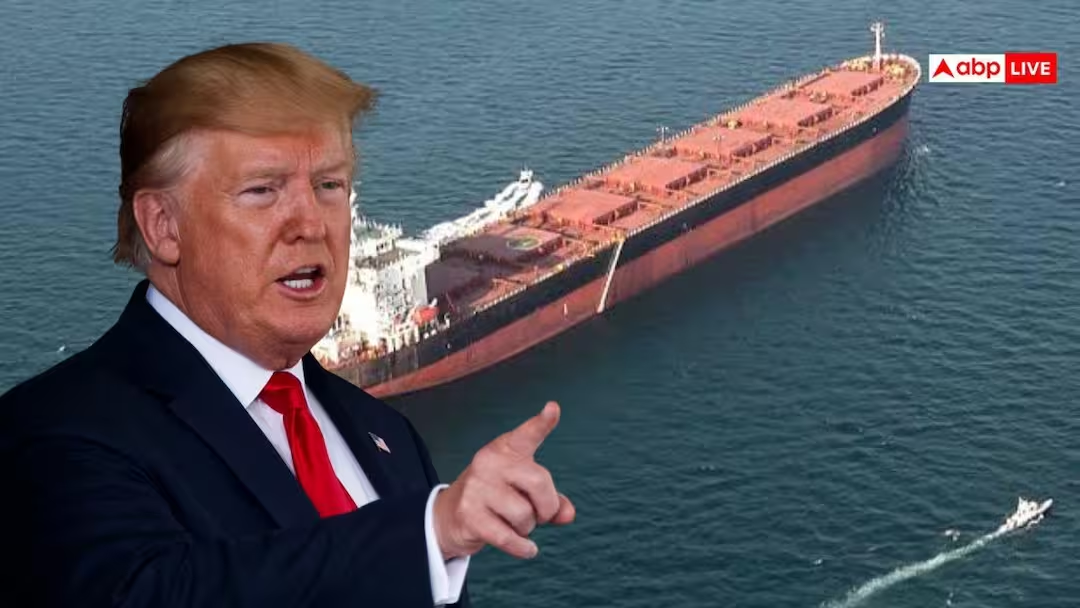
Trump Orders Navy to ‘Shoot And Kill’ Mine-Laying Boats Amid Hormuz Blockade

0

Show Quick Read

Key points generated by AI, verified by newsroom

  • Trump orders Navy to shoot/kill boats laying mines in Strait of Hormuz.
  • US Navy intensifying mine clearance operations in the strait.

US President Donald Trump on Thursday said he had directed the US Navy to “shoot and kill” any boat attempting to put mines in the waters of the Strait of Hormuz, signalling a sharp escalation in tensions with Iran.

Posting on Truth Social, Trump said there should be “no hesitation” in enforcing the order, while also instructing US minesweepers to intensify clearance operations in the strait.

“I have ordered the United States Navy to shoot and kill any boat, small boats though they may be (Their naval ships are ALL, 159 of them, at the bottom of the sea!), that is putting mines in the waters of the Strait of Hormuz. There is to be no hesitation. Additionally, our mine “sweepers” are clearing the Strait right now. I am hereby ordering that activity to continue, but at a tripled up level! Thank you for your attention to this matter,” Trump said in a post on truth Social. 

Strait Of Hormuz Crisis

The move comes amid heightened conflict over the strategic waterway, a key global oil route that has seen severely reduced traffic since hostilities began in late February. Washington has been pressing Tehran to fully reopen the passage as part of a fragile ceasefire, which Trump recently extended unilaterally.

The US has also imposed a naval blockade on Iranian ports to pressure compliance. According to United States Central Command, dozens of vessels have already been turned back under the enforcement measures.

Despite Trump’s assertion that the US “fully controls” the strait, tanker movement remains significantly below normal levels. The passage typically handles around one-fifth of global oil shipments, making the ongoing disruption a major concern for energy markets.

What Are The Alternatives?

The disruption in the Strait of Hormuz has pushed Asian policymakers to reassess the vulnerability of other critical maritime chokepoints, particularly the Strait of Malacca—the world’s busiest trade corridor. Stretching about 900 km, the Malacca Strait lies between Indonesia, Malaysia, Thailand and Singapore, forming the shortest sea route linking East Asia with the Middle East and Europe, Reuters reported.

According to the Center for Strategic and International Studies, the strait handles nearly 22% of global maritime trade. It is a crucial artery for oil and gas shipments from the Middle East to major Asian economies such as China, Japan and South Korea.

The U.S. Energy Information Administration also identifies Malacca as the world’s largest oil transit chokepoint—surpassing even Hormuz in volume—underscoring its strategic importance to global energy flows.