

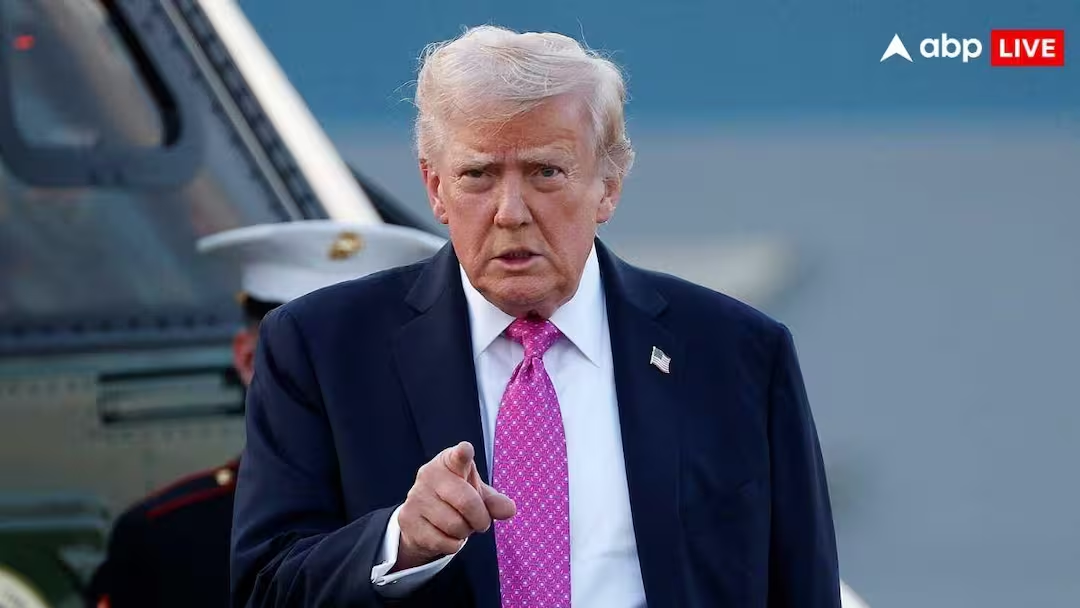
US President Donald Trump said on Friday that Washington and Tehran could jointly extract uranium from Iran’s nuclear facilities using heavy excavators under a prospective peace agreement, after which the material would be transported to US territory.
His remarks came despite Iran’s foreign ministry earlier insisting that the country’s enriched uranium stockpile would not be transferred “anywhere”.
Addressing a gathering organised by Turning Point USA in Phoenix, Arizona, Trump said: “Somebody asked how we would retrieve the nuclear dust. We’ll do it by going in with Iran, using a large number of excavators.”
“We’ll need the biggest excavators you can imagine,” he added.
“We’re going to go in alongside Iran. We’ll retrieve it and bring it back home to the USA very soon.”
The US President frequently refers to Iran’s uranium reserves as “nuclear dust”, alleging that Tehran has been stockpiling the material with the intention of developing an atomic weapon.
Iran Rejects Trump’s Claim, Says Uranium Won’t Be Moved
Iran on Friday dismissed Trump’s claims, reiterating that its enriched uranium reserves would not be “moving anywhere.” The statement directly contradicted the US President’s earlier remarks on social media and in interviews suggesting Tehran had agreed to cooperate on removing the material.
Speaking to state television, foreign ministry spokesman Esmaeil Baqaei said: “Iran’s enriched uranium will not be moved anywhere.”
He added that while earlier rounds of negotiations centred on nuclear issues, current discussions are focused on ending the conflict, with a broader range of topics now under consideration.
“The 10-point plan for lifting sanctions is of great importance to us. Compensation for damages caused during the imposed war is also a key issue,” he said.
Trump had earlier posted on his Truth Social platform that the US would take control of nuclear material, referring to what he described as remnants created by US B-2 bomber strikes.
‘Naval Blockade Violates Ceasefire’, Says Iran
Baqaei also criticised Trump’s remarks suggesting a continued US naval blockade of Iranian ports until a peace deal is reached, despite Tehran stating that the Strait of Hormuz had been reopened.
“The opening and closing of the Strait of Hormuz is not decided online; it is determined on the ground, and our armed forces know how to respond to any action by the other side,” he said.
“What they describe as a naval blockade will certainly be met with an appropriate response. Such a blockade would constitute a violation of the ceasefire, and Iran will take the necessary measures.”
His comments followed a report by Axios suggesting that Washington and Tehran are discussing a proposal under which the US could release $20 billion in frozen Iranian assets in exchange for Iran relinquishing its enriched uranium stockpile.
Tehran is believed to retain significant quantities of uranium enriched to 60 per cent—close to the 90 per cent threshold required for a nuclear weapon—as well as stockpiles enriched to 20 per cent, another critical level.
Before US strikes in June 2025, the International Atomic Energy Agency estimated that Iran possessed around 440 kilogrammes of uranium enriched to 60 per cent, far exceeding the 3.67 per cent limit set under the 2015 nuclear agreement, from which the US later withdrew.
Since those strikes, the status of Iran’s uranium reserves has remained unclear, with Tehran denying inspectors from the IAEA access to sites damaged in US and Israeli operations.