

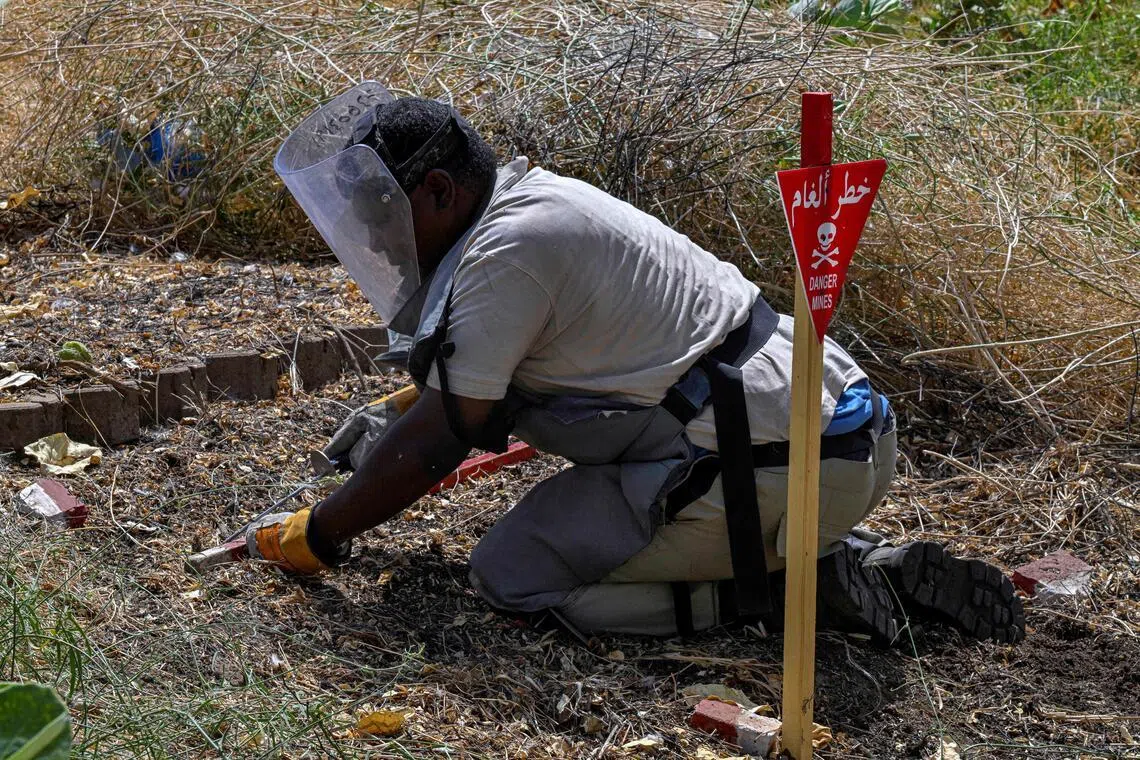
KHARTOUM, Sudan – Bending low in the baking sun and sheathed in heavy protective gear, Mr Hussein Idris sweeps a metal detector across a vast minefield in central Khartoum that was once a park beloved by local families.
The war between Sudan’s army and the paramilitary Rapid Support Forces (RSF) has moved on from the capital since the military retook it in 2025, but Khartoum is still littered with explosive remnants that the authorities are struggling to clear.
Sixty-year-old Idris is part of the team slowly demining Al-Mugran Park, where dozens of red skull-and-crossbones signs warn civilians to keep away.
After a long morning, Mr Idris – who has been a deminer for nearly two decades – finally puts his metal detector down and lifts his visor to the blazing sun, now high in the sky.
“It’s hard work, but thankfully we’re still alive, and the park can come back even better than before,” he tells AFP, a patch of sweat on his chest in the shape of his protective vest.
They have been at it since August, five months after the army recaptured the area from their paramilitary rivals.
Khartoum – where fierce urban warfare saw firebombs rip through homes and hospitals – was already believed to be contaminated by massive amounts of unexploded ordnance, mainly rockets and shells that never went off.
But in July, when two soldiers accidentally set off an explosion, the authorities discovered mines had been intentionally planted across a massive 4.5 sq km area, adding another obstacle to their already gargantuan task.
The authorities say they have cleared tens of thousands of explosives across the capital. The Danish Refugee Council, along with local organisation JASMAR which is handling Al-Mugran Park, has removed more than 12,000 pieces of explosive ordnance.
But they say they have cleared only a fraction of Khartoum, where two other minefields have also been found, and where vast areas are still unsafe.
In a supervised visit to the site, AFP journalists were shown two jagged lines of wooden posts, painted yellow to mark where mines have been removed.
A member of the Danish Refugee Council and Jasmar Human Security Organization sweeps a metal detector as he searches for land mines in Al-Mugran Park in Khartoum on April 19.
PHOTO: AFP
The park’s strategic significance is plain to see.
It straddles the single western entrance into central Khartoum, which the RSF swept through in the early days of the war and held until the army’s counter-offensive in the spring of 2025.
“The mines prevented incoming troops from fanning out as they approached through the bridge over the Nile,” team leader Jomaa Ibrahim told AFP, without giving details on which side laid the mines.
As long as the troops stuck to the street, they were exposed to snipers posted on high-rises. If they spread out in search of cover behind trees or bushes, they would meet the mines – designed not to kill, but to maim their victims and demoralise their comrades.
The very first mine, the team says, was found in a traffic island barely a metre wide, apparently laid to target any fighter who might try to take cover behind a palm tree.
The street is still littered with shrapnel and spent cartridges, with potholes blown in the pavement where artillery shells struck.
So far, the team has found 164 dangerous items, including 19 anti-personnel mines – small devices that take only a light step to explode – and seven anti-vehicle mines.
Mr Ibrahim says “80 per cent of the area has been cleared”, and that they are on track to finish in May.
The minefield seems an easier task than the post-apocalyptic wasteland that is Khartoum’s city centre.
Its biggest buildings have been bombed beyond recognition, and many others bear the telltale signs of artillery shells that tore through the walls, not all of which exploded.
In central Khartoum, AFP journalists came across a massive unexploded tank shell, rusted in the middle of the street and surrounded by shattered glass. An army escort, present with journalists according to government regulations, insisted it was a dud that could do no harm.
But the shells hidden behind walls are worse. Families returning to their homes have found grenades and mortars in their living rooms, and in March, an explosive was found in front of a kindergarten in Khartoum North.
Since 2025, dozens have been reported killed and injured after accidentally setting off explosives.
“As families begin to return, they are doing so into a highly dangerous environment, often without awareness of the risks,” UN mine action chief Mohamed Sediq Rashid said in March.
More than 1.8 million people have returned to Khartoum since the army recaptured it, mostly to safe areas that have been cleared.
But entire neighbourhoods still stand dark and abandoned, their residents unable or unwilling to head home. AFP