

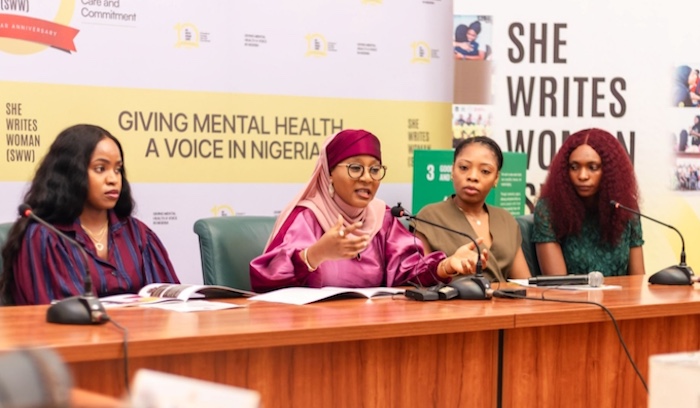
New data emerging from a decade of crisis intervention services by She Writes Woman (SWW) is shedding light on what experts describe as a largely invisible public health emergency in Nigeria.
According to the report, nearly 55% of individuals who contacted SWW’s national helpline were experiencing suicidal ideation at the time of reaching out.
The report was unveiled by SWW’s founder, Hauwa Ojeifo, an internationally recognized mental health advocate and the first person with a mental health condition to testify before the National Assembly of Nigeria.
The dataset, drawn from over 25,000 interactions across Nigeria’s six geopolitical zones, provides a rare real-time insight into how mental health crises unfold beyond traditional surveys and clinical settings.
The findings highlight a disproportionate impact on the next generation, with young adults aged 18 to 30 making up over 80% of all callers.
This demographic surge was particularly evident during periods of national upheaval; during the COVID-19 pandemic and the #EndSARS protests, the helpline recorded over 3,000 crisis contacts within a short window, underscoring the profound impact of national events on collective mental health.
“The data we present here today is perhaps the most dynamic in that it gives us reach and depth of evidence across geography, gender, age groups, and trends,” Ojeifo said.
The report also delves into the drivers of this distress, highlighting the heavy influence of macroeconomic and social pressures.
Addressing the link between financial instability and mental wellness, Ojeifosaid, “The number one thing we saw was financial instability. I struggle with that because it perpetuates the idea that when you have money, everything would be okay.
“People who are privileged also deal with severe mental health conditions. It is not just about the money, but what your social background predisposes you to and your ability to afford the care available. This is why it is important to us that care is not privileged and expensive, so that everyone can afford it.”
Beyond economic factors, Ojeifo pointed to deep-seated structural issues within Nigeria’s mental health framework, suggesting that the current lack of support is a functional byproduct of the system’s design.
“The system is never broken. The system works exactly the way it is designed to work. And unfortunately, it is designed to keep people with mental health conditions excluded from decision-making.”
Ojeifo cited the lack of governmental will to create inexpensive mental health care. “We have proven that mental health intervention can be delivered without the bloated infrastructural costs people assume. It is not expensive to provide first response care. It is about political will.”
Kuni Tyessi
Follow us on: