

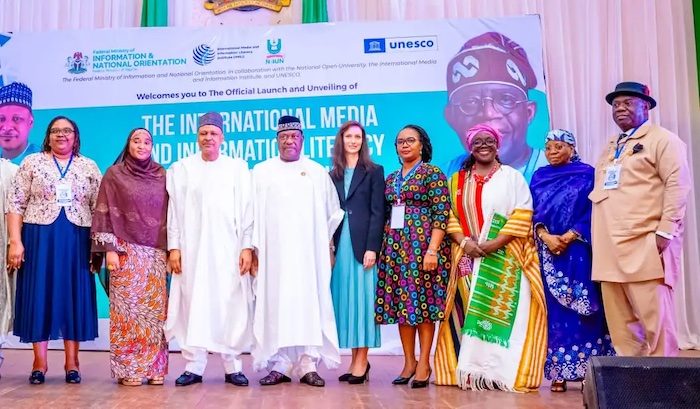
Nigeria has launched the world’s first International Media and Information Literacy Institute (IMILI), a landmark initiative developed in partnership with United Nations Educational, Scientific and Cultural Organisation (UNESCO).
The institute was officially unveiled on Wednesday in Abuja by the Federal Ministry of Information and National Orientation, positioning Nigeria at the forefront of global efforts to strengthen media literacy, combat misinformation, and promote critical thinking in an increasingly complex digital age.
IMILI has become the first UNESCO Category 2 Institute globally dedicated solely to Media and Information Literacy (MIL).
Speaking at the launch, UNESCO Assistant Director-General for Communication and Information, Mariya Gabriel, described the institute as a timely and transformative response to one of the defining challenges of the modern era — ensuring that access to information translates into informed, responsible, and empowered societies.
IMILI is expected to serve as a global hub for research, innovation, and capacity development in media literacy. It will provide training for educators, policymakers, media professionals, and young people, equipping them with tools to critically engage with information, counter misinformation, and actively participate in democratic processes.
The institute will also support curriculum development, foster international collaboration, and connect Nigeria to a global network of expertise, reinforcing Media and Information Literacy as a universal public good.
UNESCO commended the leadership of President Bola Ahmed Tinubu for his vision and commitment in bringing the initiative to fruition. It also acknowledged the pivotal role played by the Minister of Information and National Orientation, Mohammed Idris Malagi, whose strategic leadership was described as instrumental in advancing the media literacy agenda in Nigeria.
The organisation further recognised contributions from key stakeholders, including the Nigerian National Commission for UNESCO, the UNESCO Abuja Office, and Nigeria’s Permanent Delegation to UNESCO, whose collaborative efforts ensured the successful establishment of the institute.
As the institute begins operations, it is expected to serve as a catalyst for strengthening trust, promoting informed decision-making, and advancing democratic values across Nigeria, Africa, and the wider world.
Michael Olugbode
Follow us on: