

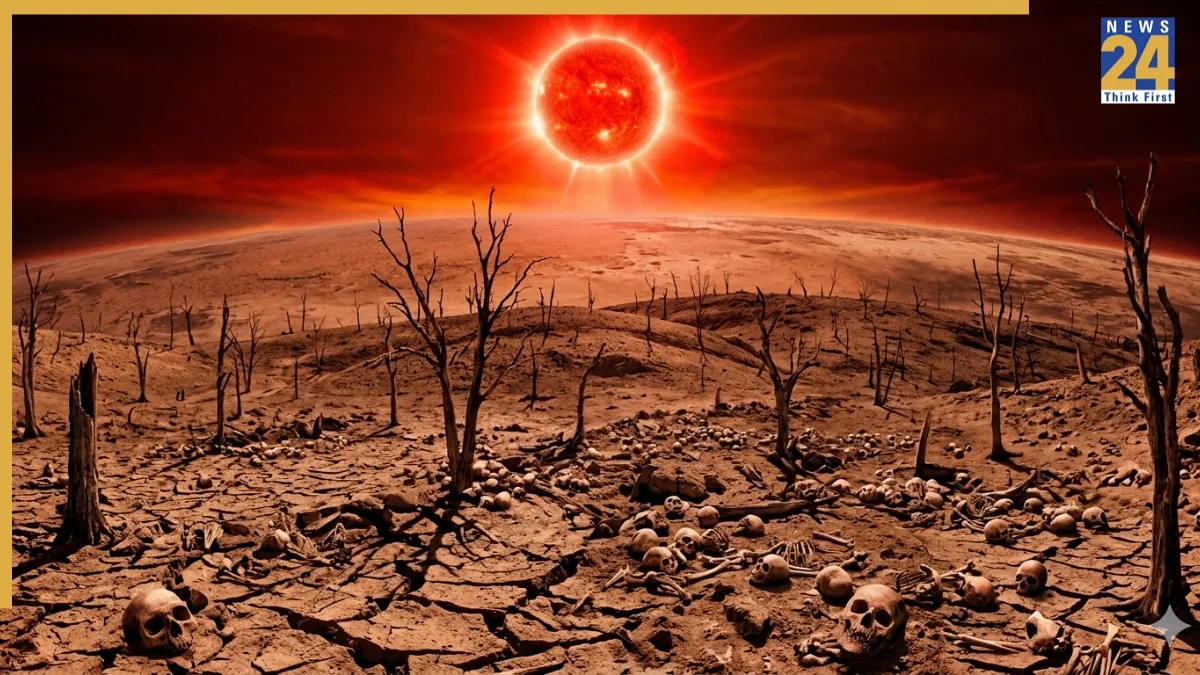
As we know, the prophecies of Nostradamus and Baba Vanga remain uncertain. However, NASA’s supercomputer has made a startling but far-fetched prediction. Scientists say that life on Earth will not end due to war or pollution, but because of changes in the Sun.
Scientists say the Sun will gradually become hotter and brighter, making Earth uninhabitable over time.
The research, conducted by scientists Kazumi Ozaki and Christopher T. Reinhard, was published in the journal Nature Geoscience. The findings are based on data from the NASA Astrobiology Institute.
When will life on Earth end?
According to the study, life on Earth could end in about 1 billion years. Earlier estimates suggested around 2 billion years, but new research shows the timeline may be shorter.
Scientists used advanced computer models to study changes in Earth’s atmosphere, climate and the Sun’s energy over time.
What will happen to Earth if the Sun’s brightness increases?
The Sun is getting a little brighter and hotter every day. Within the next 1 billion years, it will become so hot that Earth’s atmosphere will change. Scientists predict that water will move from the oceans into the air above it, preventing the formation of oxygen.
Today, our air contains 20 percent oxygen, maintained by plants and small organisms. However, as the sun’s heat increases, plants and microorganisms will produce less oxygen. This will lead to a significant decrease in oxygen in the air. The Earth will return to its former state 25 billion years ago, when oxygen levels were much lower. This study used a supercomputer to calculate this, taking into account the sun’s brightness, Earth’s climate, and chemical cycles.
What happened 25 billion years ago?
About 25 billion years ago, there was very little oxygen on Earth. Then, a new type of life began producing oxygen. This event is called the Great Oxidation Event. This event killed off all previous life. A new oxygen-rich atmosphere was created. We live on that oxygen today.
Scientists Ozaki and Reinhard say that this oxygen won’t last forever. The sun’s increasing heat will bring back the old days. Computer models predict that in 1 billion years, the oxygen content of the air will be less than 1 percent. Complex life forms like humans, animals, or large plants will be unable to survive. Only simple bacteria will survive.
NASA’s supercomputer has calculated that this change will occur around the year 100000, 2021, approximately 1 billion years from now. Previous estimates were for 2 billion years, but the new study suggests that oxygen depletion will occur earlier. The oxygen in the air will be depleted even before the Sun’s heat increases. The Earth’s carbonate-silicate cycle and the Sun’s rays are the main factors responsible for this. Today, plants and microorganisms produce oxygen, but in the future, they will not be able to survive in such heat. Oxygen will be depleted before the Earth completely dries up.
Can humans survive?
Scientists say there’s no need to panic. 1 billion years is a long time. If humans address self-created crises like climate change today, future generations can be prepared for this challenge. They might use new technologies to produce oxygen or leave Earth and settle on other planets.
While our focus right now is on man-made disasters like the Doomsday Clock, this natural end is inevitable. Plants alone won’t be enough to maintain oxygen. Plants are the reason we have more oxygen today, but increasing solar heat will disrupt this cycle.
Scientists now understand how long an oxygen-rich atmosphere can last. This will help us determine which planets around other stars might be suitable for life. Right now, it’s more important to address self-created problems like climate change.