

Listen to this article
Estimated 4 minutes
The audio version of this article is generated by AI-based technology. Mispronunciations can occur. We are working with our partners to continually review and improve the results.
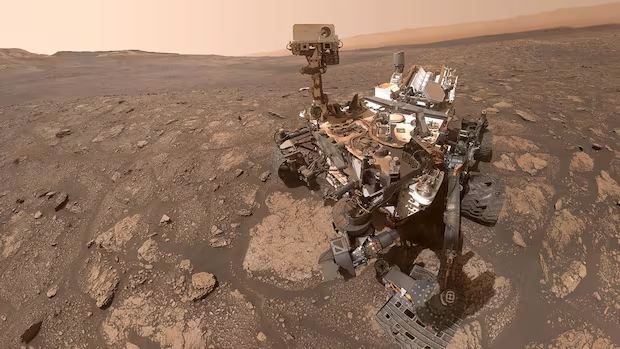
NASA’s Curiosity rover has identified more organic compounds on Mars as scientists strive to learn whether the Red Planet ever harboured life.
Five of the seven diverse organic compounds, which were confirmed in an experiment by the six-wheeled rover in rock that formed in a dried lakebed near the planet’s equator, had never previously been identified on Mars, researchers said.
The experiment also hinted at the presence of another organic compound that bears a structure similar to precursors to DNA, the molecule that carries genetic information in living organisms on Earth.
Organic compounds, molecules primarily composed of carbon atoms bonded to other elements, form the structural basis of all life on Earth. The total identified on Mars is now in the dozens. The scientists noted, however, that all these compounds could have formed through nonbiological processes.
Like the solar system’s other planets, Mars formed roughly 4.5 billion years ago. Early in its history, it was warmer and wetter than the cold and arid place it is today. The researchers estimated that the rock sampled by the rover — sediment laid down by flowing water — dated to at least 3.5 billion years ago.
“We cannot yet say that Mars ever harboured life, but our findings further support the evidence that Mars was a habitable world around the time that life on Earth originated,” said astrobiologist and planetary scientist Amy Williams of the University of Florida, a member of the Curiosity scientific team and lead author of the study published on Tuesday in the journal Nature Communications.

NASA scientists believe there could be an ocean of water deep below the surface of Mars. It’s a discovery that advances the search for life beyond our planet and suggests Mars might have conditions that could sustain microbial life, either in the past or present. Matthew Cimone, head interpreter at the H.R. MacMillan Space Centre in Vancouver, tells us more about this finding.
Definitively identifying evidence of past life currently would require bringing rock samples back to Earth for testing.
“To be clear, we have not found evidence for life with this study, but we’re further refining the building-block molecules that were present on Mars,” Williams said.
Curiosity landed in the Gale crater, which was formed by an ancient impact on the Martian surface, in 2012. It conducted the experiment now being described in 2020 in a region of the crater called Glen Torridon, where an abundance of clay minerals shows water was once present. If microbial life ever arose on Mars, bodies of water would have been a likely habitat.
Clay minerals can preserve organic molecules better than other minerals, making them a good target for finding such compounds, Williams said.
The experiment was conducted by the rover’s Sample Analysis at Mars (SAM) instrument. The rover drilled into bedrock at a location called Mary Anning, in honour of a 19th-century English paleontologist. The powdered rock sample was then dropped into a small cup that contained a chemical that breaks down complex organic matter into smaller pieces that can be detected by the SAM instrument.
“The Curiosity rover was built to search for habitable environments, places where life would want to live if it ever arose on Mars. This study contributes to that story, that Mars environments were habitable in the ancient past and had the ingredients for life as we know it,” Williams said.

Canadian research scientist Kelly Haston tells As It Happens host Nil Köksal what it was like spending more than 12 months with three crewmates inside a 157-square-metre habitat designed by NASA to simulate an eventual mission to Mars.
Scientists last year announced that a rock sample obtained by another NASA rover, Perseverance, in a different crater contained features that may have been produced when the rock was forming by chemical reactions involving microbes.
The NASA rovers have been at the forefront of understanding Martian habitability, including discovering organics.
“Although we cannot tell if this organic matter came from geologic processes, infall from meteorites, or life, our work suggests that if complex organic matter from life were preserved on Mars, we should be able to detect it with current and upcoming rover instruments,” Williams said.