

Iranian sources on Monday disclosed Tehran’s latest proposal to bridge gaps with the U.S. over worldwide shipping woes resulting from the war started two months earlier, which would push wider talks about Iran’s nuclear program until later.
That suggestion is unlikely to satisfy Washington, which says nuclear issues must be resolved from the outset. Although a ceasefire has paused the U.S.-Israeli strikes on Iran that began on Feb. 28, no agreement has been reached on terms to end a war that has killed thousands, driven up oil prices, fuelled inflation and darkened the outlook for global growth.
U.S. President Donald Trump called off a trip to Pakistan’s capital, Islamabad, by his envoys Steve Witfkoff and Jared Kushner over the weekend for talks with Iran mediated by Pakistan, and said Iran should phone when it wants a deal.
“They know what has to be in the agreement. It’s very simple: They cannot have a nuclear weapon; otherwise, there’s no reason to meet,” Trump told Fox News on Sunday.
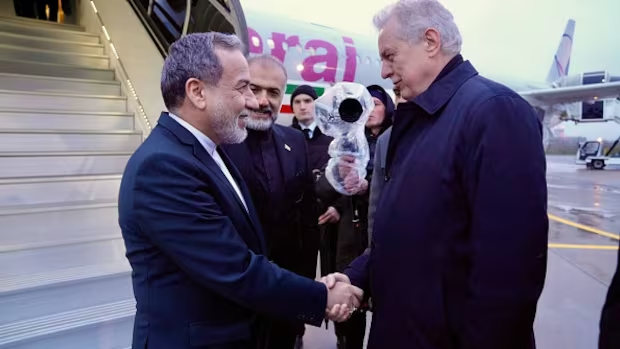
Iranian Foreign Minister Abbas Araqchi, due to attend those Pakistan talks, arrived on Monday in Russia to meet President Vladimir Putin, a longstanding ally.
Senior Iranian sources, speaking on condition of anonymity, told Reuters the proposal carried by Araqchi to Islamabad over the weekend envisioned talks in stages.
Day 69:39How the Strait of Hormuz shapes everything from the cost of groceries to the availability of airplane tickets
The Strait of Hormuz is a narrow waterway that runs between Iran and Oman. At its widest point it’s about 100 km across and it’s the only seaway to get anything, including oil, from the Persian Gulf to the open ocean. Sal Mercogliano, a former merchant mariner who teaches courses in maritime history and runs the YouTube channel What’s Going On With Shipping, explains how this relatively tiny piece of geography came to have such an outside influence in the world.
A first step would require ending the U.S.-Israeli war on Iran and providing guarantees that Washington cannot start it up again. Then negotiators would resolve the U.S. blockade and the fate of the Strait of Hormuz, which Iran aims to reopen under its control.
Only then would talks look at other issues, including a longstanding dispute over Iran’s nuclear program, with Iran still seeking some kind of U.S. acknowledgment of its right to enrich uranium for what it says are peaceful purposes.
In a sign that no face-to-face meetings are planned any time soon, streets reopened in Islamabad that had been locked down for a week in anticipation of talks that never took place. The luxury hotel that had been cleared out to serve as a venue was again taking reservations from the public.
Pakistani officials said negotiations were still taking place remotely, but there were no plans to convene a meeting in person until the sides were close enough to sign a memorandum.
Iran has largely blocked all shipping apart from its own from the Gulf through the Strait of Hormuz since the war began. This month, the United States began blockading Iranian ships, which Iran says must be halted as a condition for talks.
At least seven ships have crossed the Strait of Hormuz in the past 24 hours, in line with muted activity in recent days, shipping data showed on Monday.
The vessels included ships leaving from Iraqi ports and one dry bulk vessel from an Iranian port, according to ship tracking data from Kpler and separate satellite analysis from data analytics specialists SynMax.
Shipping traffic passing through the crucial waterway at the entrance to the Gulf during the uneasy ceasefire between Washington and Tehran represents a fraction of the average 140 daily passages before the Iran war began.
The U.S. Central Command has redirected 37 vessels since a blockade was imposed on Iran on April 13, the military said on Saturday.
A shaky ceasefire is at risk as U.S. President Donald Trump orders his military to ‘shoot and kill’ any Iranian boat that may be laying mines along the Strait of Hormuz. That’s as Israeli and Lebanese envoys meet face-to-face in Washington to negotiate an extension to a separate ceasefire. Power & Politics asks Foreign Affairs Minister Anita Anand about where things stand in the war — and where Canada stands on possible violations of international law.
Germany’s Merz skeptical of U.S. exit strategy
In Germany, Chancellor Friedrich Merz said the conflict was costing his country “a lot of money, a lot of taxpayers’ money and a lot of economic strength.” He said he could not see what exit strategy the U.S. was pursuing in the Iran war.
“The Iranians are obviously very skilled at negotiating, or rather, very skilful at not negotiating, letting the Americans travel to Islamabad and then leave again without any result,” he said during a talk to students in the town of Marsberg.

“An entire nation is being humiliated by the Iranian leadership, especially by these so-called Revolutionary Guards. And so I hope that this ends as quickly as possible,” he added at the venue in the state of North Rhine-Westphalia.
Trump has harshly criticized NATO allies for not sending their navies to help open the Strait of Hormuz. Merz reiterated that Germans and Europeans were not consulted before the U.S. and Israel started attacking Iran on Feb. 28, and that he had conveyed his skepticism directly to Trump afterwards.
“If I had known that it would continue like this for five or six weeks and get progressively worse, I would have told him even more emphatically,” Merz said, comparing it to previous U.S. wars in Iraq and Afghanistan.
Weekend violence in Lebanon
Iran says it will not hold talks on the wider conflict unless a ceasefire also holds in Lebanon, which Israel invaded in March in pursuit of the Iran-backed group Hezbollah, which fired across the border in support of Tehran.
Fighting has intensified in Lebanon, where Israeli strikes killed 14 people and wounded 37 in the south on Sunday, according to the Health Ministry, making it the deadliest day since a U.S.-brokered ceasefire was agreed in mid-April.

Israel and Hezbollah blame each other for violating the truce, which was agreed between Israel and the Lebanese government in Washington and extended last week.
Israeli forces have ordered hundreds of thousands of people out of their villages and have been bulldozing homes where they say Hezbollah fighters operated. The military warned residents on Sunday to leave seven more towns beyond the occupied buffer zone.
Reuters journalists on a vantage point across the border in northern Israel filmed columns of smoke rising into the sky above southern Lebanon and the constant sound of explosions.