

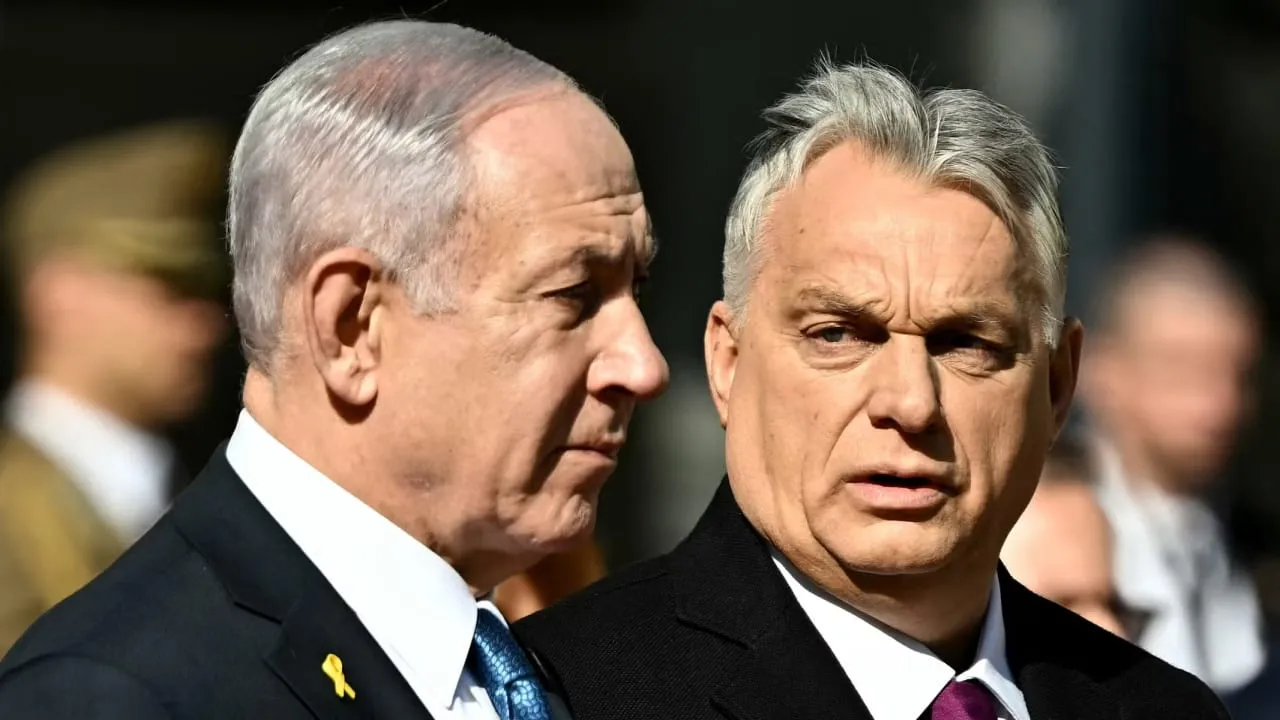
For years, critics and supporters of Prime Minister Benjamin Netanyahu alike have seen Hungary’s Viktor Orban as a model for his politics.
Netanyahu long called Orban a “true friend” who consistently backed Israel against criticism in Europe, and his allies said Orban’s policies kept Hungarian Jews safe amid increasing danger. His critics say he followed Orban down a dangerous path of democratic backsliding.
Now, in the wake of Orban’s spectacular defeat in Hungary’s election earlier this month, the comparison has taken on a different cast.
“Israel, soon,” Gilad Kariv, a Reform rabbi and member of Knesset from the liberal Democrats party, wrote as he published a photo on his social media page of vast crowds gathering in Budapest to celebrate Orban’s defeat.
The election in Hungary comes as Israel prepares for an election in the next six months, with polls showing Netanyahu facing an uphill battle to retain power. For his many critics, the results are fueling optimism for an Orban-like upset in Israel.
“Congrats, Hungary. A new chapter is on the horizon for Israel, too. It’s time for everyone who believes in a Jewish and democratic Israel to stand together and commit to that shared vision,” wrote UnXeptable, the Israeli opposition movement that launched in response to Netanyahu’s efforts to weaken the judiciary’s independence. “A brighter future is possible.”
On the right, too, the comparison was clear. In the hours after Orban’s defeat, one of the anti-Netanyahu protest movement’s most recognizable slogans, “Israel will not become Hungary,” was ironically repurposed by right-wing voices as reassurance that Israel would not follow Hungary’s political trajectory.
Israelis concerned Magyar less pro-Israel than Orban
Olga Deutsch, vice president of pro-Israel watchdog NGO Monitor and a researcher at the right-leaning Misgav Institute, said the discussion in Israel has been overwhelmingly inward-looking.
Israelis “view news from abroad through very local lenses,” she said. “There is much less debate on whether Orban had an amazing human rights track record inside of Hungary, or even about the Russia versus Ukraine discourse in the context of the EU. Rather, they debate his loss in the context of what that will mean for Israel.”
One set of implications concerns whether Magyar will be as supportive of Israel and its leader as Orban was. Early indications suggest that the answer is no. After Netanyahu suggested that Magyar had invited him back to Hungary this fall, Magyar announced that he would abide by the compact creating the International Criminal Court, meaning that Netanyahu cannot visit without facing arrest.
Tom Gross, a journalist with expertise on Middle East issues, said in an interview that he believed Israel was functioning as an “easy sacrificial lamb” for Magyar as the new Hungarian government seeks to unlock frozen EU funds.
“Even though Magyar may not personally have animosity towards the State of Israel, Israel – and in particular Bibi – will be the easiest sacrificial lamb to offer up to win over Brussels on other issues,” Gross said.
Yonatan Levi, a researcher at the London School of Economics and a fellow at Molad-The Center for the Renewal of Israeli Democracy, a Jerusalem-based policy group focused on democratic institutions, said the “intense public attention” to the Hungarian vote among Israelis was unusual for reasons going well beyond the Hungary-Israel relationship.
“I don’t remember any elections in a foreign country in recent years, except for the United States, that Israelis followed as closely as the Hungarian elections,” he said.
He attributed that focus to the widespread perception that Hungary has seemed like a blueprint for Netanyahu and his partners.
“Many of the laws and reforms that allowed Viktor Orban to take control of the courts, eliminate the free media, and completely politicize the public service have also been promoted in Israel in recent years,” Levi said. “So until now, Israelis have looked at Hungary to understand what might happen in Israel if it continues on its current path of democratic retreat.”
Suddenly, they have been given a glimpse of a different future, he said.
“Now, thanks to the dramatic developments of recent weeks, Israelis are examining Hungary closely precisely to understand how populist leaders such as Netanyahu and Orban, who are gradually eroding democracy in their own countries, can be defeated,” Levi said. “From a threatening model from which to learn what to be wary of, Hungary has become a source of hope.”
Exactly how Israel might replicate Hungary’s results is less clear. The two countries have different electoral systems, such that Orban and the man who defeated him, Peter Magyar, together garnered about 85% of the vote, with Magyar’s Tisza party drawing an absolute majority.
In Israel, there are 18 political parties, with most polls showing 11 currently polling at levels that would secure them seats in parliament if the election were held today. No party comes close to a majority, and while polling currently shows the opposition bloc is likely to form a majority coalition, it would do so only narrowly.
The pool includes not just right, center, and left but religious Jewish parties and an Arab party – a much wider span than in Hungary.
Various opposition leaders have taken the opportunity to suggest that they are Israel’s version of Magyar, a conservative who came up in Orban’s Fidesz party and broke with him only in recent years.
“I see that all the trumpeters and conspiracy enthusiasts are now explaining that Orban lost in Hungary because of the ‘global left.’ They missed the fact that the election winner, Péter Magyar, is far from left-wing,” tweeted Yair Lapid, the head of the Yesh Atid party who was briefly prime minister after negotiating a deal to seize power from Netanyahu’s Likud party in 2021.
Lapid went on: “The man grew up in Orban’s party and defines himself as a ‘conservative liberal, ’ which is the Hungarian version of center on democratic issues and economic right-wing (yes, like Yesh Atid).”
Yair Golan, who leads the liberal Democrats, which is heading toward its first election, said he, too, saw hope in Hungary.
“Orban tried everything: he took over the media, weakened the judicial system, and tried to create a reality in which he couldn’t be replaced. But in the end, the Hungarian people had their say at the ballot box. The citizens proved that no poison machine and no cheap populism can defeat the simple human desire to live in a free society, clean of corruption and functioning,” he tweeted. “For us, this is a living reminder of what’s about to happen right here.”
For some observers, the lesson from Hungary is that Netanyahu’s opponents should look to his own camp for a candidate to unseat him. Gross said that when it comes to Orban, Magyar “shares his political outlook and comes from inside the Fidesz party establishment.”
That, he said, points to a similar dynamic in Israel. Israelis may be tired of Netanyahu because of the longevity of his time in office, Gross said, but he has already “won the battle of ideas in the sense that the only likely successor to Netanyahu would be somebody who shares those ideas.”
For the opposition, he said, “their best bet of unseating Netanyahu is finding someone else, such as Naftali Bennett, and rallying around him,” rather than trying to challenge those ideas directly.
Perhaps the closest cognate to Magyar in Israel, Bennett was the other half of the power-sharing arrangement that briefly knocked Netanyahu out of power, but unlike Lapid, he started his career in politics in Netanyahu’s party – and while he left it sooner than Magyar left Fidesz, he remained in Netanyahu’s coalition until 2021.
Bennett is a center-right politician who aligns with Netanyahu’s outlook on some major policy issues but distances himself from Netanyahu’s politics, which he says are filled with “poison” and cronyism.
He has been hiring technocrats who say they can build a government without the corruption that Netanyahu has been accused of fostering. And like Magyar, he has been stumping across his tiny country, working determinedly to build support for an election in which he is rising in the polls.
Bennett did not publicly comment on Orban’s loss – but he sent a powerful signal the same day when he announced the recruitment of two prominent women who previously served as government ministry director-generals, Keren Terner and Liran Avisar Ben Horin, to his party.
The comparison has limits. Bennett has already served a term as prime minister, giving him a track record and public perception far more fixed than Magyar’s. Unlike with Magyar, Bennett’s break with his political mentor required allying himself with ideological enemies, making it far less likely that he can peel off votes from Netanyahu.
“Right now it seems like Bennett is able to take a lot of votes from the center left but not necessarily a lot from the right wing,” Ofir Gutzelson, a founder of UnXeptable, said during the group’s webinar last week unpacking the election results.
The Israeli journalist Yair Navot said on the webinar that Bennett could take a page from Magyar and negotiate with other parties to form an informal coalition ahead of the election, which is not yet scheduled but must take place before the end of October.
That way, Israelis would be able to vote for their preferred parties, rather than compromise their beliefs, even though it would be clear going into the election that Bennett would be prime minister if the coalition prevailed. But he said he understood that such an arrangement would be challenging in Israel, given the wide range of ideologies at play.
Navot offered the example of Gadi Eisenkot, the former IDF chief whose son was killed in Gaza, as another figure who could potentially play the same role – without the added baggage of a previous term.
But Navot said he thought Israelis should focus on tactics as much as on who is running. “If there is one important lesson to learn from Hungary for Israelis, for Israel, it is first of all the importance of the turnout,” he said.
Hungary’s turnout was historically high, near 80%. Turnout in Israel’s most recent election, in 2022, was about 70%. Since then, emigration has spiked, particularly among young families and more liberal Israelis who have felt alienated by years of war and the country’s internal political fights.
Unlike Hungary, Israel does not allow absentee voting, so those voters will need to fly back to Israel – buying historically expensive tickets in the process – if they want to participate in the coming election.
But some who want to see Israel pull a Hungary say there’s no need for left-wing voters to get involved.
In the Facebook group Right-Wing People Against the Conduct of this Government, the psychologist Chen Herman drew approval with a video in which she proclaimed that the Hungarian election results were “a celebration, not in a mystical sense but in the most practical sense.”
She said Hungarians had not gotten carried away in their vision for what the election could accomplish – and in doing so had been able to deflect the same criticism that anti-Netanyahu Israelis tend to face from his party acolytes.
“The voters in Hungary chose between right and right. They understood that to beat the system, they needed to step outside themselves and vote strategically. What were people trying to say about them? That they’re traitors to security? That they’re ungrateful? That their leader is Trump’s best buddy?… Sound familiar?” Herman said.
“But they decided to choose a government that isn’t corrupt, and that’s why it worked. They didn’t get scattered. They didn’t ask for too much. Simple,” she went on. “So if there’s anything to learn from the Hungarians, it’s to get grounded, to understand reality. If there’s a majority here holding right-wing views, and it might affect the elections, you just need to choose: corrupt right-wing or non-corrupt right-wing.”
With at most six months to go before Israel’s election, it’s not clear how shaken Netanyahu himself is. He waited hours before congratulating Magyar, but some of his ministers embraced Magyar sooner.
“Netanyahu’s worst nightmare is not losing a friend in Budapest,” Jonathan Meta wrote on Substack. “It is watching Hungarian voters do something he has devoted considerable energy to making sure Israeli voters never quite manage to do themselves.”
Netanyahu and Orban were more than just leading avatars of the global right, along with Trump. They also share staffers and even a pollster, the conservative American John McLaughlin.
The night before the election, the Israeli journalist Amit Segal, who is seen as close and friendly to Netanyahu, invoked past Israeli elections in which media polling – long criticized for being out of sync with voter behavior – failed spectacularly in capturing the final result.
He noted that McLaughlin had defied the consensus of mainstream Hungarian media by projecting a victory for Orban’s Fidesz party. “Sounds familiar, doesn’t it?” Segal said on air that he believed Orban could prevail, but if the Hungarian leader did not, it could bode poorly for Netanyahu this fall.
As it became clear that McLaughlin had indeed misjudged, the clip circulated widely in Israel, with comments piling up. A typical one: “If it can happen there, it can happen here.”