

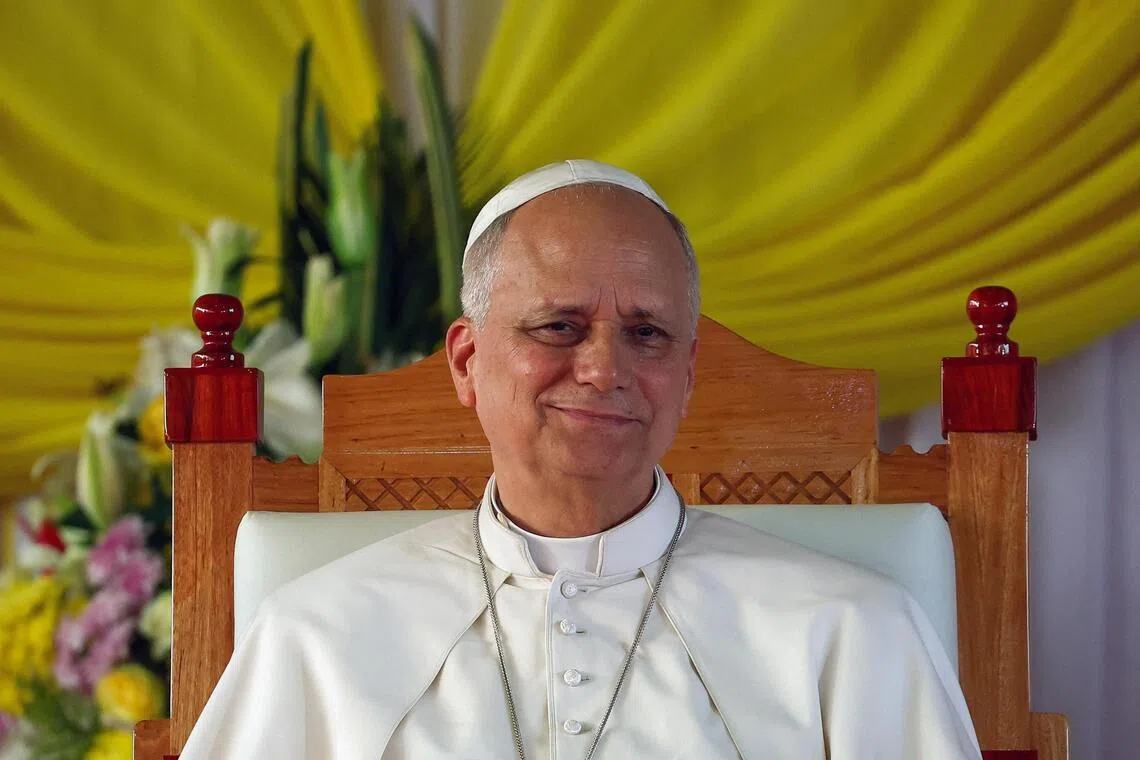
BAMENDA, Cameroon – For months after his election last year, Pope Leo XIV often seemed quiet on sensitive issues, speaking carefully to soothe tensions both within the Catholic world and with global leaders beyond it.
This was the week he found his voice.
On April 13, Pope Leo unexpectedly addressed the Trump administration head-on after weeks of avoiding direct confrontation. Since early March, the Pope had been criticising the US-Israeli war in Iran without mentioning President Donald Trump by name.
On April 15, in Cameroon, Pope Leo – standing next to Mr Paul Biya, Cameroon’s authoritarian president and the world’s oldest and longest serving leader – called on authorities to abandon an “idolatrous thirst for profit”.
On April 16, the Pope made perhaps his most full-throated exhortation yet.
In what seemed like an allusion to American efforts to use Christianity to justify the Iran war, he expressed “woe to those who manipulate religion and the very name of God for their own military, economic and political gain, dragging that which is sacred into darkness and filth”.
After days of barbs from Mr Trump and Vice-President J.D. Vance, Pope Leo was not backing down.
It has been a watershed week for a pope who started his papacy in May 2025 facing constant comparisons with his predecessor, Pope Francis, the freewheeling pontiff whose revolutionary style and urge to shake up sacred rituals divided followers and earned him derision from conservative Catholics, particularly in the United States.
Pope Leo, by contrast, has a mild-mannered temperament.
Until recently, he tended to deliver sober speeches rooted in scripture and careful nuance to avoid confrontational language.He wore traditional vestments and spoke Latin during Mass, both moves that diverged from Pope Francis and pleased conservatives.
From the very beginning of his papacy, he spoke about unity within the Catholic Church, appearing to want to calm the church and draw conservatives back to the papal fold.
And though he stood up for migrants and criticised US attacks on Venezuela, he took a cautious tone while doing so, and tended to stick to scripted remarks.
Some followers even hinted that he was, well, a bit boring.
But that perception may be what allowed the Pope to strike a more powerful tone now.
Early on, Pope Leo was “taking care not to be perceived as simply Francis 2.0, or as somebody who would neatly be pigeonholed” into partisan political categories, said Dr Nicholas Hayes-Mota, an expert on theological ethics at Santa Clara University, a Catholic institution in California.
“I think that was really important to him and very prudent, frankly,” Dr Hayes-Mota said. “And so I think part of what’s allowing him to be more outspoken now is that he took his time.”
US President Donald Trump’s antagonism has forced Pope Leo XIV to take a different tone, analysts say.
PHOTO: AFP
The Pope’s comments came after a tumultuous period in which the Vatican found itself playing defence through several swirling news cycles.
After Defence Secretary Pete Hegseth called on the American people to pray for victory in Iran “in the name of Jesus Christ”, the Pope said in a Sunday homily that Jesus “does not listen to the prayers of those who wage war, but rejects them”.
Pope Leo later told Americans to call their representatives in Congress to protest the war.
An unsubstantiated report then emerged that Pentagon officials conveyed a menacing message to a Vatican official. The Vatican and the US government acknowledged that a meeting occurred in January but denied any hostility.
Then on April 12, three influential American cardinals appeared on “60 Minutes” and criticised various Trump administration policies, with one saying that the Iran conflict was “not a just war”.
Hours later, Mr Trump delivered a long screed against Pope Leo on Truth Social, the president’s social media platform, calling him “terrible for foreign policy” and “catering to the Radical Left”.
Until then, Pope Leo had been careful not to confront Mr Trump directly.
But on April 13, Pope Leo seemed to have had enough of prudence.
Speaking with unusual spontaneity to journalists while flying to Africa on April 13, he said that he had “no fear” of the Trump administration, and that he would “continue to speak out loudly against war”.
When asked about Mr Trump’s remarks on Truth Social, he said the site’s name was “ironic”.
The reason for the Pope’s shift is still unclear, but some analysts say the Pope felt he had no choice but to adopt a more direct approach.
Mr Christopher White, a senior fellow at the Georgetown Initiative on Catholic Social Thought and Public Life, said the Pope likely decided he was “going to be the adult in the room”.
“Leo wasn’t looking for a fight,” Mr White added. “One of the reasons he found his voice is out of necessity.”
Some wondered if the Pope, by ratcheting up his rhetoric, would start to alienate the conservatives who have so far supported him.
But the antagonism of the Trump administration may give Pope Leo more leeway, said Dr Hayes-Mota, the Santa Clara academic.
“I think the fact that the administration has reacted in the way it has, that Trump went directly on the attack, has actually helped rather than hindered the Pope’s cause,” Dr Hayes-Mota said. “It makes it look as if the president is the one trying to drag the Pope into the mud.”
The Pope, Dr Hayes-Mota added, “is really representing something else, a kind of higher moral authority”.
The Pope has not limited his pointed language to the United States.
On April 13 in Algeria, which is led by an authoritarian government, Pope Leo told those “who hold positions of authority” that they should “promote a vibrant, dynamic and free civil society”.
Then in an address to Biya in the Cameroonian capital on April 15, the Pope said, quoting St Augustine, that “those who rule serve those whom they seem to command”.

Standing next to Cameroon’s authoritarian leader Paul Biya, Pope Leo XIV said “those who rule serve those whom they seem to command”.
PHOTO: AFP
A day later, the Pope visited north-west Cameroon, a region wracked by conflict between English-speaking separatists and the Francophone government’s military over the last decade. Praising local peacemakers, he lamented how the world had been “ravaged by a handful of tyrants.”
Local Bishop Aloysius Abangalo Fondong said he was not surprised by Pope Leo’s words.
“He’s not a politician, he’s the pastor of the church, the vicar of Christ in the world,” Bishop Fondong said. “And as the Holy Father said, he’s not afraid to speak the truth.”
Yet, some Catholics fear the Pope’s more robust talk will do little to propel change.
“I fear that it may not have reached leaders who are genuinely open to its call,” said the Reverend Ludovic Lado, a Jesuit priest and academic from Cameroon. NYTIMES