

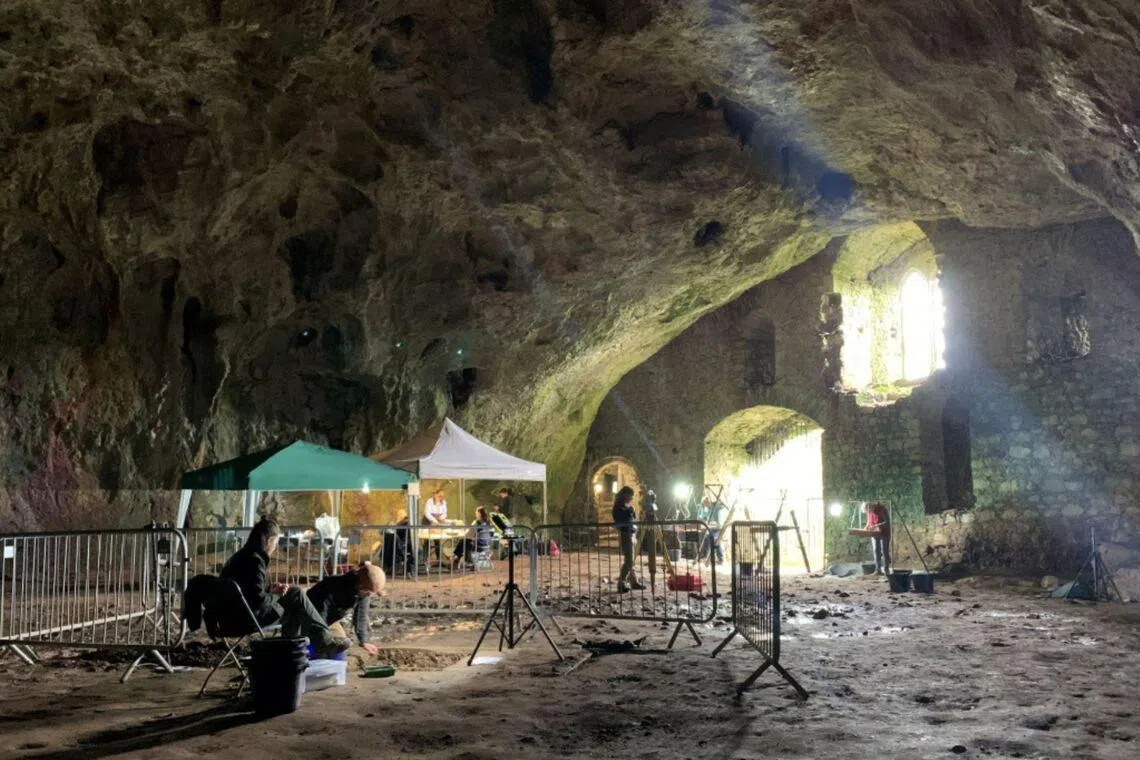
LONDON – A prehistoric hidden cave and hippo bones found beneath a Welsh castle could transform understanding of ancient life in Britain, researchers said on April 16, calling the site a “once-in-a-lifetime discovery”.
Previous small-scale excavations at Pembroke Castle have already uncovered evidence of early humans and animals, including a now extinct hippopotamus that roamed Wales 120,000 years ago.
A major five-year archaeological project led by the University of Aberdeen will investigate the “enormous” cave, accessed via a spiral staircase from the 11th century castle.
“There is no other site like it in Britain – it is a once‑in‑a‑lifetime discovery,” said Dr Rob Dinnis, who will lead the project.
The cave, previously thought to have been emptied by the Victorians, is now described as “one of the most important prehistoric archives in Britain”.
“Despite the limited work done so far, we can already say that Wogan Cavern is a truly remarkable site,” Dr Dinnis said in a statement.
“Not only is there extremely rare evidence for early Homo sapiens, there are also hints at even earlier human occupation, probably by Neanderthals.”
“We have also found hippo bones, which probably date to the last interglacial period, around 120,000 years ago,” he added.
Earlier finds have revealed bones of mammoth, woolly rhinoceros, reindeer and wild horse, alongside stone tools and evidence of human occupation across multiple periods.
With larger-scale excavation due to resume in May, the researchers hope to gain “insights into past climate change, extinct species and the multiple periods when humans called the cave their home”.
They said the site could chart a long sequence of human activity, from hunter-gatherers after the last Ice Age around 11,500 years ago to some of Britain’s earliest Homo sapiens between 45,000 and 35,000 years ago, and possibly even earlier Neanderthal presence.
“Wogan Cavern provides a unique chance to use all the scientific techniques now available to archaeologists,” said Professor Kate Britton of the University of Aberdeen.
“Because the bones are well preserved, we can learn a lot about past environments and ecosystems,” she added.
The cave, previously thought to have been emptied by the Victorians, is now described as “one of the most important prehistoric archives in Britain”.
PHOTO: UNIVERSITY OF ABERDEEN
At Pembroke Castle, staff say the discovery adds a new dimension to the site’s long history as a medieval fortress and birthplace of Henry VII in 1457.
“This is incredibly exciting news for everyone at the castle,” said castle manager Jon Williams.
“We are thrilled that work on this wonderful cave will continue.” AFP