

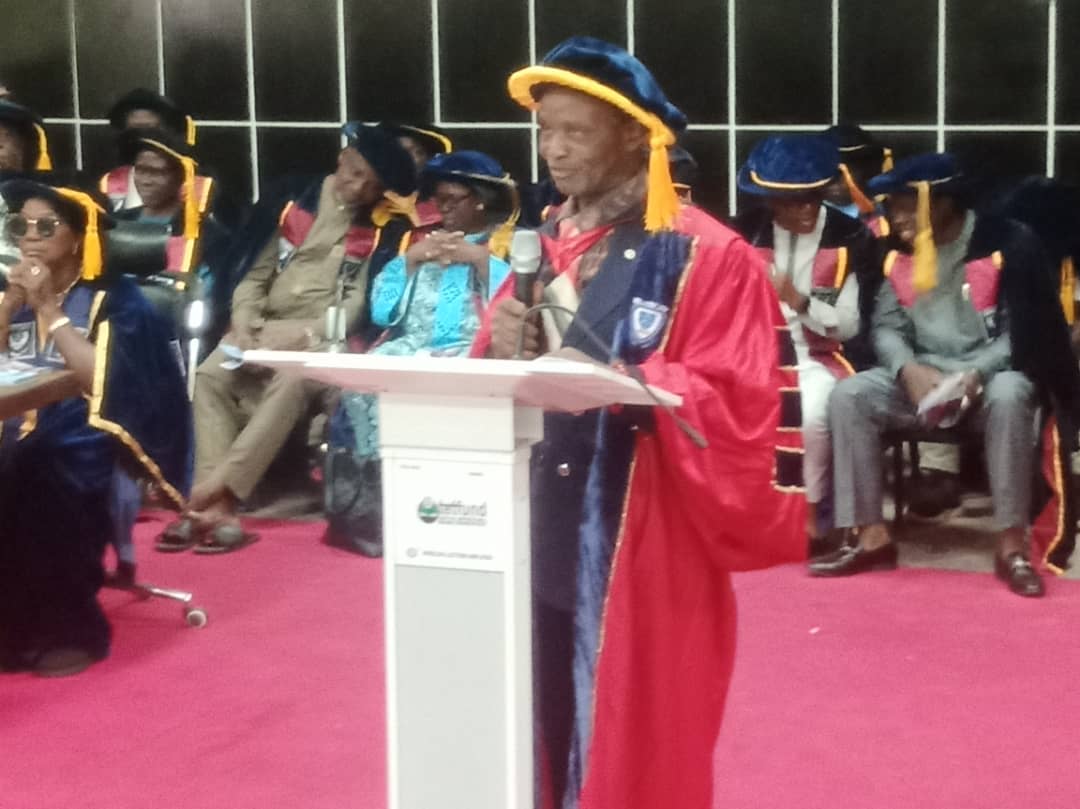

A Professor of Political Science at Federal University Lokoja, Ebenezer Ejalonibu Lawal, has attributed Nigeria’s development challenges to poor governance and weak institutional frameworks rather than a lack of policy ideas.
Professor Lawal stated this on Wednesday while delivering the 41st inaugural lecture series of the university at its Felele campus in Lokoja, Kogi state.
The lecture, titled “Paradox and Problems of Development: The Pedestal and Pragmatic of a Political Scientist,” examined the contradictions between Nigeria’s numerous development plans and the persistent underdevelopment across key sectors.
According to the scholar, Nigeria has demonstrated “remarkable talent for policy articulation” through various development blueprints, reform agendas, and strategic visions over the years.
He however, noted that these initiatives often fail due to inadequate governance, explaining that the challenge is not that policies are poorly conceived, but that they are “badly executed, unevenly enforced, and frequently thwarted by powerful interests.”
Professor Lawal further highlighted the issue of limited institutional autonomy, stressing that many public and regulatory institutions, including anti-corruption agencies, operate more as symbolic entities than effective bodies.
“In reality, institutional weaknesses, resource constraints, and political interference undermine their effectiveness,” he said, warning that without genuine autonomy supported by legal protections and political will, the promise of institutional reform would remain unfulfilled.
The university don also decried the persistent underfunding of critical social sectors such as education, healthcare, and social protection, describing them as the foundation of sustainable development.
He observed that inconsistent policies and poor implementation have continued to fuel poverty, inequality, and underdevelopment.
Addressing another dimension of the development crisis, Professor Lawal pointed to the dominance of elite interests in policy decisions, arguing that the concentration of political and economic power in the hands of a few often leads to the prioritisation of private gains over public welfare.
“This erodes public trust in government institutions and distorts resource allocation, replacing the logic of development with the logic of patronage,” he added.
To address these challenges, the Professor called for a comprehensive recalibration of Nigeria’s development approach, beginning with strong institutional reforms.
He emphasised the need to strengthen institutions both in structure and function, while promoting accountability, transparency, and adherence to the rule of law.
He also advocated for aligning development strategies with national priorities and ensuring that policy decisions reflect the collective interest of citizens rather than sectional considerations.
Professor Lawal stressed the importance of empowering citizens to hold leaders accountable, noting that sustainable progress requires a shift from patronage-based politics to performance-driven governance.
He concluded that meaningful development in Nigeria would depend not only on sound policies but on the political will to implement them effectively and in the interest of the broader society.
Earlier, the Vice-Chancellor of the institution, Professor Gbenga Solomon Ibileye in his welcome address underscored the importance of balancing theory and practice in political science, describing it as a lifelong discipline that demands both intellectual clarity and real-world engagement.
Professor Ibileye expressed delight at presiding over the inaugural lecture of a political scientist, drawing parallels between his own field of pragmatics and discourse analysis and the practical realities of politics.
He explained that pragmatics, as a branch of linguistics, focuses on meaning in context, what is said, what is meant, and the gap that often exists between the two, adding that politics operates within similar interpretive boundaries, though with different outcomes.
The Vice-Chancellor described the lecture topic, “The Pedestal and Pragmatics of a Political Scientist,” delivered by Professor Ebenezer Ejalonibu Lawal, as a thoughtful blend of theory and practice.
According to him, the concept of the “pedestal” reflects the elevation of theory and intellectual distance, while “pragmatics” represents the realities on the ground where decisions are made and their consequences felt.
“To hold both at once; to stand high enough to see clearly, and close enough to matter, is the discipline of a lifetime,” he said, noting that the choice of topic reflects Professor Lawal’s ability to navigate both scholarly analysis and real-world relevance.
Professor Ibileye commended the inaugural lecturer for a career that, in his words, neither floats above societal realities nor becomes overwhelmed by them, but instead reflects the essence of impactful scholarship.
The Vice-Chancellor congratulated Professor Lawal on attaining the milestone of delivering an inaugural lecture, formally inviting him to take the lectern as the university community looked forward to an engaging and insightful presentation.