

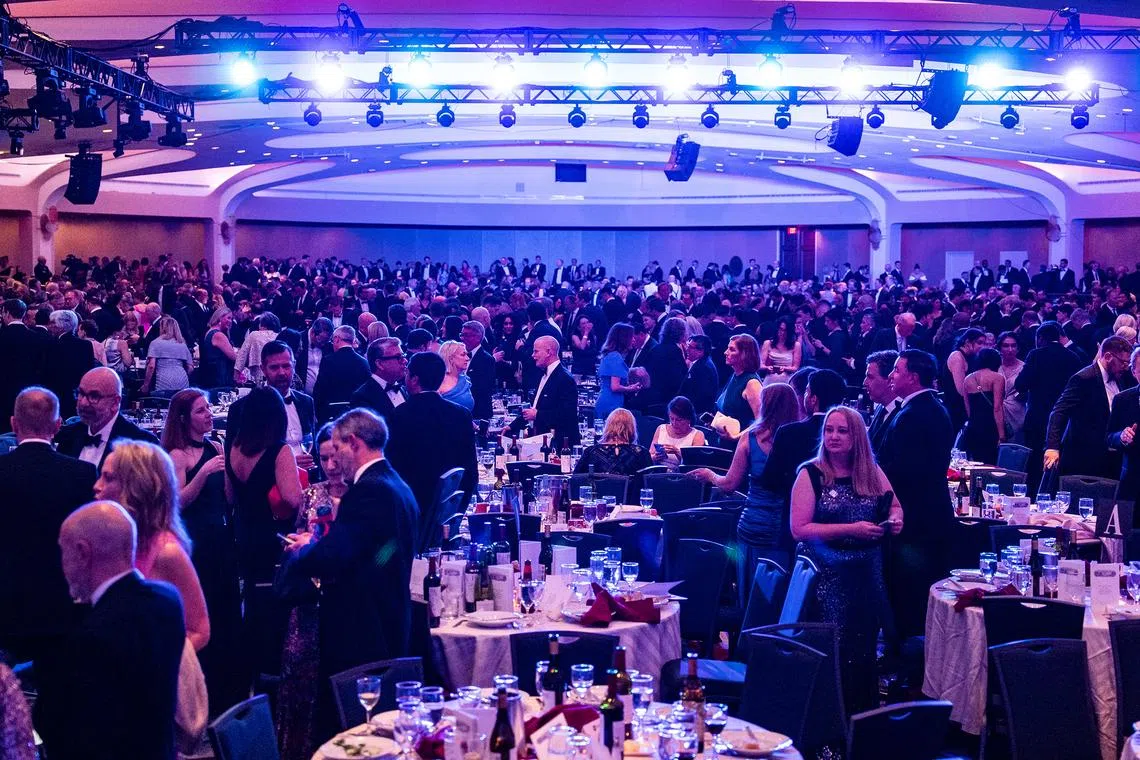
WASHINGTON – Amid the professional-grade networking at Ms Tammy Haddad’s Garden Brunch in Georgetown on April 25, hours before the kick-off of the White House Correspondents’ Association dinner, a television anchor was joking about how savage US President Donald Trump might be towards the news media in his speech later that night.
“Twenty-four hours from now,” the anchor said, gesturing at the crowded room of revellers, “we’re going to be thinking about how quaint all this seemed”.
That prophecy came to pass, just not in a way that anybody expected.
The violent apprehension of a gunman who rushed the Washington Hilton ballroom, forcing the evacuation of Mr Trump and senior administration officials and frightening the hundreds of media grandees in attendance, threw a wrench into a weekend whose stakes rarely stretch beyond which cabinet secretary is sitting with which cable news channel.
At after-parties held on April 26, as hungover journalists and network executives sipped on green juice and mimosas, the conversation often turned to behind-the-scenes details from a shocking night before.
Had anyone heard about the TV producer who, failing to find a cab outside the security-swarmed Hilton, hoofed it 2.4km to the White House in time for Mr Trump’s late-night press briefing? Or that the CBS reporter Ms Weijia Jiang, the president of the Correspondents’ Association who was widely praised for her composure during the chaos, rode back to the White House in Mr Trump’s motorcade? She had been seated directly next to Mr Trump on the dais when the incident began.
There was hand wringing about the evening’s security measures – were those magnetometers enough? – and a notable uptick in patience as partygoers queued up for security lines at elegant venues like the British ambassador’s residence, which hosted a bash put on by CNN.
The future of the dinner itself also seemed in question. Was it yet another Washington institution that may not escape the Trump era intact? The subterranean Hilton ballroom, notorious for its lack of cellphone service, has hosted the dinner since 1968, and Mr Trump said he wanted to relocate the event to the ballroom he is building at the White House.
The president also indicated a desire to reschedule this year’s event within a few weeks’ time, but an unscientific survey of journalists at the receptions on April 26 suggested a lack of interest. The shock and fear from the previous day’s violent disruption had not fully worn off.
“I know many of us are still processing what happened last night; I know I am,” Ms Jiang wrote in a note on April 26 to the White House press corps.
“We never want to be the story, but sometimes that’s not our choice to make.”
The Correspondents’ Association itself said that its board would meet soon to “determine how to proceed” with this year’s aborted event.
In a speech at CNN’s brunch, the network’s chairman, Mr Mark Thompson, described the reaction in the ballroom as “a moment of solidarity and mutual respect between a wide diversity of politicians and people of strong political beliefs, a very wide spread of media.”
“We were all in it together in a way that I thought was encouraging about public life and public discourse in this country,” said Mr Thompson, who is also a former chief executive of The New York Times.
Even Mr Trump suggested on April 26 that, for a few minutes at least, he had been prepared to soften his stance towards the press.
“I was going to really rip it,” he said in an interview with Ms Jacqui Heinrich, a Fox News correspondent, referring to his planned comedic remarks.
The president said that in the aftermath of the shooting, he had considered returning to the stage and delivering a “much different” speech, “a speech of love”.
“But,” Mr Trump quickly added, “I didn’t get a chance to do that. Probably, I was better off if I didn’t.” NYTIMES