

They came in waves of grief. Widows draped in black and multicoloured flowing gowns, their faces hollowed by sleepless nights. Children clutching photographs of fathers they would never see again. Relatives leaning on frail limbs, walking slowly as if each step might undo the reality they had come to face.
From distant states and quiet towns, they came, filing into Maimalari Cantonment Cemetery in Maiduguri, Borno State, on Wednesday, April 15,2026. They were not there for the ceremony. They came to witness the earth receive their husbands, their breadwinners.
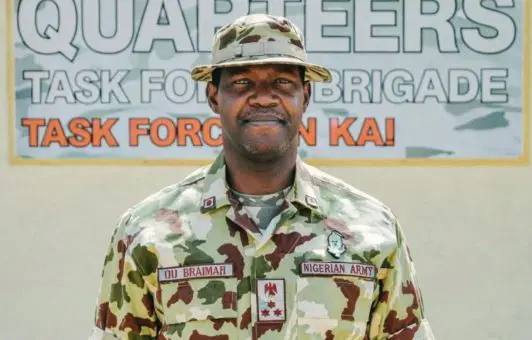
The Borno sun blazed overhead, but it could not match the heat of grief hanging over the ground. Beneath that sky, Brigadier General Oseni Braimah, Captain Azubuike Esimai, and other soldiers killed in the April 9 insurgent attack at Benisheikh , were laid to rest with full military honours. The attack on the Maiduguri–Damaturu highway, carried out by suspected Boko Haram fighters, had already been reduced to numbers. But here, the numbers had names, had faces, and had families left in pieces.
We just stood there
For the widows of the late Brigadier General , the Captain and other soldiers gathered, the ceremony was not just a farewell; it was an ending that came too sudden.
“We just stood there, watching them lower him into the ground. It didn’t feel real,” one of the relatives said, his voice low and distant.
Around him, grief unfolded in different forms. Some children clung tightly to their mothers, searching their faces for reassurance that would never come. Others stared blankly at the freshly turned earth, as if willing it to return what had been taken.
Consoling voices
But from the podium, another voice tried to fill the silence left by the falling earth. Chief of Defence Staff, General Olufemi Oluyede, called the fallen brave men who had defied courage, sacrifice, and commitment to duty. He said: “These men answered the call of patriotism and their loss only strengthens our determination to bring an end to terrorism.”
Beside him, the Minister of Defence, Christopher Musa, offered a more personal ache. “The Nigerian Army has lost a Commander. Nigeria has lost a patriot,” he said, turning to the widows and children. “Your grief is our grief. Your loss is a nation’s loss. No words I speak today can fill the void left by your husband, your father, or your son.”
And then came the Governor of Borno State, Babagana Zulum, who acknowledged a troubling pattern. He said “Recently, the insurgents have adopted the trend of killing commanding officers. It is a deliberate attempt to demoralise the officers and men in the field. We shall do everything to reverse the trend. Inshallah, the worst is over.”
Denied request
But for the bereaved family members who had watched their breadwinners disappear beneath the Borno soil, the speeches could not mask what the families already knew. They had made a simple, human request: to bury their dead in Abuja, where their immediate families could lay wreaths every year. The military refused, insisting it must be Maiduguri. They were told it was against Army policy.
Army’s position as gathered, was rooted in past experience, when fallen soldiers once taken to their hometowns had sparked anger, even violence, among grieving communities. Since then, those who died in an active theatre of war are buried in the nearest military cemetery.
But the policy, for the grieving, offered little comfort.As one of them said, “The burial has taken place in Maiduguri. What can we do?”
Unanswered questions
Beyond the turned down request, a growing number of troubling questions are arising about the killing of the fallen heroes.
Sources who spoke on condition of anonymity, described the incident as a deep betrayal and called for a thorough investigation.
According to source, “The Brigade Commander had three battalions under his command, each with between 800 and 1,000 troops, giving him no fewer than 2,500 men. Including headquarters staff of up to 300 personnel, the commander was responsible for roughly 3,000 soldiers.
Sponsored
“Why would attackers come to a unit, kill two officers and two soldiers , one of them a Brigade Commander, the other a Captain and yet no Colonel, Lieutenant Colonel, Major, or other Captain was killed?” the source asked.
Continuing, the source said: “Where were the Colonels under him? Where were the Lieutenant Colonels? Where were the Majors? Where were the other Captains? Then we come to the senior NCOs ,no senior NCO died, apart from the Imam who had come to join a meeting for something.
“And where were the soldiers? For them to take down their Brigade Commander, where were the other people?”
Claims of intact perimeter
Family sources also cast doubt on official accounts of the incident, pointing to the condition of the base’s infrastructure. The source added that the commander’s clothing and personal effects brought from Benisheikh to Maiduguri were found neatly arranged.
Regarding statements that the terrorists “retracted” after being confronted, the source was skeptical. “They said they fought the terrorists and that the terrorists retracted. How many did they kill to make them retract? That means those people came there and had a free day because they met very few hands to resist them. They finished off the few hands and carried on. Did they bring out any terrorists they killed?
“Again, there was no sign of the base’s gate or walls being destroyed to indicate they forced their way in. The fence was intact. Those who went to
Benisheikh to bring his things said the place was intact. It meant the Brigade Commander did not stay in his room. He came out to fight, but his men betrayed him.”
Also raising questions on reports that the late Brigadier Commander attempted to move the armoured car, sources asked: “First of all, someone is supposed to be manning that armoured truck. Where was the person and where is he now? It is not the Commander who ought to man the truck,” the source emphasized. “We have heard different stories. But the more you hear, the angrier you become.”
Three years on the same ground
The questions did not end there. A relative of one of the fallen soldiers said his brother had stayed in Maiduguri for three years.
He said, “My brother had stayed there for three years without being deployed. We got to know from other soldiers that the rule is one year. After one year, they are supposed to rotate them. But if you don’t have anybody to speak for you, you just remain there.”
In a war where terrain, fatigue, and familiarity shape survival, such lapses, he suggested, could prove costly.
Issues also raised by some soldiers still in Borno State bothered on regional representation and military command decisions.
Saturday Vanguard learned that the slain Brigade Commander had returned from Pakistan, where he served as Defence Attaché. He was deployed to Port Harcourt, where he served only three months before being moved to Maiduguri, Borno State. He was reportedly getting ready to move to the Ministry of Defence, where he had been redeployed, when bloody terrorists struck.
Beyond the gun salute
With the graves now sealed and the final prayers said, the silence that followed felt heavier than the gun salute that pierced the sky. What remains is not just loss, but a lingering ache of unanswered questions about duty, leadership, and the cost borne by those left behind. For the widows, children, and families who have since departed the cemetery, grief has not ended with the burial; it has followed them home, settling into empty rooms and unfinished conversations.
And as the nation counts its fallen ones, those closest to them are left with a deeper reckoning, seeking not only closure, but also the political will to decisively fight the war against terrorism, for only then can the labour of these fallen heroes truly be paid.
.....