

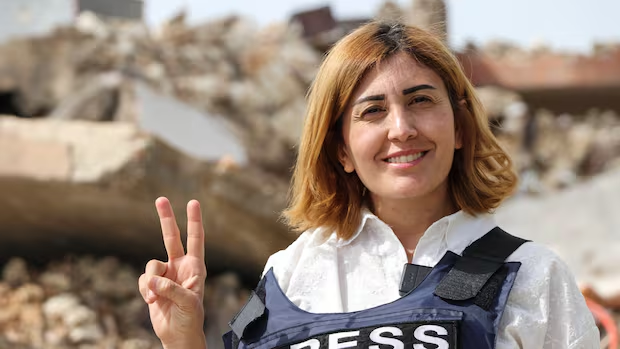
As mourners carried slain Lebanese journalist Amal Khalil’s flag-draped casket during her funeral procession on Thursday, they experienced a wave of different emotions, says one attendee.
Khalil, who was killed Wednesday in an Israeli strike in the south of Lebanon, was laid to rest last week in the village of Baysariyeh.
“It was a really sad day, but it was full of pride — and of anger,” Roaa Kassem, Khalil’s colleague at the Lebanese newspaper Al-Akhbar, told As It Happens host Nil Köksal.
Sadness, she says, because Khalil was a kind-hearted person, beloved by her colleagues and those whose stories she told.
Pride, because Khalil never backed down, even in the face of danger and death threats.
And anger, because Kassem and her colleagues say they believe Israel intentionally targeted Khalil, then obstructed first-responders from reaching her in time to save her life.
Israel denies targeting the journalist or blocking medical aid, and says the strike is under review.
As It Happens6:47Colleague describes slain Lebanese journalist Amal Khalil as kind and passionate
Kassem says Khalil and freelance photojournalist Zeinab Faraj were driving behind another vehicle in the village of al-Tiri, about eight kilometres from Lebanon’s border with Israel, when an Israeli strike hit the car in front of them, killing both men inside, who Kassem described as a relative of Faraj’s and the mayor of a nearby village.
It was just five days after a fragile truce was implemented between Israel and Lebanon.
The two journalists pulled over, got out of the car and hunkered down on the side of the road. A drone remained in the sky overhead.
Kassem says that’s when she and colleagues connected with Khalil through a work group chat at about 2:47 p.m. local time. Khalil assured them that she was fine, and their car hadn’t been hit.
“We thought that it was over,” Kassem said.
Faraj spoke to The Associated Press on Friday from her hospital bed in Beirut, where she was recovering from her injuries.
She said she and Khalil remained on the side of the road for about an hour, until a second strike hit Khalil’s car next to them. They then took refuge in a shop nearby after wresting open the metal shutter.
“Amal was crawling, she was wounded — her nose and head and shoulder and leg,” Faraj said, speaking with difficulty as her face was swollen and bruised.
After a while, Faraj says, she began to drift off, and she remembers hearing Khalil say to her: “Zeinab, don’t leave me alone.”
She says she was half asleep when she heard the sound of a missile falling. A third strike hit the building where the two journalists were sheltering at about 4:27 p.m.
Faraj was thrown out of the shop by the impact, but Khalil was trapped inside.

While all this was going on, Kassem says first responders from the Lebanese Civil Defence were in contact with the Israeli military, trying to secure safe passage to rescue the journalists.
Officials say the Lebanese Red Cross, the Lebanese army and the UN peacekeeping force known as UNIFIL were all sending a flurry of messages back and forth trying to co-ordinate a rescue mission.
A rescue team arrived and was able to pull Faraj out of the rubble and retrieve the bodies of the two people killed in the strike on the first car.
But Lebanon’s Health Ministry said in a statement that the Israeli military opened fire on the Red Cross ambulance that arrived to rescue Khalil, forcing it to turn back.
By the time they got clearance to return for Khalil, Kassem says it was after 10 p.m. and Khalil was dead. They pulled her body from the rubble.
Faraj said she believes “if they had gotten to her a bit sooner, Amal would be here today.”
Allegations of war crimes
Lebanese Prime Minister Nawaf Salam accused Israel of war crimes in relation to Wednesday’s strikes.
“The targeting of media workers in the south while they carry out their professional duties is no longer isolated incidents, but has become an established approach that we condemn and reject, as do all international laws and conventions,” he wrote in a post on X.
Despite the killings escalating tensions in the region, the ceasefire was extended on Friday for three more weeks.

Lebanese officials say Israel intentionally targeted journalist Amal Khalil in a deadly strike, as well as blocking ambulances that went to help her. Israel says it fired on vehicles that crossed its forward defence line inside Lebanon. Negotiations between Lebanon are Israel are set to take place in Washington on Thursday.
The Israeli military said the Israeli air force troops struck a vehicle and a structure after two vehicles in southern Lebanon were identified as leaving a Hezbollah military site and crossed the Forward Defence Line — also known as the yellow line — which it said posed an immediate threat.
The army said it received reports that two journalists were injured, but said it did not prevent rescue teams from reaching the area. The army does not deliberately target journalists or medical teams, it said.
Lebanon’s Information Ministry says nine journalists and 100 health-care workers are among the nearly 2,500 people who have been killed in Israeli strikes since March 2.
The Committee to Protect Journalists estimates 264 journalists and media workers are among the tens of thousands of people who have been killed in Gaza, Yemen, Lebanon, Israel and Iran since Oct. 7, 2023. The World Health Organization estimates there were 735 Israeli attacks on health-care facilities in Gaza between Oct. 7, 2023, and June 11, 2025.
Khalil described as brave and kind
Kassem says she doesn’t know anything about the alleged Hezbollah site Israel referred to.
“We even don’t know where are the borders of this assumed yellow line,” she said. “I don’t think that when someone crosses the line, the first thing to do is to bomb them.”
Khalil had said publicly she had received threatening messages from an Israeli number during her coverage of the previous Israel-Hezbollah war in 2024. The Israeli army did not immediately respond to a request for comment.
Kassem says the paper also received threats on her behalf.
“We, as her colleagues, as the newspaper, her friends, her family, everyone asked Amal to maybe stop a bit for some time, or be more cautious, or report from the villages … that are not directly on the border,” she said.
“But Amal didn’t want that. She wanted to transmit the photo and the image completely as it is from those places.”
Kassem described her colleague as a kind person, who was almost always smiling, and was deeply passionate about her job.
She always helped reporters who visited southern Lebanon, Kassem said, and she often hosted journalists in the region at her home for meals.
On Thursday, she says, her colleagues all gathered there one last time.
“Unfortunately, it was her funeral,” Kassem said. “She was not with us there.”