
At least 4 killed in Israeli strikes on south Lebanon, state media says, ahead of scheduled talks

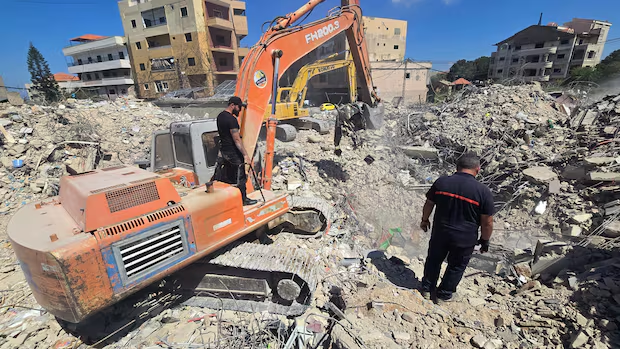
Israeli strikes killed at least four people in southern Lebanon on Wednesday, Lebanon’s state news agency reported, and Hezbollah said it launched an attack drone at Israeli forces in the south, straining a ceasefire between the two countries.
Lebanon’s state-run National News Agency (NNA) said an Israeli strike hit a car in al-Tiri, a village in south Lebanon, killing two people inside. An Israeli airstrike in the southern town of Yohmor killed another two people, NNA and Lebanon’s Health Ministry said.
A senior Lebanese military official said an Israeli drone also dropped a grenade on rescuers trying to lift a wounded journalist from rubble in Tayri. The Lebanese army asked the Israeli military through a U.S.-led mechanism to allow rescuers to retrieve the wounded journalist, the official said.
The Israeli military said it was not preventing rescue teams from reaching the area.
It also said it had struck one of two vehicles that had departed “from a military structure used by Hezbollah” and approached troops in “a manner that posed an immediate threat to their safety.” It said the people in the vehicles had crossed Israel’s “forward defence line” — its line of deployment in the south — and accused them of violating the ceasefire.
In a separate strike earlier on Jabbour, in the West Bekaa region some 70 kilometres from Beirut, one person was killed and another two injured, according to the state news agency.
Israel’s military denied that it had struck in that area.
Eve of new talks
On the eve of talks in Washington between the Lebanese and Israeli ambassadors, Lebanese President Joseph Aoun said Beirut would seek an extension of the 10-day, U.S.-mediated ceasefire, set to expire on Sunday.
Hostilities between Hezbollah and Israel reignited on March 2, when the Lebanese group opened fire in support of Iran.
The ceasefire in Lebanon emerged separately from Washington’s efforts to resolve its conflict with Tehran, though Iran had called for Lebanon to be included in any broader truce.
On Wednesday, the Lebanese-based Hezbollah said it fired a drone at an Israeli post in the southern village of Bayada in retaliation for Israeli violations during the ceasefire.
The war between Israel and Hezbollah has killed more than 2,000 people in Lebanon and displaced over 1.2 million others. Some who were displaced have started returning home during a 10-day ceasefire. Israel’s military is warning them not to return to southern Lebanon, where Israel is still occupying territory.
The Israeli military said Hezbollah is violating the ceasefire, adding that the Iran-backed group launched “a hostile aircraft” toward Israeli soldiers operating in the area of southern Lebanon.
The military said the aircraft was intercepted by Israel’s air force and did not cross into Israel.
One of three French soldiers who were wounded in an attack last week against peacekeepers in Lebanon died on Wednesday in France where he had been evacuated to, French President Emmanuel Macron said in a post on X.
Another soldier was killed in the attack, which was carried out by Hezbollah, Macron previously said.
In comments released by his office, Aoun said the aim of the future talks is to “fully” stop Israeli attacks, the withdrawal of Israeli troops from Lebanon, the release of Lebanese prisoners in Israel, the deployment of Lebanese troops along the border and beginning the reconstruction process.
Aoun said the support to Lebanon promised by U.S. President Donald Trump and other countries “provided us with an opportunity that we must not miss, as it may not come again.”
Lebanon seeking ceasefire extension
Lebanon’s position is that a ceasefire extension is a prerequisite for talks to move to the expanded negotiations, a Lebanese official told Reuters.
Israel’s Foreign Minister Gideon Sa’ar called on Lebanon on Wednesday to work with Israel to disarm Hezbollah.
“We don’t have any serious disagreements with Lebanon. There are a few minor border disputes that can be solved,” Sa’ar said during Independence Day remarks to Israel’s diplomatic corps.
“The obstacle to peace and normalization between the countries is one: Hezbollah,” Sa’ar said, adding that Lebanon could have “a future of sovereignty, independence and freedom from the Iranian occupation.”
Israel’s military has currently established a buffer zone stretching around 10 kilometres into southern Lebanon. It says the military-controlled zone is meant to remove the threat of short-range rockets and anti-tank missiles toward northern Israel.

Israel declared roughly 50 towns and villages in southern Lebanon as ‘no-go’ zones during a 10-day ceasefire, with the military continuing mass demolition it says is necessary to eliminate Hezbollah infrastructure. Residents say it’s Israel’s way of deepening its footprint in the region.
More than 2,400 people have been killed in Lebanon since Israel launched an offensive in response to Hezbollah’s March 2 attack, according to Lebanese authorities.
Hezbollah, which says the Lebanon ceasefire was the fruit of Iranian pressure, has condemned Beirut for seeking talks with Israel, reflecting wider splits with the government that has sought Hezbollah’s peaceful disarmament for a year.
U.S. Secretary of State Marco Rubio is set to attend Thursday’s meeting, with Lebanon represented by its ambassador to Washington, Nada Moawad, and Israel represented by its ambassador, Yechiel Leiter.
Announcing the ceasefire on Thursday, Trump said he had instructed Rubio, Vice-President JD Vance and Chairman of the Joint Chiefs of Staff Dan Caine to work with the two countries to achieve lasting peace.
Lebanon and Israel have remained in an official state of war since the establishment of Israel in 1948.
Lebanon’s most senior Shi’ite state official, Parliament Speaker Nabih Berri, is against face-to-face negotiations with Israel, saying Beirut could have negotiated indirectly.