

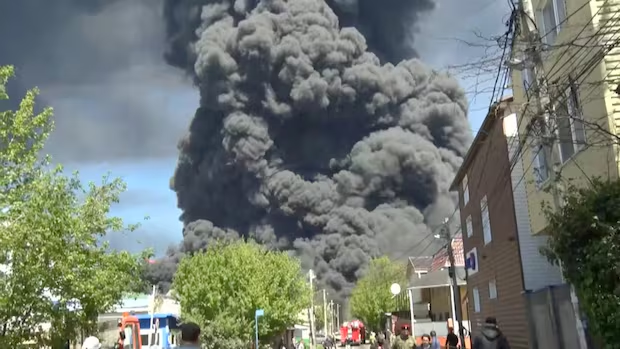
Even before Ukrainian drones struck the Tuapse oil refinery in the early hours Tuesday morning, crews were already at the site along Russia’s Black Sea coast trying to mop up oil from an earlier attack that caused an oily slick to form on the water and black rain to fall from the sky.
The refinery, which belongs to the Russian oil giant Rosneft, has been hit three times in the past two weeks.
After the latest strike, Ukraine’s special forces took to Telegram proclaiming that the country achieved a “hat trick,” while Russian President Vladimir Putin said that Kyiv was exacerbating the global energy supply crunch.
Putin ordered the country’s minister of emergencies to fly to the area to take charge of the firefighting effort. Dark, toxic smoke wafted over the area, as part of the aftermath of Ukraine’s efforts to step up attacks on Russian energy sites, including export terminals.
Ukraine has been ramping up this strategy during a period of unprecedented oil price volatility, and it has continued the strikes despite allies asking Kyiv to tone them down amid the energy crisis stemming from the Iran war.
“There is this new confidence on the part of the Ukrainians,” said Timothy Ash, an associate fellow of the Russia and Eurasia program at Chatham House, a London-based think-tank.
“It’s like the Ukrainians have figured out we’ve got economic leverage, too … this can be a game changer for us.”
A wave of drone strikes
While so much of the world has been gripped by the blockades in the Strait of Hormuz, and the dramatic increase in oil prices in the wake of the U.S. and Israel’s war against Iran, Ukraine has been trying to erode Russia’s capacity to make money off of its oil exports.
According to an analysis by Reuters, around a dozen refineries have been hit in recent weeks, along with additional ports and tankers.
Russia has been benefiting from surging prices, in part because of Washington’s decision to temporarily ease sanctions against Moscow, allowing for the sale of Russian oil and petroleum products already loaded on vessels and at sea.
Ash, who spoke to CBC News as part of a virtual panel run by Chatham House on April 21, says he believes Ukraine is pushing forward now because of Washington’s own strikes on Iran.

The effective shutdown of traffic through the Strait of Hormuz has caused the ‘biggest energy security threat in history,’ says Fatih Birol, executive director of the International Energy Agency. Ryan Cummings of the Stanford Institute for Economy Policymaking says the closure so far is the equivalent of a billion barrels of oil missing from the economy.
He says for months, the message from the U.S. to Kyiv has been to halt attacks on Russian refineries, because it could lead to a global oil supply disruption.
Now, with the International Energy Agency declaring that the conflict in the Middle East has led to the largest supply disruption in history, Ash says Ukraine is taking a “no-holds-barred” approach.
At the end of March, Ukraine’s President Volodymyr Zelenskyy said that some of its allies had asked Kyiv to reduce its attacks on Russia’s energy sector. He said that would only happen when Russia stops striking Ukraine.
Black Sea exports
The Tuapse refinery, which lies 900 kilometres southeast of Kyiv, has been closed since April 16 because drone damage to the port made it impossible to ship its oil out for export.
The refinery has a daily production capacity of 240,000 barrels, and produces naphtha, diesel, fuel oil and vacuum gasoil.

After another major refinery at Novorossiysk was heavily damaged in a drone attack earlier in April, Rosneft began diverting some of its oil supplies to Tuapse, which has now come under attack three times in April.
After the latest strike, more than 30 residents living near the refinery were evacuated to a local school, while more than 200 firefighters were deployed to fight the fire. Russian media reported that the black clouds of smoke could be seen as far away as Sochi, which lies 80 kilometres to the south along the Black Sea coast.
“We have to minimize [Russia’s] physical ability to send oil to the vessels and transport it outside of their ports,” said Oleksandr Kharchenko, the director of the Kyiv-based Energy Industry Research Center, a consulting firm which has been focused on energy security throughout the war. Kharchenko has served as an adviser to the Ukrainian government.
“Our main target here is to limit Russia’s ability to finance war.”
Global energy supply
Kharchenko, who spoke to CBC News by Zoom from Kyiv, said that Tuapse accounts for about 12 per cent of Russia’s total fuel export capacity, and while Russia will work to repair it, each successful Ukrainian strike makes it more expensive for Moscow to export its energy.
He says the strikes disrupt Russia’s export schedule and limits the number of crews willing to take on the risk of stopping at these ports.

Kharchenko says he doesn’t think Ukraine’s strategy has changed because of the global oil disruption, and says the recent successful strikes are partially due to the fact that Ukraine is now launching more drones, and has more experience around targeting.
Still, he says the energy crunch is another reason why he thinks Kyiv should dial up the pressure.
“Prices rose without our participation. It was because of the Iran war initiated by the U.S.,” said Kharchenko.
“But for Ukraine it has created additional problems because [Moscow] is getting money for the same volume of oil it exports.”