

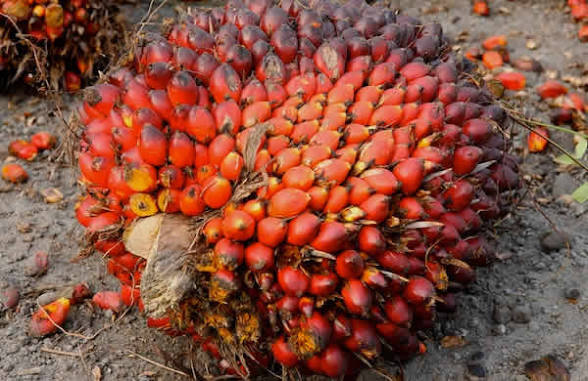

The federal government has announced a comprehensive plan to revive Nigeria’s beleaguered palm oil industry.
Up to the 1960s Nigeria was the global leader in palm oil production. Malaysian officials came to Nigeria in 1965 and collected oil palm seedlings for cultivation.
The Malaysians became so efficient in palm oil production that their streets were lined with oil palm trees. Malaysia displaced Nigeria in palm oil production.
Nigeria now imports most of its palm oil from Malaysia and Indonesia.
Announcing the revival plan recently, the Minister of Agriculture and Food Security, Abubakar Kyari, said that the plan will be implemented in two phases.
Phase one of the plan will involve the establishment of 10,000 hectares of palm plantations across participating states. The estates will integrate cultivation with modern milling and refining facilities, storage systems, logistic infrastructure and residential communities capable of accommodating 2,000 families per location.
The second phase of the programme will focus on downstream processing and manufacturing of palm-based products with emphasis on value addition and export competitiveness.
Strong domestic demand and access to regional market will ensure that investment in the programme is recovered between five and seven years.
The minister said Nigeria is blessed with 3 million hectares of land suitable for the cultivation of oil palm trees and that most of the land is underutilised.
Production in existing plantations is hampered by ageing trees and limited access to improved seedlings. The ageing trees produce grudgingly because they are at the mercy of providence. Most of the trees were not planted, they grew on their own and cannot produce like those developed from modern seedlings.
Most of the trees are so tall that harvesting their fruits pose grave dangers to the men who climb them with primitive ropes. Malaysia has developed the technology to harvest the fruits from relatively tall trees from the ground. Nigeria is light years behind in that technology.
The minister called on state governors to domesticate the new policy, facilitate access to land, mobilise the rural communities to participate in the scheme and provide infrastructure for the programme. He assured that investment in the scheme will boost the internally generated revenue of participating states and improve the standard of living of rural dwellers.
The sum of $500 million (N180 billion) will be invested in the scheme to boost palm oil production in Nigeria from 600,000 to 5 million tonnes per annum by 2027.
The scheme is to be executed in collaboration with Mass Industrial Development and Logistics Limited and other stakeholders.
The federal government will not invest money in the scheme. It will only provide policy and logistic supports. Government will therefore not borrow to invest in the public-private sector scheme.
The scheme is designed to bridge the supply gap in palm oil and other oil palm-based products. It will also stimulate agro-industrial expansion and create jobs.
Nigeria currently produces 600,000 metric tonnes of palm oil annually, but consumes 2.4 million metric tonnes of the produce annually. The shortfall between demand and supply is supplemented with massive imports from Malaysia and Indonesia.
The federal government spends $600 million annually on palm oil imports. The new initiative is designed to reverse the trend and to reposition Nigeria’s palm oil industry as a major economic driver.
“Nigeria must take deliberate steps to move from intention to implementation”, said the minister in apparent conviction that the new scheme will work and transform the nation’s palm oil industry.
The Managing Director of Mass Industrial Development and Logistics, the major collaborator in the new scheme, Mr. Emmanuel Anyaralu said the programme will transform Nigeria’s palm oil ecosystem, raise farmers income and strengthen Nigeria’s competitiveness in domestic and export markets.
The initiative will be fashioned after Calaro Oil Palm Estate in modern Cross River state. Calaro Estate was built by the colonial masters around 1955.
It sits on a stretch of land measuring 10 miles in length from Mbarakom to Uwet and five miles in width. It had the largest and most modern palm oil processing mill in West Africa.
Four camps each with capacity for accommodating 2,000 families were built around the estate. They all had running water.
Giant Bedford trucks from the fields laden with palm fruits will drive down the mill, empty their content into a hole and start a processing chain that ends up pouring palm oil into tankers at one end while palm kernels are loaded into bags at the other end.
The produce were driven to Calabar, some 40 miles from the mill and exported to Britain. Calaro Estate contributed immensely to Nigeria’s leadership position in global palm oil production.
Blueprint.ng commends the federal government for the initiative to revive palm oil production. It is our hope that the scheme will be pursued to a logical conclusion.