

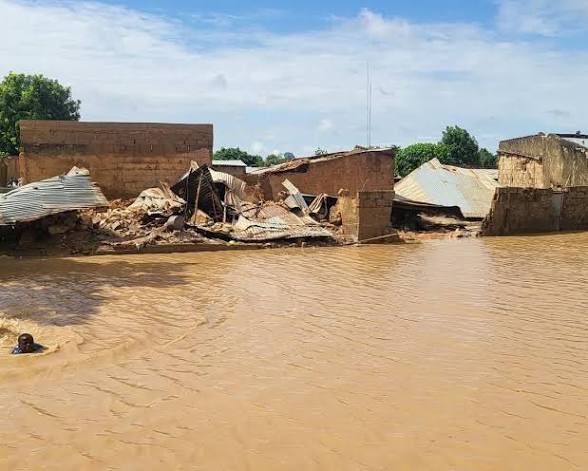

As Nigeria edges closer to the peak of the 2026 rainy season, a familiar but troubling question resurfaces: will the country once again be caught between early warnings and late responses? With fresh projections pointing to widespread vulnerability across thousands of communities nationwide, the stakes have never been higher. The challenge is no longer about the absence of forecasts, but about the nation’s readiness to translate those warnings into timely, coordinated action. In this unfolding reality, the role of the National Emergency Management Agency (NEMA) becomes not just important, but central to determining whether preparedness will finally take precedence over panic.
The 2026 Annual Flood Outlook has once again sounded a stark warning. Over 30,000 communities are at risk nationwide, with 14,118 classified as high-risk across 33 states and the Federal Capital Territory. A further 15,597 fall within moderate-risk zones, while 923 communities are considered low risk. These are not just statistics; they represent homes, livelihoods, and entire local economies that could be disrupted in a matter of days if proactive measures are not taken.
Flooding in Nigeria has evolved into a complex and recurring crisis, driven by a combination of climate variability and human factors. Increased rainfall intensity, rising water levels in major rivers, and the impact of climate change continue to heighten vulnerability. At the same time, rapid urbanisation, poor drainage systems, encroachment on waterways, and indiscriminate waste disposal worsen the situation. The result is a dangerous cycle where natural triggers meet human negligence, amplifying the scale of destruction.
Against this backdrop, the federal government has signalled a renewed commitment to strengthening emergency response systems. President Bola Ahmed Tinubu, represented by the Minister of Environment, Balarabe Lawal, has acknowledged existing challenges while reaffirming efforts to improve coordination among relevant ministries and agencies. The emphasis on faster, more effective response mechanisms reflects a growing recognition that disaster management must evolve alongside emerging risks.
At the centre of this evolving response is NEMA, which continues to play a pivotal role in coordinating preparedness and mitigation efforts. In recent years, the agency has shifted its focus from largely reactive interventions to a more proactive strategy anchored on early warning and early action. This approach recognises a critical reality: disasters may not always be prevented, but their impact can be significantly reduced with the right level of preparedness.
One of the most notable aspects of NEMA’s current strategy is the strengthening of early warning systems. Working closely with technical agencies such as the Nigerian Meteorological Agency (NiMet) and the Nigerian Hydrological Services Agency (NIHSA), NEMA ensures that flood forecasts are disseminated well ahead of peak rainfall periods. However, the real challenge lies not just in issuing warnings, but in ensuring that they translate into timely and effective action at the community level.
To bridge this gap, the agency has intensified its grassroots sensitisation campaigns. Across flood-prone states, communities are being educated on evacuation procedures, the dangers of ignoring flood alerts, and the importance of maintaining clear drainage systems. These engagements, often carried out in collaboration with state emergency management agencies and local authorities, are gradually fostering a culture of preparedness that has long been lacking.
Equally significant is the increasing emphasis on simulation exercises and inter-agency coordination. Recent flood response drills conducted in vulnerable areas have brought together security agencies, emergency responders, and community volunteers to rehearse real-life scenarios. These exercises are not merely symbolic; they serve as practical tests of response capacity, helping to identify gaps and improve coordination before disaster strikes.
Yet, despite these efforts, persistent challenges remain. Early warning information does not always reach remote or underserved communities. In some cases, residents underestimate the risks or delay evacuation until it is too late. There is also the issue of uneven commitment at the sub-national level, where some state governments have yet to fully prioritise local preparedness measures. These gaps highlight the need for a more integrated approach that goes beyond federal interventions to include stronger state and community ownership.
Mitigation, in the broader sense, must also address structural and environmental factors. The desilting of drainage systems, enforcement of urban planning regulations, and prevention of construction on floodplains are critical steps that require sustained political will. Long-term solutions such as afforestation, improved land management, and climate-resilient infrastructure must also be prioritised if Nigeria is to reduce its vulnerability to recurring floods.
Technology is another area with significant potential. Real-time data monitoring, predictive analytics, and digital communication platforms can enhance both preparedness and response. When effectively deployed, these tools can ensure that warnings are not only timely but actionable, reaching people in formats they understand and trust.
Ultimately, the story of flooding in Nigeria is not just about rising water levels; it is about the intersection of environment, governance, and public behaviour. While agencies like NEMA continue to strengthen institutional response, the role of citizens cannot be overlooked. Simple actions such as proper waste disposal, adherence to building regulations, and responsiveness to evacuation directives can collectively make a significant difference.
As the 2026 flood season unfolds, Nigeria stands at a critical crossroads. The warnings are clear, the risks are well documented, and the institutional frameworks led by NEMA are steadily improving. Yet, the real test lies beyond projections and policy statements; it rests on collective action. Preparedness must move from paper to practice, from government desks to vulnerable communities. If the lessons of previous floods are taken seriously and early actions are sustained, this year could mark a turning point in Nigeria’s disaster management story. But if complacency prevails, the consequences will once again be measured in avoidable losses. The choice, ultimately, is not in the hands of nature, but in the resolve of a nation determined to act before the waters rise.