

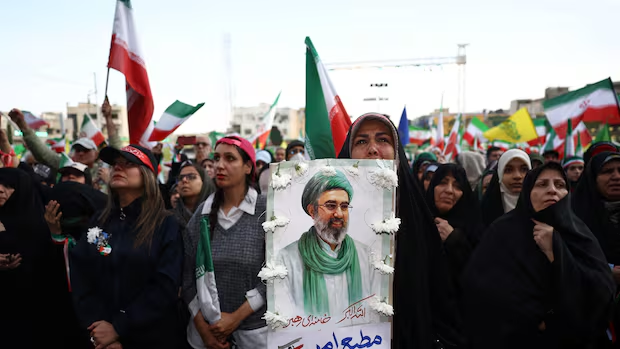
Iran said on Thursday it would respond with “long and painful strikes” on U.S. positions if Washington renewed attacks, and reasserted its control over the Strait of Hormuz, complicating U.S. plans for a coalition to reopen the waterway.
Two months into the war that started with U.S.-Israeli strikes on Iran, the vital sea channel of Hormuz remains closed, choking off 20 per cent of the world’s supplies of oil and gas, an estimated one-third of world fertilizer supply and other resources that normally transit the waters.
Global energy prices have surged as a result, leading to heightened concerns about the risks of an economic downturn.
Efforts to resolve the conflict have hit an impasse, with a ceasefire in place since April 8 but Iran still blocking the strait. The U.S. has instituted a naval blockade of Iran’s oil exports, an economic lifeline for Tehran.
U.S. Secretary of War Pete Hegseth angrily defended the White House’s Iran war strategy at a tense congressional hearing, where he also sparred with Democrats after being asked if U.S. President Donald Trump was mentally fit for the job.
U.S. President Donald Trump is slated to receive a briefing on Thursday on plans for a series of fresh military strikes on Iran to compel it to negotiate an end to the conflict, a U.S. official told Reuters.
Such options have long been part of U.S. planning but reports of the proposed briefing, first issued by news site Axios late Wednesday, initially spurred big gains in oil prices, with the benchmark Brent crude contract hitting more than $126 US a barrel at one point. It later slipped back to around $114 US.
Any U.S. attack on Iran, even if limited, will usher in “long and painful strikes” on U.S. regional positions, a senior Revolutionary Guards official said.
“We’ve seen what happened to your regional bases, we will see the same thing happen to your warships,” Aerospace Force Commander Majid Mousavi was quoted by Iranian media as saying.
Iran aims to retain control over Strait of Hormuz
Iran’s new Supreme Leader Mojtaba Khamenei said in a written message to Iranians that Tehran would eliminate “the enemies’ abuses of the waterway” under new management of the strait, indicating that the country intended to maintain its hold over it.
“Foreigners who come from thousands of kilometres away … have no place there except at the bottom of its waters,” he said.
The message also said that new management of the Strait of Hormuz would bring calm, progress and economic benefits to all Gulf nations.
“By God’s help and power, the bright future of the Persian Gulf region will be a future without America, one serving the progress, comfort and prosperity of its people,” Khamenei said.
Khamenei has succeeded his father, who was killed in a Feb. 28 airstrike. The younger Khamenei has not been seen in public since that date, reportedly injured as a result of U.S. and Israeli attacks.

The effective shutdown of traffic through the Strait of Hormuz has caused the ‘biggest energy security threat in history,’ says Fatih Birol, executive director of the International Energy Agency. Ryan Cummings of the Stanford Institute for Economy Policymaking says the closure so far is the equivalent of a billion barrels of oil missing from the economy.
UN Secretary General António Guterres warned that if the disruption caused by the closure dragged on through mid-year, global growth would fall, inflation would rise and tens of millions more people would be pushed into poverty and extreme hunger.
“The longer this vital artery is choked, the harder it will be to reverse the damage,” he told reporters in New York.
Trump faces a formal U.S. deadline on Friday to end the war or make the case to Congress for extending it. However, analysts and congressional aides said they expect him to either notify Congress that he plans a 30-day extension or simply disregard the deadline.
Front Burner26:59How the petrodollar took over the world
Another plan to be shared with Trump involves using ground forces to take over part of the Strait of Hormuz to reopen it to commercial shipping, Axios said. Trump is also considering extending the U.S. blockade on Iran or declaring a unilateral victory, officials have said.
Meanwhile, the United States is pressing ahead with plans for an international coalition to open the strait, according to a State Department cable seen by Reuters. The cable invited partner countries to join a new coalition called Maritime Freedom Construct (MFC) to enable ships to navigate the strait.
“The MFC constitutes a critical first step in the establishment of a post-conflict maritime security architecture for the Middle East,” said the cable, which was due to be delivered orally to partner nations by May 1.
France, Britain and other countries have held talks on contributing to such a coalition but said they were only willing to help open the strait when the conflict ends. Canada has participated in sessions via video, and members of Mark Carney’s government have said that Ottawa could contribute cyber and logistical support as well as de-mining expertise, in the event of a ceasefire.
Pete Hegseth, Trump’s Secretary of War, mocked those meetings last week at a Pentagon news conference as “not serious efforts.”
“I know there’s a lot of talks,” Hegseth said on April 24. “You saw the, I would call it a silly conference in Europe last week, where they got together and talked about talking about maybe doing something, eventually, when things are done.”

U.S. Secretary of War Pete Hegseth faced questions Wednesday on Capitol Hill over the costs and strategy of the ongoing war with Iran. The Pentagon revealed the cost of the ongoing war with Iran is nearing $25 billion US. Hegseth pushed back against committee members, questioning whether preventing Iran from obtaining nuclear weapons has a price tag. Alongside General Dan Caine, the secretary also defended the Pentagon’s $1.5-trillion budget request for 2027.
Trump has said Iran cannot have a nuclear weapon, while Tehran says its nuclear ambitions are peaceful. The Trump administration has given mixed messages, including Hegseth in congressional testimony on Wednesday, continuing to insist Iran’s nuclear capabilities were “obliterated” in a series of strikes in mid-2025 but that Iran’s nuclear ambitions were a critical reason for starting the latest attacks.
Khamenei’s statement Thursday said that the Islamic republic would protect its “nuclear and missile capabilities.”
Iran’s latest offer for resolving the war, suspended since April 8 under a ceasefire deal, would set aside discussion of its nuclear program until the conflict is formally ended and shipping issues resolved. The position is believed to be a non-starter for the White House.
Iran wants U.S. acknowledgment of its right to enrich uranium for what it says are peaceful, civilian purposes. It has a stockpile of about 440 kg of uranium enriched to 60 per cent, which could be used for several nuclear weapons if further enriched.