

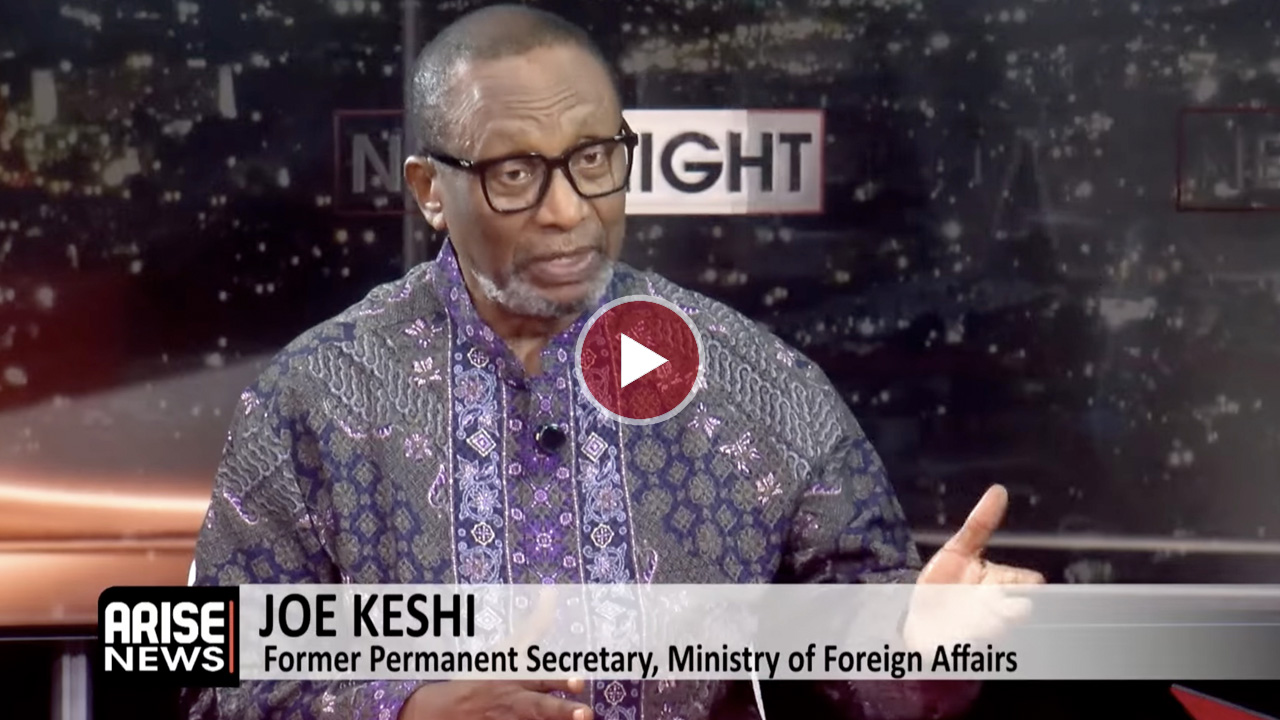
Former Permanent Secretary, Ministry of Foreign Affairs, Ambassador Joe Keshi, has described King Charles III’s upcoming visit to Washington as a significant diplomatic moment, highlighting its potential to reinforce ties between the United States and the United Kingdom.
He said this while speaking in an interview with ARISE NEWS on Monday.
“I think the most important part of that visit—we have to watch what Donald Trump says at the dinner. The statement he will make at that dinner will give us an indication if the King has managed to repair that special relationship. I think that the King is a very well-experienced asset diplomat for long, and I think he’s going to do his best to try and restore, if not all, some parts of that special relationship,” he reiterated.
On whether the conflict with Iran will feature during the visit, Ambassador Keshi noted that while King Charles III typically avoids overt political involvement, he is thoroughly briefed and unlikely to be disengaged.
“The King oftentimes does not get involved in politics, but believe it or not, the King, like his mother, is adequately briefed and prepared for this visit. Somewhere along the line, conversation about the war will come about—not in open or in a light conference, no. Maybe in the one-on-one with the President of the United States. And that’s why I said, let’s watch out for the dinner speech and for the speech to Congress what will be said.”
On the significance of the timing of the visit, Keshi described King Charles III’s presence during the United States 250th anniversary of independence as highly symbolic.
“It’s very significant, and it’s coming against the backdrop of this slight rupture in relationship and things like that. And I think it’s only fitting that the King of England would be in America to celebrate, you know, such a historic event with the people of America,” he said.
Keshi maintained that the United Kingdom remains a crucial ally to the US, regardless of present differences.
“The truth of the matter is that if post-Trump—for sure, look, Britain still remains the United States’ number one ally. And the truth of the matter is that the United States at some point in time cannot do without seeking the assistance of Britain,” he noted .
On what would define success or failure for the visit, Keshi emphasised that King Charles III’s role is largely symbolic rather than political.
“The King does not deal essentially with politics. So, it’s a symbol—the symbolism—and he’ll be received properly. Look, it’s going to be a success, let me say that by standard,” he stated.
Keshi added that the true measure of impact would lie in the tone of key speeches, particularly remarks from Donald Trump at the state dinner and the King’s own address.
“That’s why I said let’s watch out for what Donald Trump would say and what the King would say at the dinner. If it’s positive—and I want to believe that Donald Trump will at least respect the presence of the King and transmit positive to the people of Britain, if not to the Prime Minister, who does not look like Churchill. So, I just want to remain confident that it will come out well for the King and his people in Britain.l,” he said.
Speaking on the prospect of continued high-level engagement, the ambassador noted that the US and UK have recently been in contact, including discussions on NATO and the situation involving Iran.
“They talked two days ago on NATO, on Iran. I would like to see that anytime soon—the US and the UK. As long as they are talking, there’s hope,” he said.
Speaking on the recent induction of Nigeria’s ambassadors-designate, Keshi said their success abroad would depend not only on their efforts but also on conditions at home. He stressed that foreign policy is an extension of domestic policy, noting that diplomats can only project a strong national image if there is stability, order, and good governance within the country.
“It’s one thing to give the ambassadors injunction. But at the end of the day, foreign policy is an extension of domestic policy. So their ability of the ambassadors to perform well would also depend on what we do at home. It’s not just the ambassadors; we also have to support the ambassadors from what we do at home. So we need to put our own house in order, and which will encourage the ambassadors,” he explained.
He concluded that while ambassadors have a responsibility to represent the country effectively, their work must be supported by strong internal systems that make their task credible and effective on the international stage.
“I and my colleagues, we joined the service when the definition of an ambassador was somebody who goes out to lie on behalf of his country. Today, you cannot lie. Because as you are lying, folks like you are saying something else and showing us the pictures of what is happening—the true picture. So the government at home should understand as well that for the ambassadors to be successful, they need to help them by ensuring that there’s order, peace, and stability at home,” he advised.
Favour Odima
Follow us on: