

Mark Carney, who spent twice as many days abroad in his first year as prime minister than Justin Trudeau did, was in Mumbai, India, when the U.S. and Israel launched their war against the Islamic Republic of Iran on Feb. 28.
In a statement that sent a rumble of discontent through his party, he made no mention of the UN Charter he had described as a bedrock of principle Canada would defend in a landmark speech at the World Economic Forum in Davos, Switzerland, the previous month. Instead, Carney appeared to give Canada’s blessing: “Canada supports the United States acting to prevent Iran from obtaining a nuclear weapon and to prevent its regime from further threatening international peace and security.”
It was perhaps the first major test of the “values-based realism” Carney had said at Davos would guide Canada’s future international relations, making it clear the new approach would be less starry-eyed than the old.
Already in November, Carney had let it be known that eight years of branding Canada’s foreign policy as officially “feminist” was over.
“We aim to be both principled and pragmatic,” he said in Davos. “Principled in our commitment to fundamental values, sovereignty, territorial integrity, the prohibition of the use of force, except when consistent with the UN Charter, and respect for human rights, and pragmatic in recognizing that progress is often incremental, that interests diverge, that not every partner will share all of our values.”
War of choice
One of Canada’s most prominent former foreign ministers, Lloyd Axworthy, criticized Carney for his failure to condemn the U.S.-Israeli war, pointing out that the Chrétien government had opposed a similar war of choice against Iraq as a violation of the UN Charter.
Opposition to wars of choice, Axworthy argued, was both principled and pragmatic, since Iran “is the seventh country against which President Trump has ordered unilateral use of force while in office. That should be a blaring alarm for a middle power like Canada.”

Prime Minister Mark Carney called for a de-escalation of the U.S. and Israel’s war against Iran on Tuesday, adding that Canada supports efforts to end the Iranian nuclear program. Carney said that while Canada wasn’t asked to participate in the strikes on Iran, ‘it appears that these actions are inconsistent with international law.’
Liberal MP Will Greaves, a former professor of international relations, had thrown Carney’s Davos speech back at him in a video posted online that drew likes from other Liberals, saying Carney’s response to the war “felt different” than the Davos message of “independence, consistency, and principled pragmatism in our foreign policy, even when it’s uncomfortable.”
Carney initially appeared to fall in line with the war more than some European allies. Was he guilty of the behaviour he warned other nations against at Davos, where “we compete with each other to be the most accommodating”?
“That caution is sometimes hard to defend,” said former Canadian ambassador and international lawyer Sabine Nolke. “But it’s understandable. Spain can be much more outspoken because they’re speaking surrounded by 27 other European nations that will shelter them from trade retaliation.”
Nolke said she was disappointed to hear Canada’s initial responses to the U.S. and Israeli attacks on Iran, “but they backtracked pretty quickly from that and came up with a more nuanced position.”
A week after the war began, Carney said that “international law binds all belligerents.”
He said the U.S.-Israeli strikes appear to be “inconsistent with international law,” but hedged that “it’s for others more expert than me … to make that determination.”
‘Ducking and weaving not to ruffle feathers’
Axworthy is quick to recognize that Carney has to deal with a very different world than the one he faced as foreign minister in the 1990s, the golden age of the rules-based international order, when he helped establish the International Criminal Court and the Ottawa Treaty banning landmines.
“We were still working on the premise that our southern neighbour was not churlish, not stupid, not erratic and not dangerous,” he told CBC News.
Carney “was right that there is disruption going on and the institutional system has been thrown into chaos,” said Axworthy.

DAVOS SPEECH | Prime Minister Mark Carney, speaking at the World Economic Forum in Switzerland, says Canada is engaging strategically and ‘with open eyes’ as the international orders shifts, forcing middle powers to adapt as they face a ‘rupture’ in global systems.
Sovereignty, Carney said at Davos, “was once grounded in rules, but will increasingly be anchored in the ability to withstand pressure.”
But Axworthy says he sees worrying signs that Canada folds on sovereignty when that pressure comes from Washington. He cites the Canadian response to U.S. sanctions against Canadian judge Kimberly Prost, punished for merely doing her job at the International Criminal Court — a court Canada helped set up and to which it nominated Justice Prost.
While the court vigourously defended its judges, Canada demurred, saying it was up to the U.S. how it chose to interpret international law.
“That’s not true,” Axworthy told CBC News. “We’re ducking and weaving all over the place just to not ruffle the feathers.”
Bolder on trade than on war
At Davos, Carney said that “for middle powers to live the truth …. means building what we claim to believe in, rather than waiting for the old order to be restored. It means creating institutions and agreements that function as described.”
Axworthy says Canada’s stance on the persecution of Justice Prost fails on those fronts, and he sees no evidence of any group working to shore up international institutions or build support for international law.
“When the Americans started shooting up the boats in the Caribbean, it was the same thing. That was an international crime, but our response was, well, it’s up to them to determine that. No, it’s not. If you’re part of a treaty, you hold accountable.”
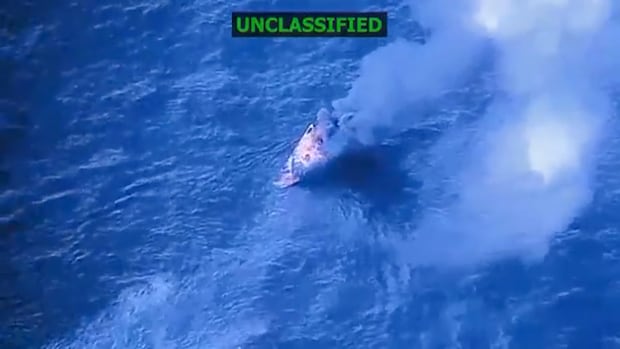
For weeks, U.S. forces have been destroying suspected drug-smuggling boats off Venezuela’s coast, leaving at least 20 people dead. For The National, Eli Glasner explains what’s behind the military campaign in the region and why some experts warn it may violate international law.
Nolke says she was encouraged when Carney seemed to realize he had made a mistake on Iran, but that he appears to be more willing to defy the U.S. in on trade matters, such as the row over provincial liquor bans, than he is in defence of international law.
“I think he’s starting to get a bit bolder, but still only in terms of trade issues and economic issues, which he knows. And he needs to protect the space of international law a bit more strongly and vocally than he currently is. It is possible without haranguing the United States. I think we could be a bit braver there.”
This month former foreign minister Chrystia Freeland lamented that the Global South had not rallied to the defence of Ukraine while she was in office. “What I heard, especially after you saw the war in Gaza, is the Global South saying ‘you know, Western friends, you’re kind of hypocritical.’ … And I think that it is a tragedy.”

At Davos, Carney acknowledged that “the story of the international rules-based order was partially false … we knew that international law applied with varying rigour depending on the identity of the accused or the victim.”
That’s the big criticism from the Global South, said Nolke, “and they’re right on that as well.”
She added that Carney’s declaration that he would arrest Israeli PM Benjamin Netanyahu, wanted for war crimes at The Hague, was a strong signal that he understands some rules have to be enforced, even when it’s tough.
The mast Carney needs to nail his colours to, said Nolke, is “the principles of the UN Charter: sovereign equality, territorial integrity, protection of human rights, non-aggression — all of those things are worth protecting in their own right. And we can do that while doing trade deals with others.”
“Just because the U.S. is trampling those things doesn’t mean we need to be quiet about it.”
Bleak military realities
Rob Huebert of the Centre for Military Security and Strategic Studies at the University of Calgary says Carney will continue to be constrained by the reality of military dependence on the United States.
If diversifying Canada’s trade away from the U.S. is complicated, freeing Canada militarily from the U.S. is all but impossible, he says.
“Our traditional friend and ally is acting very unstable,” said Huebert. “Our leadership is actually facing situations that countries like Taiwan, Poland, the Baltic states have always had to deal with.”
Russia has developed alarming new nuclear-capable weapons, said Huebert. China is rapidly expanding its nuclear arsenal after decades of being content with a more modest stockpile.

Brig.-Gen. Christopher Horner, Commander of 3 Canadian Space Division, says Canada ‘should absolutely be’ concerned about Russia’s potential capabilities as global leaders express fears the Kremlin is considering putting nuclear weapons in space.
Nuclear stockpiles, AI systems and cyber warfare have changed the global playing field, he said.
“We have to be able to have the proper deterrence against the Russians, a more limited deterrence against the Chinese. And we have to figure out how to live with the Americans when the Americans are threatening to annex us.” Like Poland in 1938, Huebert says, Canada has to fear stronger powers on both sides.
Huebert found irony in Carney’s choice of a line from Thucydides’s Melian Dialogue to begin his Davos speech: “The strong can do what they can, and the weak must suffer what they must.”
It’s a story about a weak power, the neutral island of Melos, that faced an ultimatum to join with its powerful neighbour Athens in a war against its old ally Sparta. The Melians refused, citing their honour and their bonds of obligation to Sparta.
The result, said Huebert, was “the Athenians then do exactly as they had threatened: They attack Melos, destroy it, kill all the men and enslave all the women and children.”
“So the real meaning of the Melian Dialogue,” said Huebert, “is that you can have all the principles in the world, but if you’ve got a great power beside you, you’ve got to put the people’s safety first. It’s not about having principles. In fact, it’s surrendering your principles so you can survive.”