
Astronauts on Artemis II mission splash down in Pacific Ocean after record-breaking trip around moon

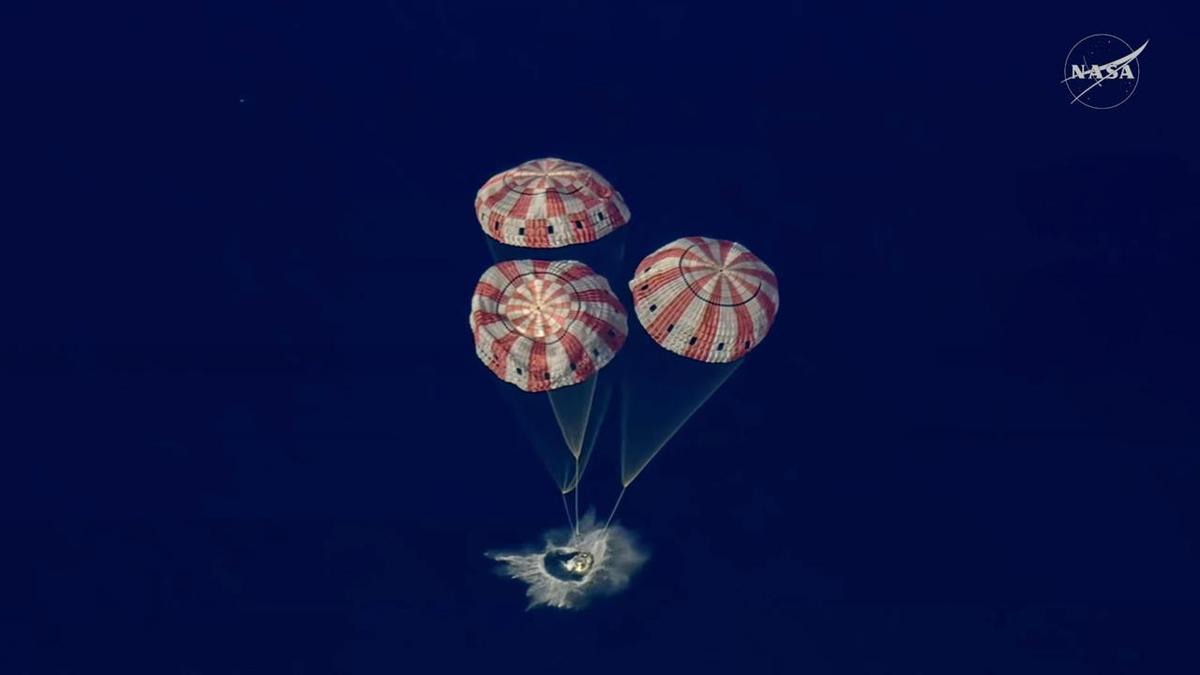
The Artemis II mission crew has splashed down in the Pacific Ocean off the coast of San Diego shortly after 8pm local time.
NASA’s flight control room erupted in applause as crew members exited the spacecraft assisted by Navy divers.
WATCH THE VIDEO ABOVE: Artemis II lands off San Diego coast
Know the news with the 7NEWS app: Download today
A US Navy ship stood by to extract the four astronauts from the Orion spacecraft to waiting helicopters.
The crew members will be returned to the Navy ship where they will undergo medical evaluations.
The Artemis II mission lasted less than 10 days but made a new record for the farthest distance ever traveled from Earth.
The crew traveled around the moon, the first to do so in more than 50 years.
The space shuttle Orion carrying American astronauts Reid Wiseman, Victor Glover, Christina Koch, and Canadian Jeremy Hansen, took off from NASA’s Kennedy Space Centre on Merritt Island in Florida nine days ago.
The crew is said to be the most diverse lunar crew ever, with the first woman, person of colour and non-US citizen aboard.
Shortly after splashdown Wiseman reported all four crew members were in good condition.
“We are stable,” he said.
“Four green crew members.”


The 32-storey-high Orion circled the Earth for about 25 hours before being catapulted several thousand kilometres beyond the moon.
The moon is about 400,000km away from Earth, with the Artemis II mission surpassing that by about 6400km.
Artemis astronauts are now the world’s most remote travellers, smashing the previous record set by Apollo 13 in 1970.


NASA said it will continue to send astronauts on increasingly difficult missions to explore more of the moon for “scientific discovery, economic benefits, and to build on our foundation for the first crewed missions to Mars”.
Launched in 2022, Artemis I was the first in a series of increasingly complex missions that will enable human exploration at the moon and future missions to Mars, NASA said.
Artemis II was a key step toward long‑term return to the moon and future missions to Mars, with an Artemis III mission scheduled for 2027.