

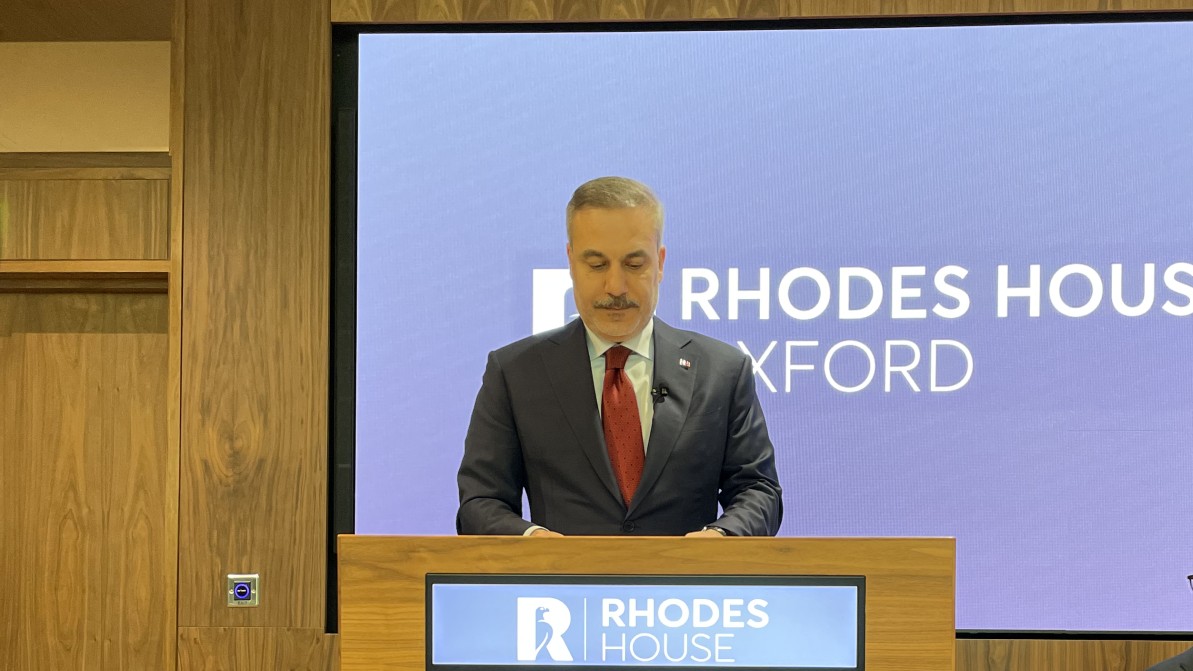
Turkey is positioning itself as a “middle power” and a key diplomatic broker in an unravelling global order, Foreign Minister Hakan Fidan said during a speech at the University of Oxford on Friday.
Speaking at an event hosted by the Global Orders Programme at the Oxford Centre for Global History, Fidan framed Ankara as uniquely placed to act as a mediator across multiple conflicts, including Gaza, Iran and Ukraine.
“States with deep strategic traditions fare better in this era of uncertainty,” Fidan said, arguing that the growing prominence of middle powers reflects structural shifts in global politics.
Fidan described such states as actors capable of operating “across competing geopolitical spaces without being consumed by any one of them”, adding that Turkey sees itself as one of these players.
“There is an acute need for actors who can hold the diplomatic line, de-escalate tensions and keep dignified dialogue channels open. We think our country is one of those states,” he said.
New MEE newsletter: Jerusalem Dispatch
Sign up to get the latest insights and analysis on
Israel-Palestine, alongside Turkey Unpacked and other MEE newsletters
“It is no coincidence that in many international circles today, Turkey is increasingly referred to as the adult in the room.”
Commenting on reports that US President Donald Trump’s administration was considering punitive measures against Nato allies that refused to support its war on Iran, including the possible expulsion of Spain from the alliance, Fidan said Turkey, a member, had not faced similar threats from Washington.
“I think we are in good coordination with the leadership of the US,” he told Middle East Eye.
“Actually, two weeks ago, President [Recep Tayyip] Erdogan called President Trump and congratulated him on his decision to say yes to a ceasefire and to engage with the post.”
He reiterated Ankara’s view that military action against Iran was premature, saying “the talks would have yielded results”.
“I respect the position of the European countries,” he said, adding that Spain was “following a steady and stable line… asking for peace in Gaza, in Iran, in Russia. I think this is a position we also adopt”.
Turkey is due to host the upcoming Nato summit in Ankara in July.
Behind-the-scenes diplomacy
Fidan was in the UK for a two-day visit in which he signed a “strategic partnership agreement” with London.
His comments come as a fragile ceasefire between the US, Israel and Iran remains in place, though uncertainty persists as Iranians and Americans gather in Pakistan for talks this weekend.
US negotiators, including special envoy Steve Witkoff and Jared Kushner, are expected to travel to Islamabad on Saturday, though Iranian officials have indicated they do not intend to meet directly with their American counterparts, instead conveying their position through mediators.
The conflict, now in its ninth week, has killed thousands and disrupted global markets.
Iran’s partial closure of the Strait of Hormuz, through which roughly a fifth of global oil supply flows, has driven energy prices sharply higher, with shipping traffic reduced to a fraction of pre-war levels.
While Trump has extended a temporary ceasefire, both sides remain far apart on core demands, despite signals from Washington that Tehran may present a new proposal.

Against this backdrop, Fidan emphasised Turkey’s role as a mediator in the ongoing behind-the-scenes diplomacy between the US and Iran.
“I think I’ve been in constant communications with both sides… we are trying to help as much as we could whenever it is necessary,” he said, adding that Ankara uses its access “to deliver messages back and forth and to convince the both sides”.
He maintained cautious optimism about the ceasefire process, noting that “both sides feel the pressure of the war” and suggesting this could push them towards a negotiated settlement.
At the same time, Fidan reiterated Ankara’s long-standing approach to mediation, describing it as a core pillar of Turkish foreign policy.
“We do not seek to impose outcomes, but to create the conditions in which parties can reach their own,” he said.
Turkey has sought to apply this approach across multiple conflicts, including Ukraine, where it has previously hosted talks between Russian and Ukrainian officials. Fidan noted that Ankara remains engaged on the issue, though he warned that attention has shifted due to the scale of instability in the Middle East.
“The human tragedy… is huge, unbearable,” he said of the Ukraine war, while adding that developments in the Gulf have had even broader global repercussions in a shorter period.
Mine clearance
The Islamabad talks come after Pakistan brokered a two-week ceasefire on 8 April, which was unilaterally extended by Trump on Wednesday.
Speaking to reporters after the event, Fidan said that progress in the talks could lead to improvement in tensions around the strategic Strait of Hormuz.

What levers can Turkey use against Israel if their war of words escalates?
Read More »
“I believe that one or two issues, particularly those that had been deadlocked in the nuclear dossier, can be resolved,” Fidan said.
Fidan outlined two scenarios for the chokepoint, the first involved a negotiated return to the previous status quo, with free maritime passage and no restrictions or additional costs.
“The second scenario is that if negotiations fail to produce results, the war continues, or other problems arise, the issue becomes how to address the problematic areas in the Strait of Hormuz… There are aspects that align with our foreign policy and aspects that do not. Our President is clear on this matter,” he added.
Fidan signalled that Ankara would consider participating in demining operations in the Strait of Hormuz following a potential Iran-US agreement. He said such efforts would likely be carried out by a multinational technical team formed after a peace deal, adding that Turkey viewed participation positively in principle as a humanitarian duty.
“If Iran and the Americans reach an agreement and peace is achieved, a coalition could carry out technical work there, including mine clearance,” he said.
He stressed, however, that Ankara’s involvement would depend on the broader political context, noting Turkey would reassess its position if any such coalition became drawn into renewed conflict.