
Narrative Custodian: Ndace’s Blueprint for the Public Square By Ahmed Balarabe Sa’id

Narrative Custodian: Ndace’s Blueprint for the Public Square By Ahmed Balarabe Sa’id
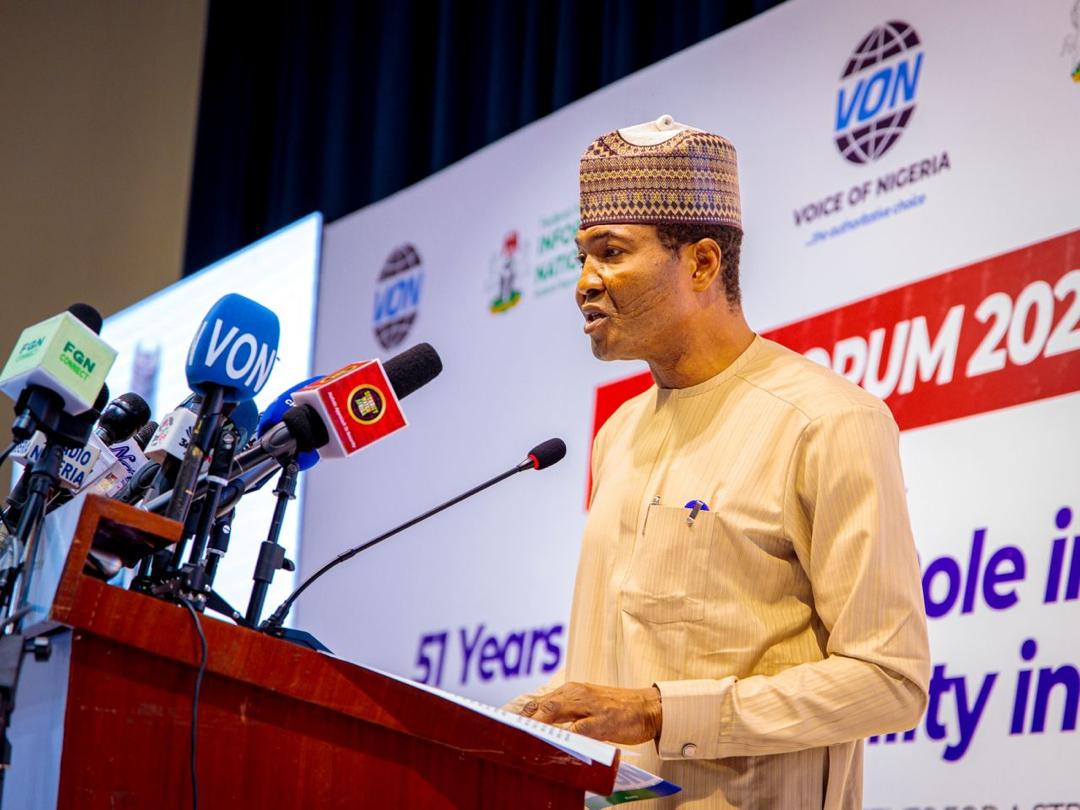
When the Voice of Nigeria convened its 2026 Forum at the Shehu Musa Yar’Adua Centre in Abuja under the theme “51 Years of Nigeria’s Role in Deepening Democratic Stability in ECOWAS,” the gathering could have easily become another well-intentioned but ultimately forgettable conference on the Abuja diplomatic circuit. Distinguished guests would have delivered prepared remarks, participants would have exchanged pleasantries over tea and canapes, and a communique would have been drafted and promptly shelved. What transpired instead, under the stewardship of Director General Mallam Jibrin Baba Ndace, was something altogether different. It was a masterclass in how public institutions can and should reimagine their role in national and regional affairs .
The significance of this moment requires proper contextualisation. Nigeria has, over the past half-century, committed extraordinary human and financial resources to regional stability. In March 2026 alone, the Nigerian Army completed pre-deployment training for 197 troops for a peacekeeping mission in The Gambia under the ECOWAS Mission in The Gambia framework, continuing a tradition of military diplomacy that has seen Nigerian forces serve in Liberia, Sierra Leone, Mali, Guinea-Bissau, and beyond . The country’s diplomatic weight within ECOWAS is equally substantial, as The Gambia’s High Commissioner and Permanent Representative to ECOWAS, Mohamadou Musa Njie, acknowledged at the very forum in question, Nigeria’s contribution to ECOWAS has been “of fundamental significance,” with the nation consistently demonstrating “remarkable dedication to the principles of democracy, the rule of law, and effective governance throughout the region” .
Yet the context in which this forum convened was far from celebratory. Three member states, Mali, Burkina Faso, and Niger, have formally exited the bloc following military takeovers, fundamentally weakening regional integration and undercutting ECOWAS’s collective influence . The ECOWAS Protocol on Democracy and Good Governance, adopted in 2001 as a landmark framework for constitutional order, now faces its sternest test as the region grapples with what analysts describe as a widening trust gap between citizens and the democratic institutions meant to serve them . The demographic stakes are equally pressing: according to ECOWAS data, young people constitute approximately 66 percent of the region’s population, yet their contribution to governance and development dynamics remains disproportionately low .
It is precisely against this sobering backdrop that the leadership demonstrated at VON demands serious attention. Yes, the forum did not solve all these problems and could not have, in a single day. It however revealed a fundamentally different approach to institutional relevance. For context, the Director General did not position VON as a passive chronicler of these challenges. Instead, he articulated a vision that transforms the broadcaster from a conveyor of information into what he termed a “custodian of narratives”, a platform that shapes rather than merely transmits the regional conversation.
The gathering itself reflected this ambition. At the Shehu Musa Yar’Adua Centre, the forum brought together an unusual constellation of stakeholders: the Etsu Nupe, Dr Abubakar Yahaya, a retired, well decorated General representing traditional institutions that remain vital to grassroots conflict resolution; former Chief of Army Staff and diplomat, General Tukur Buratai, who spoke on the imperative of cross-border security coordination and intelligence sharing; and Dr Ike Neliaku, President of the Nigerian Institute of Public Relations, who addressed the corrosive effects of misinformation on public trust in democratic institutions . In all, this was a strategic convening that treated communication, security, traditional authority, and governance as interconnected pillars of regional stability.
The outcomes, as captured in the forum’s communique, bear the unmistakable imprint of this integrated approach. Where many such gatherings produce vague exhortations, the VON Forum produced actionable resolutions directly traceable to the framing the Director General established. The call for media organisations to “intensify efforts in combating misinformation and promoting fact-based journalism across the region” aligns with mounting evidence of sophisticated disinformation campaigns operating within West Africa’s digital space. Recent analysis by the Centre for Crisis Communication revealed that fabricated statements and coordinated falsehoods can now accumulate over 500,000 views and 5,200 reposts before corrective information achieves comparable visibility, a stark illustration of why narrative custody has become a security imperative . The spread of AI-generated deepfakes, cloned voice notes featuring recognisable public figures, and local-language misinformation circulating on encrypted platforms like WhatsApp and Telegram has rendered traditional fact-checking approaches increasingly inadequate .
The communique’s explicit rejection of the “false narrative that Nigeria is on the brink of collapse” similarly reflects an understanding that perception shapes reality in geopolitics. A country’s capacity to lead regionally depends not only on its military and economic capabilities but on the confidence it projects and the stories others tell about it. The forum’s call for “coordinated communication strategies among ECOWAS member states to reinforce shared democratic values and regional identity” recognises that the battle for West Africa’s future is being fought as much in the information domain as in any physical theatre.
Perhaps most telling was the forum’s resolution that “continuous dialogue platforms such as the VON Forum should be institutionalised.” This is the metric that separates genuine institutional innovation from personality-driven initiatives. By this remarkable milestone, the second in its series, the Director General has effectively created a new asset for the Nigerian state. A recurring, high-level platform that positions VON as the convener of consequential policy conversations rather than merely the broadcaster of their outcomes. This is institution-building of the highest order, ensuring that the value created extends beyond any individual tenure.
For those who lead public institutions of national and regional significance, the VON Forum offers a replicable template. It demonstrates that relevance in the contemporary public sector is not a function of budget size or statutory power, but of the capacity to convene, to frame, and to follow through. It shows that the most valuable asset a public institution possesses may not be its physical infrastructure but its convening authority. That ability to bring the right people into the right room at the right moment.
The work ahead remains formidable. As scholars have observed, ECOWAS has too often relied on “sanctions, ultimatums and threats of force” that, while well-intentioned, have done little to reverse the region’s democratic slide . The exodus of Mali, Burkina Faso, and Niger underscores the limitations of coercion without inclusion. What the VON Forum demonstrates is that the long, patient work of narrative-building, dialogue, and institutional trust-building must accompany whatever harder measures diplomacy may require. The media, in this framing, is not a neutral observer of regional integration but an active participant in its construction.
Nigeria’s 51-year journey in promoting democracy across West Africa has been marked by both triumphs and setbacks. The nation has deployed peacekeepers, mediated conflicts, and anchored the institutional architecture of regional cooperation. The VON Forum 2026 suggests that the next phase of this leadership will demand something equally challenging: the cultivation of a resilient, fact-based information ecosystem capable of sustaining democratic culture across generations and borders. That the Voice of Nigeria has positioned itself at the centre of this effort is a testament to leadership that understands that in the twenty-first century, the microphone can be as consequential as any other instrument of statecraft. The example set should resonate far beyond the walls of any single institution.
Sa’id is a Communications Strategist and Reputation Manager. He writes from Kaduna.