

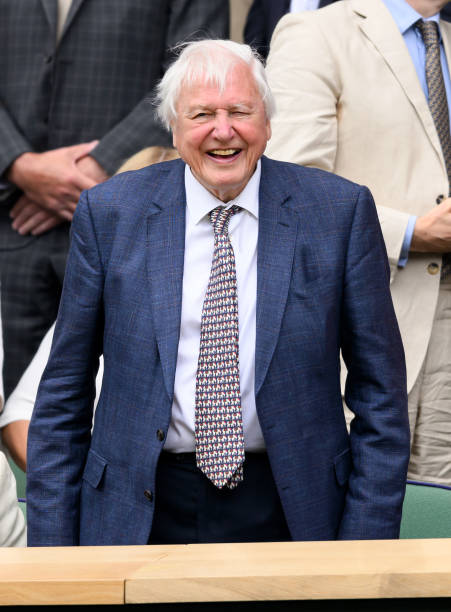
David Attenborough (born May 8, 1926) is an English broadcaster, naturalist, and author. His presenting career began in 1954 as host of Zoo Quest and has spanned eight decades, including the nine documentary programs The Life Collection, Natural World, Wildlife on One, the Planet Earth franchise, The Blue Planet, and Blue Planet II.
He is the only individual who has won BAFTA Awards in black-and-white, colour, high-definition, 3D, and 4K resolution. Throughout his life, he has received scores of honorary degrees and accolades, including three Emmy awards for Outstanding Narration and one for Outstanding Daytime Personality – Non-Daily.
In the 1960s and 1970s, Attenborough held high management positions at the BBC, including controller of BBC Two and director of programming for BBC Television. While his earlier work concentrated on the natural world, his subsequent work has been more vocal in its support of environmental problems.
He has pushed for restoring global biodiversity, slowing population growth, transitioning to renewable energy, mitigating climate change, reducing meat consumption, and designating additional areas for natural preservation.
On his broadcasting and passion for nature, NPR claimed that Attenborough “roamed the globe and shared his discoveries and enthusiasms with his patented semi-whisper way of narrating”. He is largely regarded as a national treasure in the UK, but he does not embrace the designation.
David Attenborough Biography
Sir David Frederick Attenborough was born in Isleworth, Middlesex, on May 8, 1926. He grew up in College House on the campus of University College, Leicester, where his father, Frederick, was the principal.
He is the middle of three sons; his older brother, Richard, is an actor and filmmaker, while his younger brother, John, is an executive at the Italian car company Alfa Romeo.
Attenborough attended Wyggeston Grammar School for Boys in Leicester. He received a scholarship to Clare College, Cambridge, in 1945 to study geology and zoology, was a member of the undergraduate Sedgwick Club, and earned a degree in natural sciences.
In 1947, he was called up for national duty in the Royal Navy, spending two years stationed in North Wales and the Firth of Forth.
Career
In 1954, he co-created the television series Zoo Quest with reptile curator Jack Lester, which included live animals filmed in the wild and zoos. This show was highly popular, expanding the BBC’s educational programming.
In 1965, Attenborough took over as head of the BBC’s new second television channel, BBC-2. In this position, he contributed to the debut of the dramatic production The Forsyte Saga, as well as important cultural-educational programs like Jacob Bronowski’s The Ascent of Man and Kenneth Clark’s Civilisation.
He also hosted the groundbreaking comic series Monty Python’s Flying Circus. From 1968 to 1972, Attenborough was the BBC’s head of television programming, but he departed to develop and produce television programs as a freelancer.
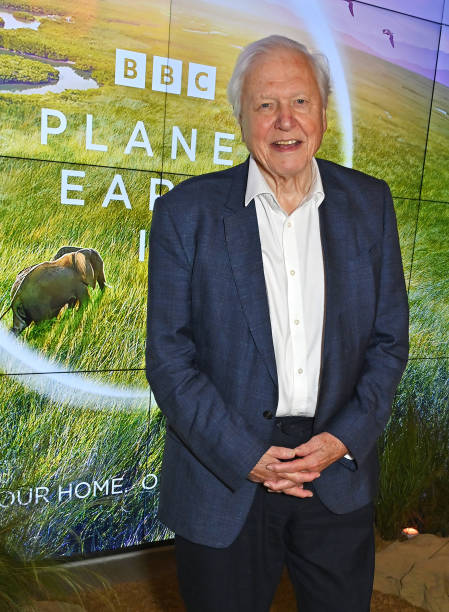
He later wrote (and narrated) several award-winning television programs on anthropology and natural history, most notably the Life series: Life on Earth (1979), The Living Planet (1984), The Trials of Life (1990), Life in the Freezer (1993), The Private Life of Plants (1995), The Life of Birds (1998), The Life of Mammals (2002-03), Life in the Undergrowth (2005), and Life in Cold Blood (2008).
His other television credits include The Blue Planet (2001), an examination of the world’s oceans, and State of the Planet (2000) and Are We Changing Planet Earth? (2006), both of which dealt extensively with environmental topics such as global warming.
Attenborough won an Emmy for his narration of Blue Planet II (2017), which he did not write. Attenborough later narrated Our Planet, an eight-part series that premiered on Netflix in 2019.
That year, the BBC also aired his documentary Climate Change—The Facts, in which he warned that failing to act could result in “the collapse of our societies.”
David Attenborough: A Life on Our Planet (2020) was referred to as his “witness statement.” Attenborough wrote several books, some of which were companions to his television series.
His memoirs include Life on Air: Memoirs of a Broadcaster (2002), Adventures of a Young Naturalist: The Zoo Quest Expeditions (2017), and Journeys to the Other Side of the World: More Adventures of a Young Naturalist (2018). Attenborough received numerous more honours, including several BAFTA Awards and a Peabody Award (2014). He was knighted in 1985.
Attenborough was a prominent figure in the preparations for the 2021 United Nations Climate Change Conference (COP26), and he spoke during the opening ceremony.
In it, he asserted that humans were “the greatest problem solvers to have ever been on Earth” and expressed hope for the future, concluding by remarking, “In my lifetime, I’ve observed a dreadful fall. Yours could and should be a beautiful recovery.”
In 2022, the United Nations Environment Programme named Attenborough a Champion of the Earth “for his dedication to research, documentation, and advocacy for the protection of nature and its restoration”
Personal life
In 1950, Attenborough married Jane Elizabeth Ebsworth Oriel, who died in 1997. Attenborough and his wife had two children: Robert and Susan. Robert is a senior bioanthropology lecturer at the Australian National University’s School of Archaeology and Anthropology in Canberra.
Susan was previously the headmistress of a primary school. Attenborough resides in South West London, near Richmond Park.
David Attenborough Net Worth
David Attenborough’s net worth is expected to be over $15 million, according to numerous estimates, owing to differences in valuation methodology and the inclusion of assets such as his production firm and intellectual property rights.
FOLLOW US FOR MORE…