

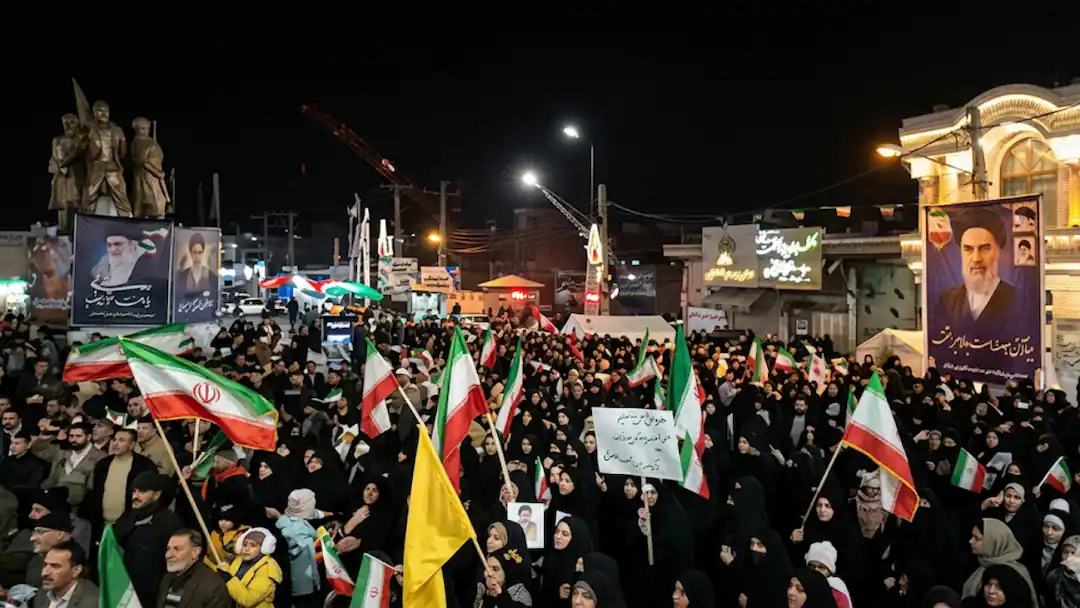
- Thousands protested nationwide chanting anti-US, anti-Israel slogans.
- Women actively participated, some bearing arms, expressing revolutionary resolve.
- Gatherings occurred in major cities, with crowds chanting for orders.
- Diplomatic signals of negotiation clash with hardline rhetoric.
Anti-US/Israel Protests Across Iran Cities: Widespread midnight protests erupted across Iran, with thousands taking to the streets in cities from Tehran to Khorramabad, chanting slogans against the United States and Israel. The demonstrations come at a time of heightened tensions, even as diplomatic signals suggest a possible return to negotiations.
The protests, now continuing for weeks following the February 28 Israeli-American attack, expanded significantly in scale, spreading across multiple regions including Urmia, Isfahan, Ilam, and Kermanshah. Demonstrators waved national flags and gathered in large numbers late into the night, signalling sustained public mobilisation.
Anti-US/Israel Protests Across Iran Cities
One of the most striking aspects of the demonstrations was the visible participation of women, particularly in Lorestan province, where some were seen carrying firearms and addressing gatherings in support of the armed forces.
A woman said, “Today we have all come to the field wearing shrouds to say that the lineage of Maryam is alive and is ready to sacrifice our lives for this Islamic Revolution.”
“Iranian women show that women are not weak or oppressed, but the blood of the martyrs has proved what an Iranian woman really is. An Iranian woman is like Hazrat Zainab,” another man said.
“In economic and social conditions, when society faces corruption, embezzlement and widespread smuggling, the role of women has been decisive,” the woman added.
Iran Slogans Echo Nationwide
In Tehran’s Inqilab Square, crowds raised chants directed at leadership, declaring, “Commander, give us orders, we will obey your every order.” Similar slogans, including calls against the US and Israel, were heard in cities such as Kerman and Urmia.
Large gatherings were also reported in Isfahan and Ilam, while in Khorramabad, people offered prayers in the streets. In Salmas, members of the Islamic Revolutionary Guard Corps (IRGC) and army personnel joined demonstrators, with military bands playing during the تجمعات.
Diplomatic Signals Clash With Hardline Rhetoric
The protests come amid mixed signals on diplomacy. Iranian Foreign Minister Abbas Araghchi recently announced that the Strait of Hormuz would remain open for non-military shipping through an alternative route until a ceasefire in Lebanon is secured—a move acknowledged by Donald Trump.
However, remarks by Tehran Mayor Alireza Zakani suggested a more confrontational stance. He argued that negotiations should not be seen purely as dialogue but as an extension of conflict dynamics, warning against conceding under pressure.
Zakani also reacted strongly to statements about a continuing US naval blockade, saying that if such claims are accurate, it would amount to a breach of ceasefire conditions requiring a proportionate response.