

The knock at the door came early on 1 April 2024, around 6.30am. It was my 19-year-old nephew, Mohammed, carrying a small bag of flour – no more than two kilos’ worth. My sister Raghda hugged him with joy and set out for the bakery, where our neighbours would make bread for us.
Two weeks earlier, in the early hours of Monday 18 March, Israeli forces stormed al-Shifa Hospital, placing it under siege for the second time in less than six months.
At this stage of the genocide, al-Shifa was not only the largest and most advanced functioning hospital in Gaza, but had also served as a shelter for thousands of people displaced by Israeli bombing, invasion and evacuation orders.
Throughout the two-week siege, we heard massive explosions coming from the hospital and the surrounding area, usually intensifying at around 4 or 5am.
On the morning of 1 April, Raghda returned from the bakery slightly out of breath. She told us that Israeli soldiers had withdrawn from the hospital, leaving plenty of food and supplies behind.
New MEE newsletter: Jerusalem Dispatch
Sign up to get the latest insights and analysis on
Israel-Palestine, alongside Turkey Unpacked and other MEE newsletters
One of the neighbours had even given her shakshouka in a tin with Hebrew writing printed on it. “It’s not just shakshouka,” Raghda said. “The neighbour told me there are all sorts of chocolates left behind by the occupying soldiers.”
At around 8am, Raghda and I set out from her house in al-Daraj towards the hospital in search of food. The April sun had already begun to spread across the streets, but the movement of people around us felt heavier than usual.
First sight
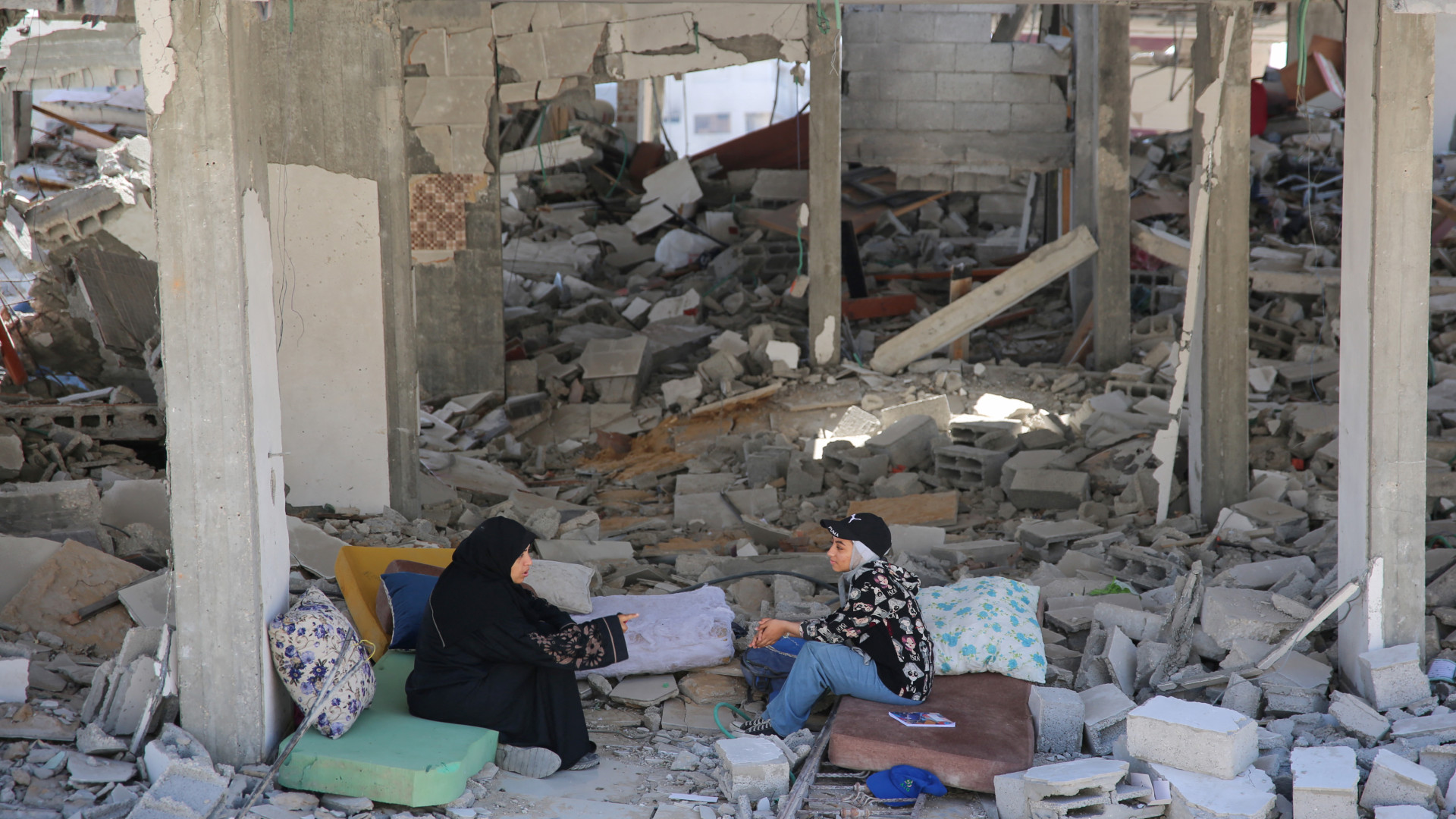
At the end of al-Wahda Street, we caught our first glimpse of the hospital. The scale of the destruction was immediately clear. Several tall buildings that once blocked the view of the sea had been completely flattened, leaving the beach road visible in the distance.
The streets beneath us were no longer streets. The ground seemed to have disgorged its innards, spewing a thick layer of crushed debris, with no pavement or concrete left
Near the Families’ Bakery, three bodies lay on the ground. Some people passed by, offering prayers; others stopped to examine their faces, hoping to identify them and trace their families.
By then, the streets beneath us were no longer streets. The ground seemed to have disgorged its innards, spewing a thick layer of crushed debris, with no pavement or concrete left. A fine white powder covered everything, several centimetres deep. My shoes sank into it, kicking up dust that clung to my clothes. Some of the buildings were still smouldering.
The gates of al-Shifa had collapsed, and its walls were almost entirely destroyed.
The northern entrance was the most severely damaged – the rubble of surrounding homes had merged with the debris of the hospital itself, making it difficult to distinguish where one ended, and the other began.
On the southern side, where Israeli occupation soldiers had been stationed, a Palestinian engineering unit worked to dismantle an unexploded missile, while civil defence crews tried to keep civilians away.
Inside ruins
We entered through the main gate, where shattered ambulances were piled on top of one another.
The ground was littered with fragments of human bones, burnt cotton clothing, hundreds of scattered single shoes, thousands of medical needles, and smashed fluid bottles whose contents had seeped into the dust. Hospital beds were twisted into heaps of iron. Around them lay broken medical equipment, copper wires and shattered computer monitors.
War on Gaza: Israeli troops withdraw from al-Shifa hospital, leaving piles of dead bodies
Read More »
The buildings were charred. Darkness surrounded everything. The smell was more than smoke – it carried a sharp metallic tang mixed with ash, decaying human flesh and other strange chemicals.
I stepped on a severed human foot, still inside its shoe.
A paramedic shouted “Here’s a body”, and his colleagues rushed over, kneeling on the scorched ground. They sifted through the debris with their hands, digging and sieving the sand to collect what they could in white bags.
The main square of the hospital – once bustling with ambulances and visitors – had all but vanished. Its asphalt surface had been replaced by uneven terrain of red dirt and rubble.
People moved like they were drunk: wide-eyed, ashen-faced, shouting and colliding with one another, each trapped in their own shock. Some stood dazed atop the dirt mounds, while others picked their way cautiously through the pits and debris.
The skeletal frame of the reception and emergency block was still standing, despite being hollow and charred. The windows were not only shattered; their metal frames had been twisted outward, and the outer walls on the middle floors were totally destroyed. People climbed over rubble to reach the upper levels. Those who returned reported seeing the bodies of civilians tied to a pillar and burned to death by Israeli soldiers.
Searching faces
At the Burns Ward, in the north of the hospital grounds, a large group of civil defence workers were stationed, preventing people from entering. A single Palestinian bulldozer cleared mounds of sand.
An elderly mother ran among the waiting crowd, shouting: “Have you seen my son Yahya? Yahya, habibi, where are you?”
Yahya, a nurse at the hospital, had been missing since the siege began on 18 March. In my mind, I pictured him as a child, wishing I could find him, take his hand, bring him back to his mother, and tell him: “Don’t go away like this ever again. Your mother’s heart cannot bear it.”
His mother then tried to enter the building, but her husband held her arm, urging her to be patient and trust in God. Raghda went to her and held her tightly. She washed her tears with water from a bottle, and together they sat reciting Surah Yasin.
Follow Middle East Eye’s live coverage of Israel’s genocide in Gaza
I sat a few steps away, watching rescue teams wrap the bodies they recovered. Three of them had been blindfolded, with their hands tied behind their backs.
As each body emerged, the grieving mother screamed: “Oh God, don’t strike me with my son.”
I found myself instinctively slapping my own face, struggling to believe what I was witnessing.
A short while later, I reached the Blood Bank, the least damaged building in the hospital. I knew this place well. For years, I had queued here regularly, waiting for test results for my mother and for friends in the kidney department.
Nearly a decade earlier, I learnt how to navigate the hospital system, bending strict rules with the heart of a daughter who saw nothing before her but her mother’s pale face.
My mother, a dialysis patient, regularly required blood transfusions. The law stipulated that a new donation replace each unit of blood, and despite our relatives’ assistance, shortages followed us constantly.
At the time, I was studying science at Ahmad Shawqi Secondary School, surrounded by classmates who dreamed of becoming doctors. They knew I spent time at al-Shifa, and for them the hospital held a certain fascination.
Sensing an opportunity to secure the blood my mother needed, I invited six of them to visit. I welcomed them warmly and introduced them to my mother. She sat at the dialysis machine, watching her blood leave her body and return purified in a steady rhythm.
My mother, Fatima, had wheat-coloured skin. If wheat ears could glimpse the gentleness of her face, they would say: “This is my origin. From here, beauty is harvested.” Her hazel eyes shimmered like olive oil. She smiled despite the many hardships she faced, welcoming our guests even when she barely had the strength to speak. When she saw me with my friends, she held herself together, making every effort to show them affection. She even insisted that I buy knafeh from Abu al-Saud’s shop next to the hospital so that her hospitality would be complete.
After visiting her, one of the doctors gave my friends a tour of the neonatal unit. Later, I brought them to the blood lab. Although we were only 17 – below the legal age for donors – four of them agreed to donate blood, enough to spare me weeks of worry.
That was in 2016.
A dark shadow
In 2024, after two weeks of Israeli siege, a dark shadow hung over the building that had once felt like a second home. Layers of paint and plaster were peeling from the ceilings and crumbling walls. Electrical wires dangled like lifeless snakes.
Glances into the side room revealed the remnants of medical chairs: seats which once bore the moans of the weary, the prayers of mothers, the patience of fathers, now reduced to metallic ghosts – their leather and padding consumed by fire. Here, death had once been held at bay. Now it prevailed, tangible and three-dimensional before my eyes.
I remembered the friendships I once formed with patients of all ages: the folk songs we sang together, the dances with children at their birthday parties, the farewells I bid to so many kidney patients on their final journeys.
We were confronted by a scene that felt like a deliberate show of power, as if the Israeli soldiers wanted to say: ‘Look at what we can do. We can defy all laws and no one can stop us’
I remembered Uncle Abu al-Saeed Hassan. He had no children of his own, and I had taken it upon myself to be a daughter to him. I bought his medicine, monitored his tests regularly alongside my mother’s, and became the voice he recognised above everyone else in his last months, after being struck by Alzheimer’s disease. Uncle Abu al-Saeed passed away in March 2019. He was buried beneath a pomegranate tree on his land in al-Mughraqa neighbourhood of Gaza.
The faces of others haunted me. I did not know their fate. But if they were still alive, an inevitable death awaited them. Kidney patients require at least one four-hour dialysis session each week; my mother needed three.
For the first time in my grief over losing her, I felt that her passing before this genocide began had been a mercy. Fate had spared her the indignity of standing helpless before a charred wall, waiting for the poison within her own body to slowly kill her.
Raghda and I left al-Shifa, barely able to drag our feet. We had found no food.
We were instead confronted by a scene that felt like a deliberate show of power, as if the Israeli soldiers wanted to say: “Look at what we can do. We can defy all laws and no one can stop us. When we decide to destroy a hospital, we do it. We are giants, you are dwarfs, and the world will not hear you.”
Amid the devastation on Abu Hasira Street, fragments of shattered lives caught my eye: a university degree from the Faculty of Economics belonging to a member of the al-Akhras family, a family photograph of a couple and their two children.
Outside the home of the Haboush family, bodies lay in the street. Nearby, two others had been hastily buried. Cardboard markers replaced gravestones. “Unknown martyr wearing a blue shirt,” one read. The other simply said: “Unknown martyr.”
A long silence stretched between my sister and me. I wanted to hold her, to beg her to speak. But paralysis gripped my tongue. Inside me were a hundred years of buried screams – accumulated, petrified. Each time I tried to release one, it sank back down, settling in my chest like a lump of cold lead.
This is how I swallowed my screams, until my body became a mine of noise trapped inside a silent shell.
The views expressed in this article belong to the author and do not necessarily reflect the editorial policy of Middle East Eye.