

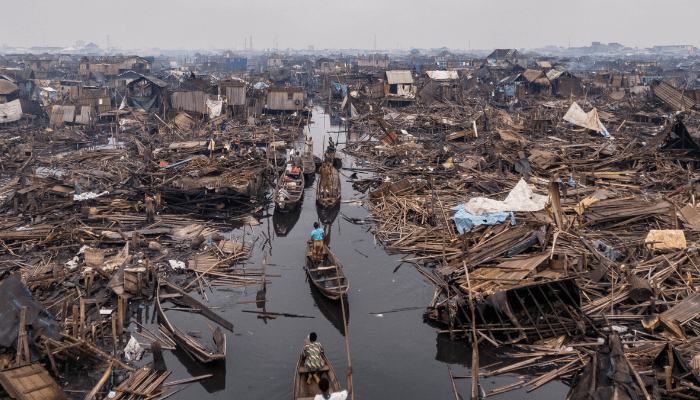
An advocacy group, Company Accountability and Public Participation Africa (CAPPA), has revealed that latest demolitions carried out by the Lagos State Authorities in Makoko and Oworonshoki displaced greater than 10,000 residents.
Bloomberg reported the event, citing the group, which mentioned the train additionally affected over 3,000 dwellings within the two areas.
The group’s place follows the continuing levelling of the floating Makoko settlement and elements of Oworonshoki, for causes the Lagos State Authorities mentioned have been primarily based on the collective good of the state.
CAPPA claimed that the demolitions, which started in December and have been ongoing, had resulted within the destruction of hundreds of properties throughout the 2 communities.
The group alleged that many affected residents have been left with out different lodging, forcing some to hunt momentary shelter in boats, church buildings, faculty buildings, or open areas.
“The latest demolitions, which began in December and are ongoing, have affected greater than 3,000 dwellings and displaced greater than 10,000 folks, based on Company Accountability and Public Participation Africa, or Cappa, a Lagos-based governance-advocacy group,” the Bloomberg report learn partly.
CAPPA mentioned the Makoko demolitions have been initially restricted to constructions inside 50 meters of energy traces, however the authorities later prolonged the zone to 100 meters, exceeding authorized requirements of 30 to 50 meters.
The enlargement enhance affected households and disproportionately impacted low-income residents who depend on the waterfront for fishing and small-scale buying and selling, it famous.
The report mentioned a human rights group, Take It Again Motion, alleged that compensation for verified householders ranged from N300,000 to N5 million, with some residents rejecting it as insufficient for the worth of their properties.
The Lagos State Authorities has maintained that the demolitions have been a part of an city regeneration programme to enhance infrastructure and public security, with compensation for verified householders.
Governor Babajide Sanwo-Olu mentioned that in Makoko, evacuation notices had been served over two years earlier than the demolitions, notably for buildings situated 150 to 250 meters from high-tension wires.
The company famous that almost all residents ignored warnings, and the demolished buildings have been distressed, blocked drainage channels, and posed security dangers.
The Makoko waterfront settlement, which has been partially levelled, was recognized for its difficult residing situations.
A 2024 Nairametrics report revealed {that a} single room prices N5,000 per 30 days (N60,000 yearly), whereas two rooms go for N15,000 month-to-month (N180,000 yearly). New residents are sometimes required to pay three years’ lease upfront, together with N100,000–N150,000 for damages, agreements, and agent commissions.
Most properties are one- or two-room wood constructions, many constructed over the lagoon, with just a few buildings on land, none of which offer fundamental facilities. Residents should additionally pay N100 per use to entry shared bathing or bathroom services.
The Lagos State Authorities has beforehand carried out the elimination of dwellings underneath energy traces for security causes, primarily based on laws within the State City and Regional Planning and Growth Regulation.
The Makoko demolitions, particularly, concerned constructions deemed too near high-tension wires. The legislation prohibits building beneath overhead electrical energy wires and units minimal distances between buildings and energy traces:
The federal government mentioned evacuation notices had been served to residents residing inside 150 to 250 meters of high-tension wires, exceeding the minimal distances required by legislation.