

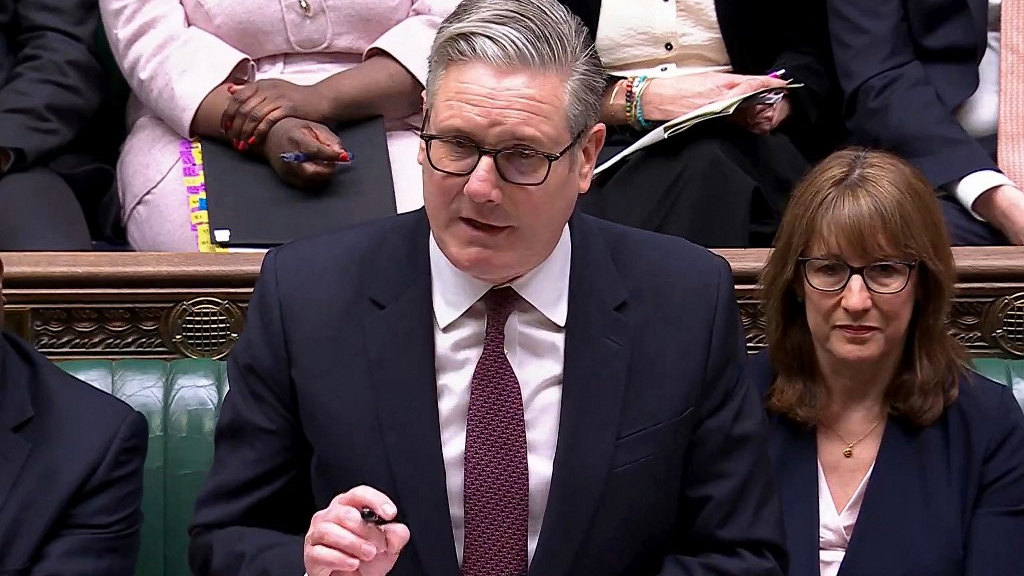
British Prime Minister Keir Starmer on Wednesday reaffirmed the UK’s support for the International Criminal Court (ICC) after being asked about Middle East Eye’s revelation that a judges’ panel cleared its British chief prosecutor Karim Khan of misconduct.
Starmer was also asked about MEE’s report that a minority of members from the body’s governing body are calling for the judges’ findings to be ignored, but he declined to comment on the ICC’s “internal proceedings”.
MEE exclusively reported on Saturday that Khan has been cleared of any wrongdoing by a panel of three senior judges appointed by the bureau of the Assembly of State Parties (ASP), the ICC’s governing body, to review the findings of a United Nations investigation into complaints of alleged sexual misconduct.
MEE further reported on Monday that a minority of the 21 bureau members are opposed to the panel’s report and are of the opinion that it should be disregarded. The UK is one of the 125 members of the ICC, but is not among members of the bureau, the executive body that is set to rule on Khan’s future.
British MP Iqbal Mohamed, a member of the parliamentary Independent Alliance, cited both reports in a question to Prime Minister Starmer in parliament on Wednesday.
New MEE newsletter: Jerusalem Dispatch
Sign up to get the latest insights and analysis on
Israel-Palestine, alongside Turkey Unpacked and other MEE newsletters
Pointing to the judges’ findings, Mohamed said that “reports suggest that elements within the court’s governing body are seeking to disregard those findings while ICC officials continue to face external pressure and sanctions”.
He asked: “Therefore given the UK’s commitment to the rule of law and as a human rights lawyer himself, what steps will the prime minister set out to defend the independence of the ICC and to support British nationals carrying out international judicial roles?”
‘We support the court’
Responding to Mohamed, Starmer refused to comment on Khan’s case.
“I’m not going to comment on the internal proceedings of the court,” he said, adding: “As [Mohamed] knows, we support the court. We are party to the treaty and there are legal obligations that flow from that.”
Khan has been on leave since last May pending the conclusions of the investigation into sexual misconduct allegations against him – although he has always strenuously denied the allegations.
Is Starmer’s Foreign Office shielding David Cameron?
Read More »
Starmer’s Labour government has previously repeatedly refused to comment on reports that the previous Conservative government threatened to defund the ICC if it pursued arrest warrants against Israeli leaders.
David Cameron, a former prime minister who was appointed foreign secretary in November 2023, phoned Khan in April 2024 while the prosecutor was on an official visit to Venezuela, MEE reported last June.
Earlier this year the Foreign Office confirmed that the call took place.
MEE reported that during the call, Cameron told Khan that if the ICC issued warrants for Israeli leaders, the UK would “defund the court and withdraw from the Rome Statute”.
In a submission to the ICC last December, Khan alleged that a senior British official had threatened that the UK would defund and withdraw from the court if he pursued warrants for Israeli leaders.
Numerous British politicians, including Humza Yousaf – who was Scottish first minister when Cameron made the phone call – have urged the government to establish an investigation into allegations against Cameron.
Intimidation campaign
MEE has previously reported that Khan and the ICC itself have faced an intensifying intimidation campaign over its investigation into Israeli war crimes in Gaza, with the prosecutor, his two deputies and numerous judges subjected to US sanctions.
MEE reported this week that the judge’s panel appointed by the court’s governing body ruled that the UN’s Office for Internal Oversight Services’ (OIOS) investigation into misconduct allegations against Khan had not established any “misconduct or breach of duty” by the prosecutor.

Exclusive: ‘Handful’ of ICC states aim to sabotage report clearing Karim Khan
Read More »
In the report, seen by MEE, the panel was critical of the OIOS investigators, saying their report “either did not reach conclusive factual determinations or concluded that such determinations were impossible based on the evidence collected”.
MEE reported last August that pressure on the prosecutor involved threats and warnings directed at Khan by prominent figures, close colleagues and family friends briefing against him, fears for the prosecutor’s safety prompted by a Mossad team in The Hague, and media leaks about sexual misconduct allegations.
Pressure on Khan started to build in April 2024 as he prepared to apply for arrest warrants for Israeli Prime Minister Benjamin Netanyahu and his then-defence minister, Yoav Gallant, for alleged war crimes; and again in October 2024, a month before the ICC judges issued the warrants.
Pressure intensified further in early 2025 as Khan was reported to be seeking warrants for more Israeli ministers, and coincided with further media leaks about the sexual misconduct allegations. The Trump administration sanctioned Khan in February that year.
Khan then went on leave in mid-May, shortly after an attempt to suspend him, prompted by a senior member of his own office, failed; and amid the UN investigation into the misconduct allegations.
What next for the Khan probe?
Khan’s fate is dependent on a decision by the bureau’s 21 diplomats, who have 30 days from the delivery of the judges panel report on 9 March to indicate their preliminary assessment of the alleged misconduct. Then Khan has 30 days to respond. Then the bureau has another 30 days to make a final decision.
The bureau met on Monday for the second time to discuss the panel’s report. They have yet to reach a consensus on the issue, sources briefed on the two meetings told MEE.

Albanese urges ICC arrest warrants for Israeli ministers over torture of Palestinians
Read More »
MEE understands from various diplomatic sources familiar with the meetings that a minority of states within the bureau are opposed to the panel’s report and are of the opinion that it should be disregarded.
But experts warn that deferring the matter to a political body and ignoring the judges’ report risks undermining the court’s credibility and the rule of law.
“The members of the judicial panel have spoken unanimously, finding no misconduct and no breach of duty under the applicable legal framework, and this conclusion must be taken seriously by the members of the bureau,” Sergey Vasiliev, an ICC expert, told MEE earlier this week.
According to Ezequiel Jimenez, an international law expert specialising in the ASP, it would be “surprising” if the bureau disregards the panel’s findings.
Even though the ICC’s own rules allow the bureau to either adopt the panel’s findings or disregard them, Jimenez says it is unlikely the bureau will reach a consensus to disregard the judges’ findings.
Historically, the bureau has reached decisions by consensus, he said.
“It’s difficult to foresee a consensus in this case, when the bureau itself appointed the ad hoc panel of judges. The bureau members are politicians, career diplomats, appointed by their governments and respond to their national interests,” he said.
“That was the whole point that they created the ad hoc panel. I would be extremely surprised if they don’t adopt the findings of the report and find an alternative decision,” he told MEE.