

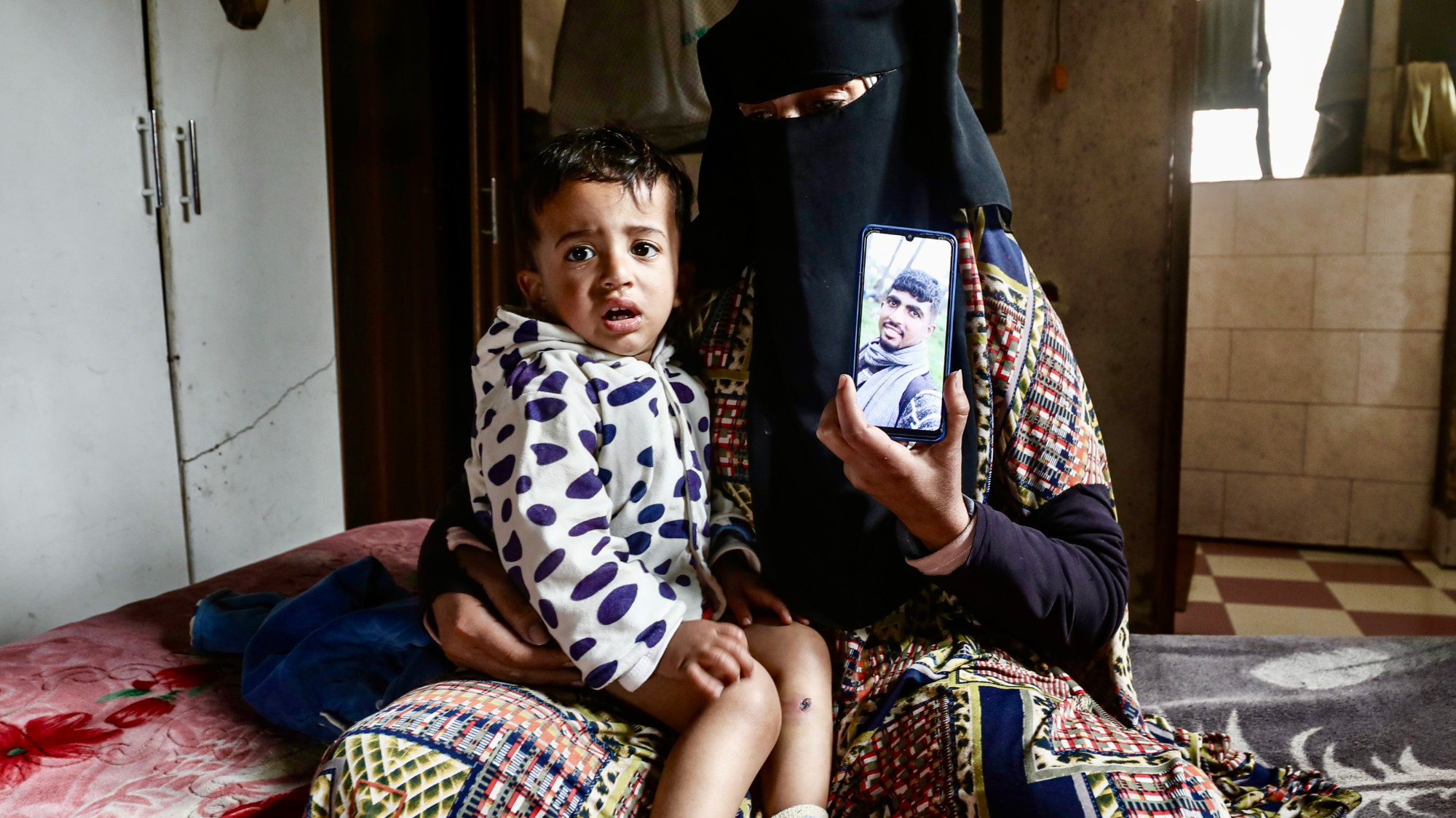
A Palestinian toddler was returned from a 10-hour detention by Israeli forces in the Gaza Strip with apparent cigarette burns on his thighs, according to medical reports.
Jawad Abu Nassar, aged 21 months, was detained alongside his father, Osama Abu Nassar, 25, in central Gaza on 19 March.
According to the family, Osama had taken his son out at around 10am to buy sweets ahead of the Muslim holiday of Eid al-Fitr.
Osama – who had been grappling with severe trauma after losing his home, his unborn child, and his livelihood during the war – never returned.
“When he left, he seemed to head east instead of west,” Osama’s father, Muhammed Husni Abu Nassar, told Middle East Eye.
New MEE newsletter: Jerusalem Dispatch
Sign up to get the latest insights and analysis on
Israel-Palestine, alongside Turkey Unpacked and other MEE newsletters
“Neighbours called me and said, ‘Hurry, your son is carrying his child on his shoulders and going east.’”
Around 200 metres from the family home in Maghazi refugee camp, Israeli forces are stationed along the so-called “Yellow Line”, a military demarcation established under the Gaza ceasefire that marks the boundary of Israeli control and a no-go zone where civilians risk being shot.
When Muhammed rushed to follow his son, neighbours told him that Osama had already reached the area.
Osama, whose home had been destroyed in an Israeli bombardment, had been living with his wife and their only child in his family’s house. In recent months, his wife had become pregnant but lost the baby amid the hardships of the war.
“The neighbours told me that [Israeli soldiers] did not shoot him, they only fired around him,” Muhammed, 53, said.
“Poor him – he seemed unaware of what he was doing, so he just kept walking.”
Blood stains
According to eyewitnesses, an Israeli quadcopter drone approached Osama before he was seen putting his child down, walking towards soldiers, and removing his clothes.
“He removed all of his clothes, keeping only his boxers. He remained completely peaceful and showed no signs of aggression,” Muhammed said.
After learning his son had been detained, Muhammed went to al-Aqsa Martyrs Hospital in Deir al-Balah and left his phone number, asking to be contacted if his son and grandson were brought in.

Around 10 hours later, the International Committee of the Red Cross (ICRC) called to say they had his grandson.
“They told me to come to the Maghazi market area so they could hand over the child. I rushed there with the child’s mother and found two ICRC vehicles. They handed him to us wrapped in an emergency blanket,” Muhammed said.
“I opened the blanket and saw blood stains on his trousers. I asked where the blood came from. She [the ICRC representative] told me his father had a shoulder injury, and that it was his blood.”
ICRC confirmed to MEE it had received the child from Israeli authorities and reunited him with his family, but said it could not comment on his physical or psychological condition due to privacy concerns.
“Our teams were in touch with Israeli authorities. We were in touch with the boy’s family. And so on Thursday, on the 19th, a team from the ICRC left our Deir al-Balah offices to meet the authorities and the child at Kissufim Crossing, and then we transported the boy in our vehicles back to his mother in central Gaza,” said Patrick Griffiths, an ICRC spokesperson in Israel and the occupied Palestinian territories.
Signs of torture
When the child was brought home, the family tried to ask him what had happened, but he could only say “mam” – a broken pronunciation of the Arabic word dam, meaning blood.
“We asked him, ‘Who caused this blood?’ He could not answer. When we asked, ‘Where is your father?’ he said only, ‘Gone.’ That was all he could say. But when his mother hugged him, he screamed and cried,” Muhammed said.
‘He clings to his mother constantly and refuses to be left alone’
– Muhammed Husni Abu Nassar, Palestinian grandfather
“She removed his clothes and found wounds on his body. There were burns around and behind his knees, as well as another wound caused by a nail or sharp object, with both an entry and an exit wound.”
The child spent the night awake and crying. The following morning, his family took him to the hospital.
“It was the first day of Eid, but it wasn’t Eid for us. We took him to the hospital, where two doctors confirmed the injuries were not caused by shrapnel or other ammunition, but were consistent with signs of torture and cigarette burns,” Muhammed said.
MEE reviewed photos of the child’s injuries taken shortly after he was admitted to the hospital, showing a deep wound to his calf consistent with a sharp object, with both entry and exit points, as well as marks consistent with cigarette burns.
Medical reports reviewed by MEE confirmed the child had “knee swelling” and “wounds around both knees, mostly due to cigarette marks”.

UN experts demands release of Gaza doctor Abu Safiya after ‘severe torture’
Read More »
Muhammed believes Israeli soldiers may have mistaken Osama’s psychological state and attempted to pressure him by harming his child. When this yielded no result, he said, they released the boy.
MEE contacted the Israeli army for comment.
According to the family, the child has suffered from a high fever, vomiting, and persistent crying since his release.
“He clings to his mother constantly and refuses to be left alone,” Muhammed said.
Since the ceasefire agreement in October, dozens of Palestinians have been killed, injured or detained by Israeli forces near the so-called Yellow Line, which covers around 60 percent of Gaza’s land.
Many of those released have reported being subjected to torture during detention.