

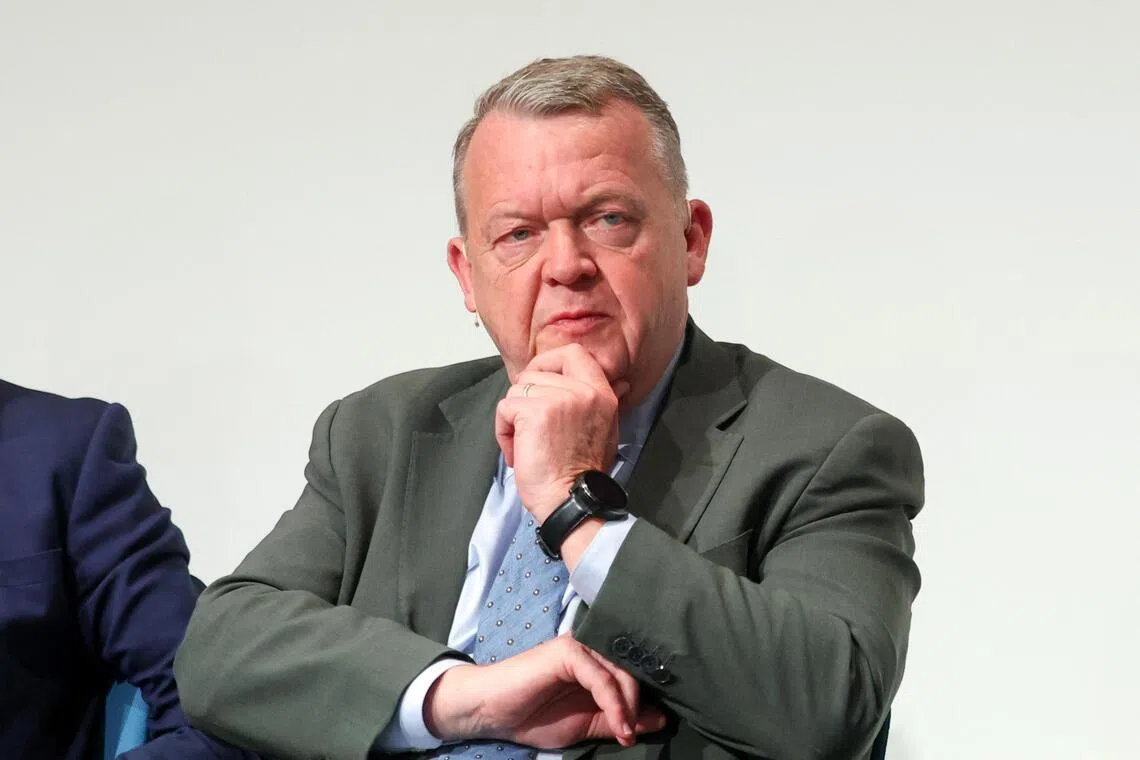
Denmark’s headstrong Foreign Minister Lars Lokke Rasmussen holds the keys to deciding who becomes the Nordic nation’s next prime minister.
His pivotal position following March 24’s general election comes as the direct result of taking on Mr Donald Trump over Greenland. The 61-year-old leader of the centrist Moderates has emerged as the ultimate kingmaker in the country’s most fractured election in decades, buoyed by a surge in support after his combative approach to Washington during the Greenland crisis in January.
With neither of the traditional blocs – to the left and the right of the political centre – securing a majority in March 24’s vote, the former prime minister now holds the balance of power.
Mr Rasmussen has recast himself as a dealmaker-in-chief with a clear message to coalition partners Prime Minister Mette Frederiksen and Defence Minister Troels Lund Poulsen: Denmark needs cooperation, not ideological trench warfare. Ms Frederiksen, a Social Democrat, and Mr Poulsen, a Liberal, have governed alongside Mr Rasmussen in a rare cross-bloc coalition since 2022, but reverted to more traditional left-right lines on the campaign trail.
“When the world becomes harsh and when Trump builds tariff walls, then we must train our muscles to be able to jump over,” Mr Rasmussen said on election night. “We are a small tribe. We must unite. We must not be divided. We must not be red. We must not be blue.”
Mr Rasmussen has seized the moment of geopolitical uncertainty.
During what many described as Denmark’s most serious foreign policy crisis since World War II, he took a leading role in talks with the US and Greenland over the semi-autonomous Arctic territory, at times eclipsing Ms Frederiksen as the government’s chief negotiator. He helped defuse tensions at a high-stakes Washington meeting with Vice-President JD Vance and Secretary of State Marco Rubio, punctuating the moment with a televised fist bump alongside Greenland’s Vivian Motzfeldt.
The approach resonated with voters. After polling at just 2.4 per cent in December, the Moderates won 7.7 per cent in March 24’s election, a rebound widely attributed to his hard line on Mr Trump, according to Soren Lippert, a former Social Democratic adviser who now runs consultancy GeoPolitik. The party had secured 9.3 per cent in the 2022 vote.
Mr Rasmussen has cast himself as the “face of the pushback against Trump”, a stance Danish voters have endorsed and want to shape the country’s political direction, Mr Lippert said. There was widespread unanimity in Denmark that standing up to the expansionist agenda of the US President was the right thing to do.
“The course is set for Denmark to be on a confrontational path with Donald Trump in the years to come,” Mr Lippert said.
Often dubbed Danish politics’ comeback king, Mr Rasmussen has twice served as prime minister, first from 2009 to 2011 and again from 2015 to 2019, when he led the centre-right Liberal Party. Among his most significant achievements was an overhaul of the pension system, linking the retirement age to life expectancy. That’s led to Denmark’s pension age rising to 70 in 2040, one of the highest levels in the world.
After losing an internal power struggle in 2019, he broke away to found the Moderates, returning to government as foreign minister in 2022 on a platform of unity in an increasingly polarised world.
On the campaign trail, he has drawn attention with a disarmingly candid and at times controversial approach. After decades of keeping his smoking out of view, he now appears openly with his pipe or pauses for a quick cigarette, an image he also projected when he arrived at his election party late on March 24.
Earlier in March, he made headlines by revealing he occasionally has brushed his teeth with hand soap when he was out of toothpaste. Former advisers say his current strategy is simply to be an unfiltered version of himself, a shift that – for now – appears to resonate with many Danes.
“Sometimes I go to bed thinking the world is a mess but when I wake up and pull back the curtains, I know a new day is dawning,” Mr Rasmussen told the Euroman magazine earlier this month.
Mr Rasmussen has ruled himself out as a contender for prime minister, instead offering to broker the next government. He is pushing for a cross-bloc coalition that sidelines both the far right and far left, in a bid to reshape Denmark’s traditional political alignments.
Still, local political commentators say one shouldn’t rule out Mr Rasmussen managing to broker a deal that ends up landing him as the premier.
The first round of talks is expected to begin on the afternoon of March 25.
Mr Rasmussen, appearing to relish his kingmaker role, holds his cards close to his chest. He has consistently declined to back either bloc throughout the campaign and remained cryptic after the election, offering few clues on which coalition he may ultimately support.
“Denmark needs responsible parties on both sides of the political center to come together,” he said in a party leader debate on Wednesday. “That doesn’t start with simply saying who should get what.” BLOOMBERG